Being a proud Atheist, and a freedom loving INFIDEL AKA "KUFFAR", WE are threatened by the primitive pidgeon chested jihad boys in the medieval east.
FRACK YOU!! SAY US ALL!! Don't annoy the Pagans and Bikers,, it's a islam FREE ZONE!!! LAN ASTASLEM!!!!
Tom is a regular contributor not only here at Russia Insider but also at Seeking Alpha and Newsmax. Check out his blog, Gold Goats 'n Guns and please support his work through his Patreon where he also publishes his monthly investment newsletter. There are few people in this world more odious than French President Emmanuel Macron after his behavior this week. I’m
sure there are child molesters who are worse. But as a man who is
pivotal in the future of hundreds of millions of people, his decision to
order the French military to quell the Yellow Vests protests with live
ammunition is simply vile.
Macron outed himself as the very symbol of what animates the globalist elite he represents. Disdain.
The disdain he holds for the people he leads is palpable. It’s
as palpable for his disdain for the British who voted for Brexit. To
him the EU is all, the EU is inevitable and when faced with the choice
of serving France or serving the EU, he chooses the EU every time.
That is what led him to this disastrous decision to
deploy the French military to the streets for the first time since 1948
with orders to shoot protestors.
And that disdain is so complete that he doesn’t realize what happens
if even one of those men goes too far and takes the President at his
word. Thankfully, that did not happen.
But if it did, he would have lost complete control of his country, if he hasn’t already.
The estimates for Act XIX of the Gilets Jaunes this weekend were over
125,000 across France. That many people taking to the streets risking
getting shot is not something you dismiss with a wave of your hand.
It is something as a leader you need to take very seriously.
Because the real fear for Macron is not a
violent demonstration that ends with protestors shot and killed. No, the
real fear is the protests that are peaceful.
Because what happens, Mr. Macron, if the soldiers you deployed to
suppress attendance to these demonstrations see first-hand just how much
the violence reported has been overblown?
Or worse, the lack of it confirms their suspicions that the violence
was committed by agent provocateurs who now didn’t show up because it’s
no longer worth the €25/hour they are being paid to sow discontent?
They’ll see exactly what Macron doesn’t want them to see:
angry, dispirited, desperate people with legitimate grievances
expressing those feelings the only way they know how.
If Macron wasn’t courting civil war before this weekend, he is now.
Because an uprising against a corrupt and unresponsive
government by some people is one thing. It starts with the most angry
but it can spread over time only if the government doesn’t hear them.
Macron’s reactions have only made things worse at every turn.
So, while the people started this fight for the future of France it
will be the military that ends it. And woe to Macron and the French
political elite if the military on the ground sides with the people they
were sent to shoot.
There is nothing more cowardly than a supposedly liberal, tolerant
democracy sending in the military to shut down and order violence
against is own people for taking to the streets. It is simply the order
of tin-pot dictator with delusions of adequacy.
Prudent leadership stems from having weapons and knowing when
and how to use them. The images coming from France have been horrific
and no better than those captured during Mariano Rajoy’s crackdown on
Catalonia during its independence referendum in 2017.
That response cost him his job. So too will it be for Macron now that he has crossed that line.
Macron is under the orders of his paymasters in The Davos Crowd to
get control over France. He will not be removed from office as long as
he acts in accordance with their wishes. By now they would have replaced
him with someone more acceptable to defuse the situation.
There is only one problem with that. There is no one else.
Macron’s approval rating is abysmal. He’s polling behind Marine Le
Pen’s National Rally who will send more members to the European
Parliament than his En Marche will in May.
He was already the bait and switch candidate in 2017’s
election. The globalist-in-reformer’s clothing. And now that he’s the
focal point of the Gilets Jaunes’ anger nothing short of a violent
put-down of their rebellion will save Macron at this point.
Because they know this and they know that he hates them. But a violent put-down is only winning the battle to lose the war.
With the EU locked in mortal combat with Brexiteers and Italy pushing
the envelope in the European Council, there’s no room to maneuver here.
So, this continues until it can’t. At which point Macron’s
legitimacy will evaporate and political change will occur. But the
globalists behind Macron and in French political circles will put that
off for as long as possible.
That’s why the lack of violence at ACT XIX’s marches this
weekend was so important. Macron’s bluff was called. And that means
we’re nearing the end of his story. And it couldn’t happen to a more
deserving weasel.
In rejecting the
claim for asylum of a man who converted from Islam to
Christianity, and presumably compelling his return to Iran,
the British government is effectively sentencing him to death.
"[O]ut of 4,850
Syrian refugees accepted for resettlement by the Home Office
in 2017, only eleven were Christian, representing just 0.2% of
all Syrian refugees accepted by the UK." — Barnabas Fund.
At the same time,
the Home Office allowed a Pakistani cleric, Syed Muzaffar Shah
Qadri, considered so extreme that he is banned even from his
native Pakistan, to come and lecture in UK mosques.
"It's
unbelievable that these persecuted Christians who come from
the cradle of Christianity are being told there is no room at
the inn, when the UK is offering a welcome to Islamists who
persecute Christians.... There is a serious systemic problem
when Islamist leaders who advocate persecution of Christians
are given the green light telling them that their applications
for UK visas will be looked on favourably, while visas for
short pastoral visits to the UK are denied to Christian
leaders whose churches are facing genocide. That is an urgent
issue that Home Office ministers need to grasp and
correct." — Dr. Martin Parsons, Barnabas Fund.
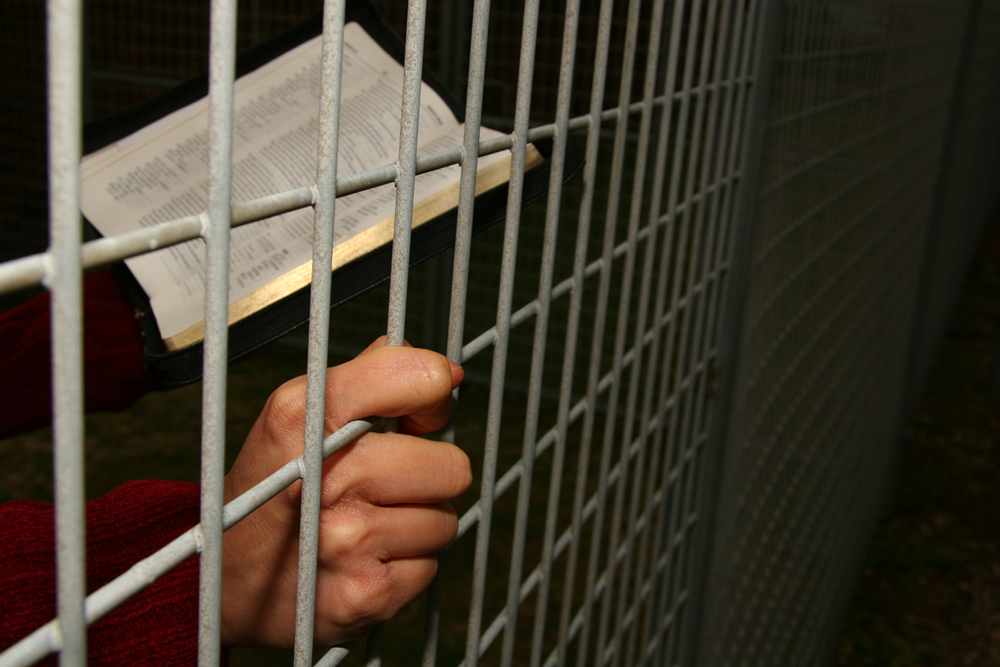
In
rejecting the claim for asylum of a man who converted from Islam to
Christianity, and presumably compelling his return to Iran, the British
government is effectively sentencing him to death. (Image source:
iStock)
In two unrelated cases, the United Kingdom denied
asylum to persecuted Christians by bizarrely citing the Bible and
Jesus. Both Christians, a man and a woman, are former Muslims who
were separately seeking asylum from the Islamic Republic of Iran,
the ninth-worst persecutor of Christians -- particularly of those
who were Muslims and converted to Christianity.
UK asylum worker Nathan Stevens recently shared
their stories. In his rejection letter from the UK's Home Office,
which is in charge of immigration, the Iranian man was told that
biblical passages were "inconsistent" with his claim to
have converted to Christianity after discovering it was a
"peaceful" faith. The letter cited several biblical
excerpts, including from Exodus, Leviticus, and Matthew, presumably
to show that the Bible is violent; it said Revelation was
"filled with imagery of revenge, destruction, death and
violence." The governmental letter then concluded:
The first problem
with the EU is that, though it is called a union, it isn't
really one. The EU is essentially an economic club; not a
state.
Brexit has
highlighted the key challenges that the EU faces. The first
challenge concerns a widespread overestimation of the EU's
role. This is due to its perception as a supra-national state,
which it certainly is not.
The EU is also
facing the challenge posed by the return of the nation-state
as the most popular model of socio-political organization
across the globe. Right now all supra-national and/or
international organizations, from the United Nations to NATO,
are regarded with suspicion, if not outright hostility, not
only in Europe but also throughout the world.
(Image
source: iStock)
With the Brexit saga's denouement still uncertain,
the European Union would do well to re-examine its performance as a
daring experience in socio-political engineering on a grand scale.
Even if, as expected, the United Kingdom somehow manages to fudge
Brexit and remain tied to the EU, the fact remains that millions of
Brits and other Europeans are unhappy with aspects of the
experience.
The first problem with the EU is that, though it is
called a union, it isn't really one. To be sure it has a flag, an
anthem, a parliament, a council of ministers, and even
pseudo-embassies in many countries, but despite such trappings of a
state, the EU is essentially an economic club; not a state.
Salim Mansur, Professor Emeritus of Western University, condemns Prime
Minister Justin Trudeau as a globalist demagogue who has no mandate to
speak for Canada or Canadians.
"Thank God, the
tests on the IR4 and IR2M (centrifuges) have been completed.
They were tested for over 12 years. Today we have all the
data, and we can easily manufacture them on an industrial
scale." — Ali Akbar Salehi, head of the Atomic Energy
Organization of Iran.
The International
Atomic Energy Agency (IAEA) was not allowed to inspect or
monitor Iran's military sites where nuclear activities were
most likely being carried out. Among the many concessions that
the Obama administration gave the Iranian government, one was
accepting the Iranian leaders' demand that these military
sites would be out of the IAEA's reach.
Due to this
surrender, various high-profile Iranian sites such as the
Parchin military complex, located southeast of Tehran, were
free to engage in nuclear activities without the risk of
inspection.
Once the
authoritarian, anti-Semitic and anti-American government of
Iran possess a nuclear bomb, no amount of actions will be able
reverse the catastrophe.
The
National Council of Resistance of Iran -- which revealed Iran's
clandestine and undeclared uranium enrichment facility at Natanz
and a heavy water facility at Arak in 2002 -- has recently
confirmed that Iran is continuing to pursue its nuclear ambitions.
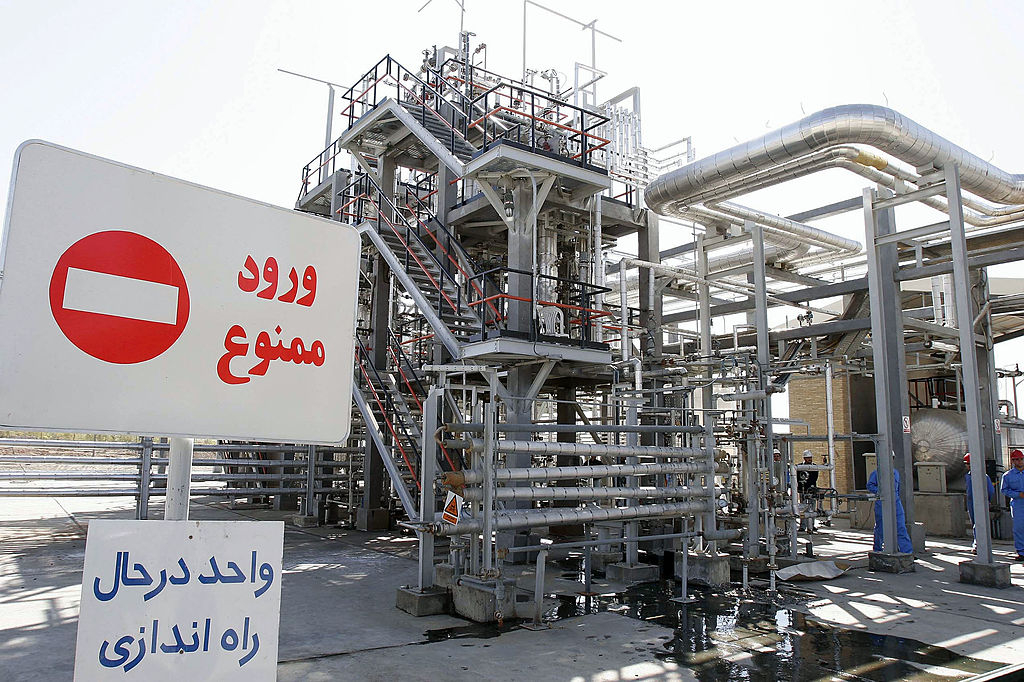
Pictured: The heavy water production facility at Arak, south of
Tehran. (Photo by Majid Saeedi/Getty Images)
Advocates of Iran's nuclear deal are conspicuously
ignoring the Iranian government's nuclear activities, even though
they jeopardize global security as much as Israel's security.
Advocates of Iran are also rushing to criticize the Trump
administration in the United States for tightening its sanctions in
response to Iran's illegal defiance.
In a recent interview with Iran's state-owned
Channel 2 in the Persian language, Ali Akbar Salehi, the head of
the Atomic Energy Organization of Iran, made it clear that the
flimsy "nuclear deal" initiated by then US President
Barack Obama has done nothing to stop Iran from making advances in
its nuclear program.
Salehi boasted:
"If we have to go back and withdraw from the
nuclear deal, we certainly do not go back to where we were before
... We will be standing in a much, much higher position."
The Islamic State issued several claims of responsibility for
attacks by the group known as the Islamic State in the Greater Sahara (ISGS)
in Mali, Burkina Faso and Niger.
At least 15 people were killed yesterday when Shabaab, al
Qaeda’s branch in East Africa, detonated a car bomb on one of Mogadishu’s
busiest roads. The bombing was just the latest in a string of car bombs that
have hit the Somali capital this week. Those 15 people were killed when the
car bomb detonated […]
US Secretary of State Mike Pompeo confirmed that part of
Washington's overall strategy in the Middle East is aimed at
expelling Iran and its forces and militias from Syria. "Our
strategy is designed to prevent that from happening," Pompeo
said during his testimony at a congressional hearing on the State
Department's budget review on Wednesday in which several congressmen
spoke on their concerns about the US troop withdrawal from Syria and
the possibility of Iranian influence strengthening there.
The United States is keen to see that Malaysia,
Singapore and others are fully aware of illicit Iranian oil shipments
and the tactics Iran uses to evade sanctions, a top U.S. sanctions
official said on Friday. Sigal Mandelker, under-secretary of the
Treasury for Terrorism and Financial Intelligence, told reporters in
Singapore the United States had placed additional "intense
pressure" on Iran this week.
The U.N. Security Council unanimously approved a
resolution Thursday naming terrorist financing a serious crime and
demanding that all countries set up a domestic legal framework to
counter the practice. The U.N.'s counterterrorism chief Vladimir
Voronkov said the resolution came at a critical time, as terrorist
attacks around the globe have demonstrated that groups like Islamic
State and al Qaeda have continuing access to vast financial revenues.
In her March 5, 2019, statement to the International
Atomic Energy Agency (IAEA) Board of Governors on the subject of
monitoring and inspection in Iran, U.S. Ambassador Jackie Wolcott
stated that "[t]he United States welcomes the Director General's
February 22 report on verification and monitoring in Iran. We once
again extend our appreciation to the Director General, and . . .
[his] staff for their continued dedication in carrying out their
responsibilities in Iran..."
The proponents of Iran's nuclear deal are criticizing
the new sanctions imposed on Iran's nuclear program by the US last
week. The Treasury and State Department unveiled measures against 14
individuals and 17 entities that are linked to the Iranian Ministry
of Defense. These entities are reportedly associated with Iran's
attempts to build nuclear weapons.
Nearly half of Middle Eastern survey respondents say
they are skeptical that Iran has stopped working to achieve nuclear
weapons, according to a poll taken by Israel's Ministry of Foreign
Affairs and reported by the Hebrew daily Israel Hayom. The
latest survey conducted by professional pollsters on behalf of the
ministry found that 43% of Middle Easterners say Iran did not stop
its nuclear program. The number of North American respondents who
believe similarly is also high at one-third or 33%.
A court in Luxembourg has ruled against a group of Sept.
11 victims in a novel lawsuit seeking $1.6 billion in Iranian assets,
bringing to a head a long growing disagreement about a significant
question of international law: Should governments be immune from
lawsuits even when they are accused of responsibility for terrorist
attacks? For decades after World War II, as the modern international
order was established, the United States stood in alignment with the
world by restrictively interpreting "sovereign immunity,"
the principle that people generally cannot sue governments.
The United States placed additional "intense
pressure" on Iran this week, a top U.S. sanctions official said
Friday. Sigal Mandelker, under-secretary of the Treasury for
Terrorism and Financial Intelligence, told reporters in Singapore she
would stress the inherent risks in dealing with Iran in meetings over
coming days with government officials in Malaysia, Singapore and
India.
Japanese refineries have put a halt on imports of
Iranian oil after buying 15.3 million barrels between January and
March ahead of the expiry of a temporary waiver on U.S. sanctions,
according to industry sources and data on Refinitiv Eikon. The
waiver, which allowed Japan to buy some Iranian oil for another 180
days, expires in early May. However, Japanese refiners want to ensure
enough time for all cargoes already loaded to arrive in Japan and for
payments to be completed.
A top U.S. sanctions official is in Asia to push efforts
to increase pressure on Iran, saying Washington was intent on making
Tehran "radioactive to the international community." Sigal
Mandelker, the U.S. Treasury undersecretary for terrorism and
financial intelligence, said in Singapore on March 29 that she would
stress in further meetings this week with officials in Malaysia,
Singapore, and India the risks involved in dealing with Tehran.
Iran's trade
generally declined in the first two months of 2019, largely due to
less oil exports and a substantial reduction in imports, due to its
ongoing economic crisis. Iran's exports to U.S. reached zero during
January 2019, while its imports from the United States plunged to
$4.5 million, according to U.S. Census Bureau statistics, released
March 28. The monthly trade turnover between the two countries stood
at the lowest level since 2000.
Iranian foreign
ministry spokesman Bahram Qasemi has downplayed US warnings on a
possible stop of waivers from sanctions on Iran's oil imports.
Washington "will not achieve all its objectives," Qasemi
was quoted as saying by state news agency IRNA on Thursday. "The
policy of the United States is that we are not looking to grant any
new oil waivers," Brian Hook, the US special representative for
Iran, said this week.
Iran's semi-official Tasnim news agency is reporting
that the death toll from flash floods across the country has risen to
44 from 17. The Thursday report quotes Hamidreza Khankeh, an official
in the country's emergency medical services agency, as saying 44
people have died since Monday in 10 provinces. Since March 19, many
roads in Iran have been affected by heavy rainfall that caused flash
flooding.
Saudi Arabia relies
on the principle of preserving sovereignty and stability of States in
dealing with Arab issues, while Iran incites regional crises in order
to break the unity of Arab states, stressed Saudi Ambassador to Egypt
and Permanent Representative at the Arab League Osama bin Ahmed
Naqli. The Ambassador indicated that this also applies to the
Kingdom's endeavor to get an independent Palestinian state
established on the 1967 border with East al-Quds as its capital, in
accordance with the resolutions of international legitimacy and the
Arab peace initiative.
US President Donald Trump's March 21 decision to
recognize Israeli sovereignty over the Golan Heights has sparked
widespread international reaction. While European countries announced
that they would not follow suit, Russia expressed
concern over the "negative repercussions" of the move.
Turkey adopted a more active stance, calling for an emergency
meeting of the Organization of Islamic Cooperation (OIC). Trump's
announcement was also met with negative reactions from Arab
allies of the United States.
As the dust settles after the last week of escalation
between Israel and Gaza, neither Hamas nor Netanyahu have managed to
score a substantial victory or breakthrough.
Eye on Iran is a periodic news summary from United
Against Nuclear Iran (UANI) a program of the American Coalition Against
Nuclear Iran, Inc., a tax-exempt organization under Section 501(c)(3)
of the Internal Revenue Code. Eye on Iran is not intended as a
comprehensive media clips summary but rather a selection of media
elements with discreet analysis in a PDA friendly format. For more
information please email press@uani.com.
United Against Nuclear
Iran (UANI) is a non-partisan, broad-based coalition that is united in
a commitment to prevent Iran from fulfilling its ambition to become a
regional super-power possessing nuclear weapons. UANI is an
issue-based coalition in which each coalition member will have its own
interests as well as the collective goal of advancing an Iran free of
nuclear weapons.