Please take a moment to visit and log in at the subscriber area, and submit your city & country location. We will use this information in future to invite you to any events that we organize in your area. How the "Sons of Iraq" Stabilized Iraq
by Mark Wilbanks and Efraim Karsh
Middle East Quarterly
Fall 2010, pp. 57-70 (view PDF)
http://www.meforum.org/2788/sons-of-iraq
Testifying before the Senate Armed Services Committee on April 8, 2008, Gen. David H. Petraeus, the top U.S. and coalition forces commander in Iraq, reported a dramatic reduction in violence levels and civilian deaths from fifteen months before when Iraq seemed on the brink of civil war.[1] Petraeus attributed this turning point to the increased numbers of coalition and Iraqi forces, part of the surge declared by President George W. Bush in January 2007, but he gave equal credit to the predominantly Sunni popular movement known as the Sons of Iraq (SOI). "These volunteers have contributed significantly in various areas," he said. "With their assistance and with relentless pursuit of al-Qaeda-Iraq, the threat posed by AQI, while still lethal and substantial, has been reduced significantly."[2]
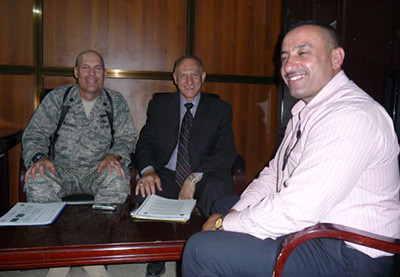
Lt. Col. Mark Wilbanks (left), Maj. Gen. Muther al-Mawla (center), and Abu Haidar meet at the offices of the Implementation and Follow-up Committee for National Reconciliation, the International Zone, Baghdad, September 15, 2009. Mawla was appointed to oversee efforts to incorporate Sahwa members into the Iraqi state apparatus.
|
Initially known as al-Anbar Awakening (Sahwat al-Anbar), the movement made its appearance in the summer of 2006 when local sheikhs, disillusioned with the insurgency that had ravaged the province during the past two-and-a-half years, offered their support to the coalition forces. While pundits and commentators have varyingly acknowledged the significance of the movement, less is known about the motives and the thoughts of its key participants, including those members of the coalition forces with whom the Awakening worked.
What motivated these Sunni tribesmen to sign loyalty oaths to fight for an Iraqi government with whom they had only recently battled viciously? What were U.S. officers thinking when they provided military training and money for arms and equipment to men who, more often than not, had been their enemies just a short time before?
While the program was successful in reducing violence and quickly spread throughout Iraq, it did not prevent the ruling Shiite elites from viewing the Sons of Iraq with suspicion. Nor have the achievements of the recent past guaranteed that a true reconciliation between feuding sides has been reached. Through a fascinating series of interviews held in late 2008 and 2009—as the program was being unwound—the outlines of this unlikely social and military development can be glimpsed.
The Sunni Insurgency
The U.S.-led invasion of Iraq and the collapse of Saddam Hussein's repressive regime unleashed sectarian and religious enmities that had been kept in check by the tyrant. As early as April 2003, while coalition forces were still mopping up the last traces of Baath resistance, a prominent Shiite leader, Abdul Majid al-Khoei, who had just returned from exile, was murdered in the holy town of Najaf.[3] Four months later, on August 29, 2003, a car bomb exploded outside that very mosque, killing more than 100 people, including Ayatollah Muhammad Baqir al-Hakim, leader of the Iranian-sponsored Supreme Council for the Islamic Revolution in Iraq (SCIRI).[4] On February 1, 2004, another 100 people were killed in two suicide bombings in the Kurdish town of Erbil.[5]
While some of this sectarian violence was perpetrated by Islamist Shiite militias that sprang up in southern Iraq in the immediate wake of the invasion, the main instigator was the minority Arab Sunni community, about 20 percent of the total population, which had dominated Iraqi politics for centuries and which resented its exclusion from the new state structures established by the victorious powers.[6] In no time, the "Sunni Triangle"—the vast area between Baghdad in the south, Mosul in the north, and Rutba in the east where most of Iraq's Sunni population resides and consisting of the four governorates of Baghdad, al-Anbar, Salah ad-Din and Ninawa—was in flames.
For some insurgents, notably members of Saddam's regime and tribe, the overriding motivation was loyalty to the fallen tyrant. For others, such as the tens of thousands of soldiers and officers who had lost their jobs when the predominantly Sunni army was dissolved in May 2003, it was a desire for revenge. There was also a deep sense of humiliation felt by those who had long considered themselves the only people capable of running the affairs of the Iraqi state. All feared and resented their possible domination by the despised Shiites and their perceived paymaster—Iran's militant Islamist regime—and all wished to regain lost power and influence.
These grievances were further reinforced by tribal interests, values, and norms. The Sunni Triangle is a diverse mosaic of hundreds of small and medium-sized tribes, as well as a dozen large tribal federations, notably the Dulyam and the Shammar Jarba, each comprising more than a million members. Under Saddam, many of these tribes, especially the Dulyam, had been incorporated into the regime's patronage system. With such material benefits and political prestige curtailed after the U.S.-led invasion, many tribesmen joined the insurrection.
Such was the tenacity of the insurrection that in September 2006, Lt. Gen. Peter W. Chiarelli, commander of U.S. and coalition forces in Iraq, questioned the U.S. ability to defeat it. "It is our job to win," he said. "But it is not the kind of fight that is going to be won by military kinetic action alone … I think the real heart of [the matter] is that there are economic and political conditions that have to improve out at al-Anbar, as they do everywhere in Iraq, for us to be successful."[7]
The Anbar Awakening
To make matters worse, the Sunni Triangle's location near the Jordanian, Syrian, and Saudi borders made it the first port of call for al-Qaeda terrorists and other foreign elements. The overall number of these infiltrators was insignificant compared to the many thousands of Iraqi insurgents—some estimates put the number of al-Qaeda terrorists in Iraq at less than 1,300[8]— but they exerted a disproportionate impact on the course of the fighting by recruiting significant numbers of Iraqi jihadists, providing invaluable military and logistical expertise, and mounting most of the mass-casualty suicide bombings.[9] At the same time, al-Qaeda in Iraq (AQI) expected compensation for the security they helped provide to their local allies, often crossing the line from payment to extortion. Muscling in on time-honored smuggling routes and trying to forcibly wed women in order to build tribal ties exacerbated tensions. But AQI began to overreach in their efforts to control the area. A U.S. Marine colonel cited this example:
Fallujah … I remember the day [March 2007] that I got there. I think it was the secretary of the city council, his nephew … a 12-year old boy [who] was hit by AQI right on the main street in Fallujah. Ran him over with a vehicle several times. Broke several, maybe all his bones. Then threw him on the door step of the secretary of the council's house and shot him in front of everybody. … We couldn't get there. Everybody got there too late. The populace knew who did it. They knew why they did it. … They had had it. That was it. They stopped. They stopped listening to AQI. They turned.[10]
Al-Qaeda's overreaching was coupled with a growing awareness that the Americans, who did not interfere with traditional sources of revenue or seek to change tribal custom, would eventually leave. AQI, on the other hand, was determined to impose its version of Shari'a (Islamic law) on the entire population as a stepping stone to the creation of the worldwide Muslim community (umma).
It was this realization that led to the advent of the Sahwa or Awakening movement. With the coalition anxious for local allies who would help defeat the insurgency and prevent its retrenchment, and a growing number of ordinary Sunnis and tribal leaders increasingly disillusioned with the mayhem and dislocation occasioned by the fighting, a meeting of minds was only a question of time. The acting national security advisor to the Iraqi government Safa Hussein al-Sheikh explained:
Most people don't know that the first time we thought about the Sons of Iraq was ... in 2005 … Things were getting worse from a security point of view ... This was opposed directly and strictly by the leadership of the MNF [Multinational Forces] at that time because they thought this was the creation of militias ... Then at the end of 2005—at that time al-Qaeda had almost full control of Anbar province and other areas—something happened on the border with Syria. It was the Albu Mahan tribe and another tribe, al-Karabla, big tribes on the border. They live mostly on smuggling ... And one of these tribes made some kind of an agreement of understanding with al-Qaeda ... So both tribes there were fighting between themselves ... My colleagues and I advised that we should support the tribes against the tribe [that was allied] with al-Qaeda.[11]
On most occasions, however, the tribes made the first offers to cooperate. A U.S. Army captain related his experience with a first contact:
We had gotten a call in the TOC [Tactical Operations Center], and we were located in Camp Blue Diamond. North of the river was our task force headquarters. And there was a report that one of our task force level HVTs, high value targets enemy personnel, was at the gate and asking to come in and talk with our task force commander ... Hindsight being twenty-twenty and seeing how it played out, it doesn't seem as alarming, but at this time, he was a high value target, was known or had allegedly ... been involved with attacks against coalition forces, had been successful, had been a leader ... How do you react? There had not been a precedent set for something like this. We had never seen anything like this. So it was really an exercise in good faith and you know those were some tense times.[12]
A former insurgent-turned-Sahwa fighter gave his side of the story:
No one supported me in my work but the American forces. They did that because I brought a backhoe, and I bermed all the roads in my area. I left only one road [open] with a checkpoint on it, so I can control my neighborhood since I have only thirteen people working for me. My house is high, so I can monitor the entire area. Even the Americans, they couldn't drive through these [berms] with their tanks and Humvees, but I told them: "There's no need, this is a safe area." The area is about ten kilometers by ten, maybe less. It was closed for all but me. No one can come through this area without being noticed. I was in constant contact with the American soldiers in the area, and we agreed that they will come to my area dismounted. My area is very close to Blue Diamond, which was an American base. The distance between us was three kilometers, so the Americans would stop with their tanks at a distance and would then come to us on foot.[13]
By mid-August 2006, such low level contacts had led to a formal meeting between Col. Sean MacFarland, the newly appointed commander of U.S. forces in Ramadi, and Sheikh Abd as-Sattar Abu Risha, a prominent tribal leader, who had just issued a manifesto denouncing al-Qaeda in Iraq (AQI) and pledging support to U.S. forces. MacFarland described the scene at Abd as-Sattar's home: "The walls were just lined with guys in sheikh robes. … I go down and see the governor about once a week, and it's just me and the governor. I go into Sheikh Sattar's house, and the place is packed."
Soon an agreement was struck, and by November, an estimated 1,500 recruits sent by the sheikh had joined the revamped police training program for Ramadi. In comparison, a mere forty men had previously signed on to the Ramadi police force, then numbering only 150 officers in total.[14]
This collaborative pattern spread rapidly throughout the province, and before long coalition forces were providing training opportunities, first in Jordan then in Anbar, to the growing number of volunteers, who often had previous army or police experience although not to Western standards. A senior marine officer described the recruitment and training process:
You had to kind of read and write. You had to have, I think, twenty-two teeth. … They had mixed standards, and we would vet them and, of course, BAT [Biometrics Automated Toolset System] them ... And so this is all good stuff. But we would build the police and the army by recruiting. And they would recruit and basically use the sheikhs. The next day six hundred or seven hundred guys would show up, and we would put them through the process. Who was eligible, who met the criteria to join the army or the police. So we built the first and seventh Iraqi army divisions, and we increased the police from about 5,000 to almost 28,000 in that year. And that was the Sons of Anbar.[15]
After a probationary period, the volunteers were allowed to carry their own weapons, which many of them bought with money provided by the coalition. There was also an effort to train Iraqi women—the "Daughters of Iraq"—to replace female Marines responsible for female body searches at checkpoints.
Being "concerned local citizens" (CLC, as they were initially called by the coalition), rather than professional soldiers, the Sahwa volunteers were not allowed to carry out offensive operations. Instead, they were tasked to perform defensive missions such as manning checkpoints and providing intelligence on insurgent activities and locations. The dividing line between these activities and actual participation in fighting was, however, more often than not, blurred. A junior U.S. officer recalled:
Although the CLCs were not supposed to be used offensively, there was no stopping them this day because they were pretty amped up about losing some of their friends.
I was on a roof, and I'm talking to F-16s that are flying around, and we've got air weapons teams, and there is a lot of activity ... we're getting ready to move out. Maybe four or five CLCs, a couple of IPs [Iraqi police], a couple of SWATs [Special Weapons and Tactics], ISF [Iraqi Security Forces]. It is just this big mix of dudes.
I talked to the [Sahwa leader] ... who spoke English: "I'm going to be bounding up this way, and we're going to get there. You'll provide over watch, we'll go in and take it. When we say it's clear, then we'll pull you guys in, and then we'll leave you guys up there to control the area."
And he maneuvered his guys up there. And it was just an amazing day.[16]
The new recruits proved particularly efficient in the fight against the al-Qaeda jihadists and their local allies. The Sunnis knew where al-Qaeda fighters lived and worked because they had harbored them initially, and they had no qualms about using the same brutal methods in fighting back. This resulted in a swift routing of al-Qaeda in a revenge-based frenzy: "They hunted al-Qaeda down with a vengeance. They dragged al-Qaeda guys through streets behind cars ... they had videos of feet on the altars in mosques ... It was pretty much just a ruthless slaughter."[17] An Iraqi official recalled how a tribal sheikh gleefully told him how he had a certain al-Qaeda operative beheaded: "And then he smiled and said, 'I want to show you something you will like.' One of the [al-Qaeda] people who tried to assassinate him, and he showed me on the telephone a picture of a head."[18]
At times the savage war against al-Qaeda pitted members of the same tribe against each other. A U.S. colonel recounted this example:
The Zobai tribe came under a lot of friction. They literally told us to stay out of the Habanniya Zoba village-Khandari area for seventy-two hours because Zobai against Zobai were going to fight. Al-Qaeda against the tribe ... al-Qaeda would come into the village, and they would sit down and have a meeting. It is tribal, and they would negotiate, and if they couldn't solve the negotiations, then there was going to be a fight. After twenty-four hours of fighting, they couldn't handle it, and they asked us to come in and support them. So for about the last week of March, we had a fairly significant fight, and for the Zobais, that was the first example and demonstration from the U.S. side that, yes, we will fight against al-Qaeda, and we won't arrest you.[19]
Helping the Surge
Within a year of its advent, the Awakening movement had dramatically changed the security situation in Anbar with monthly attacks dropping from some 1,350 in October 2006 to just over 200 in August 2007.[20] By now, the movement had been established on a national basis as the coalition sought to replicate its success in other parts of Iraq. It played a particularly prominent role in improving the security situation in Baghdad as part of the troop surge, helping to slash murders by 90 percent and attacks on civilians by 80 percent, as well as destroying numerous insurgent networks. Its contribution in other provinces was no less substantial: By the end of the year, al-Qaeda leaders admitted that their forces throughout Iraq had been decimated by over 70 percent, from 12,000 to 3,500.[21]
No less importantly, the Sahwa eventually became a tool for promoting sectarian reconciliation and weaning fighters away from sectarian militias. This process began in fall 2007 in the Baghdad suburb of al-Jihad, a Shiite neighborhood aligned with the radical militia leader Muqtada al-Sadr, where the government sought to elicit mass participation in the Awakening program. Working with these Shiites was difficult because Sadr forbade anyone from dealing with the Americans. Yet, he would broker a cease-fire and enforce it by passing the names of Mahdi Army leaders whom he could not control to the Iraqi government for arrest or elimination with the knowledge that this information would be shared with coalition forces. An Iraqi official recalled:
It was a really ambitious project. There were some successes in al-Jihad in which we brought people from the Sadrists and included them in the Sahwas with close cooperation from Colonel Franks who was the local commander there, and he is an excellent man. His mind is very well-oriented to these kinds of activities. And we first had to talk to the Sadrists in the areas. The environment there is better than any place else to include the Sadrists into the Sahwas because these Sadrists were surrounded by areas of Sunnis.
There was a funny discussion with the leaders there of the Sadrists when I told them. [Usually with] Shiite people, I try to appease their fears and their concerns. [But] I did the opposite there. Increased their fears.
They are not the majority, and they do not have the upper hand. So this is one point. The other point is that the Sadrists, in general, do not have good financial support. And the payment in the Sahwas is pretty good for them. But they have a problem [in] that their leadership will denounce any person who talks to the Americans.
The general concern was that the balance of Sunni-Shiites would change. So I said to them: "It is in your hands. If you don't get your people to join, it will change, and you can do nothing about it." And it was a very hard time for them because they couldn't say, yes, because of Muqtada al-Sadr. So they tried to give me a message that "If we don't know and something is arranged, it is okay." [Laughter]
Once the Jihad area went, the rest of the Sadr areas wanted the money, and they followed suit. But other things happened, and this project wouldn't continue as we wished. When al-Basra operation came, in their minds, the process [ended. Still] al-Jihad was maintained as a quiet area.[22]
This example was, however, more of an exception to the rule as the Iraqi government was slow to acknowledge the merits of the Awakening movement. In fact, as the coalition accelerated recruitment and institutionalized regular salaries to its members, the government remained wary of this large and predominantly Sunni force—which had grown to some 80,000 members by early 2008—and its future political intentions. A senior Iraqi advisor to the coalition forces recalled the situation:
The Shiites thought, it is a conspiracy. That is: al-Qaeda cannot be tolerated, so now they came in other clothes [sic], and they are trying to surround Baghdad. And maybe the Americans, because of the violence, are desperate, and they want to bring the Sunnis back and that is why they support them. So this theory of conspiracy controlled the minds of the Shiites inside the government and popularly.[23]
After much haggling, the Americans managed to persuade Nuri al-Maliki's government to take over the Awakening program and to incorporate it into the newly established security and state structures. In the words of a political advisor to Gen. Raymond T. Odierno, second ranking officer in Iraq at the time and source of much of this behind-the-scenes wrangling:
[What was] very interesting was the cultural difference. The Americans would come every day and say: "Look at how fantastic the Sahwa are and what they are doing," and the Iraqi government just didn't believe it. So the Americans brought more power points—and bigger ones—and paraded them about pointing to all the great things the Sahwa have done. And then with Safa [Hussein al-Sheikh's] advice, we started talking about the bad things that some Sahwa had done. And once we started to admit that some of them were involved in violence and involved in bad things ... then the government felt at last that we were more trustworthy. So that was the famous meeting in December [2007] where General Odierno stood up and said, "Here are the bad things; these are the good things. We want the government really to take control of this program, and this is what we suggest." And the prime minister said, "I agree with everything that General Odierno suggests."[24]
Forging Relationships
On the ground, young officers and soldiers knew little of the higher level maneuvering that went on between the coalition and the Iraqi government. For them, the Sahwas were not abstract programs but human beings who formed close relationships with their coalition colleagues. They suffered casualties alongside the coalition forces; their wounded shared rides in medical helicopters, and they formed the kinds of bonds of mutual trust and respect that can only happen in combat. A U.S. Army platoon leader explains:
We showed up to the JCC [Joint Command Center] to pick up the first round of CLCs we were going to institute across the city. It was just very comical because I've got about half of my platoon with me, and my other half is holding a patrol base where I am getting ready to take some of these guys. We're sitting around the JCC outside the mayor's office and all of the sudden, they come walking in. And they're proud, they're happy, they're like, "I'm part of this thing, and we are going to go do this, and it's going to be great."
There ... were three groups. One we called the classic camouflage because they were all in the same uniform. They all had T-shirts with … a regular woodland camouflage print on it, and it also had the text that read "Classic Camouflage." …
The next group that comes in we called them the Headlamp Platoon because, for some reason, every single one of those guys had a headlamp. So they had no uniform, but they had headlamps. And the last group we called the AQI group because they came in, and … they looked just like jihadists. There was one guy Hassam ... He was a natural leader. … he looked American ... He spoke English pretty well, and he was [a] teacher.
I don't know what [their agenda] was ... But for a period of time, their agenda and our agenda were perfectly aligned, and we all worked together pretty well to secure that place. And we formed pretty tight relationships and we earned their trust ... they earned our trust.[25]
Respect was mutual. Officers who attempted to speak Arabic and who attended Iraqi events and participated in tribal customs were respected. As an Iraqi general and former Sons of Iraq member recalled:
Lt. Col. Silverman is an extraordinary officer. He is special. He worked in the al-Jazeera area ... So he has been able to establish an excellent relationship with these tribes. The relationship that they had between the U.S. Army and the tribes was abnormal … extraordinary … awesome. If they have a funeral, he will go to the funeral reception.
This is our tradition. This is our culture, and he was doing the same thing. He would go into the funeral, and he would say salam aleikum. And he would recite al-Fatiha. I'm sure he doesn't know what it means, al-Fatiha, or he cannot read, but after he finishes, he would do this [wipes his hand over his face]. Exactly how the normal Iraqi people do it. And he would also pay and contribute [to] the funeral reception. The people, the sheikhs, the tribes, they liked him. They were impressed. He was Lawrence of Arabia, Silverman. If we had tribal conflicts, he would sit, and he would judge. … The tribes liked the hookah [water pipe]. He would sit with them, and he would have his hookah with them. You would say this guy, he is an Eastern man. He is Iraqi, but in an American uniform.[26]
The Iraqi general continued:
I would like to tell you the story of an American officer. His name was Patrick [Capt. Travis Patriquin, 1st Brigade, 1st Armored Division]. He was a friend of Sheikh Sattar. Sheikh Sattar used to call him Hisham, not Patrick, because he had a mustache. He would always sit with Sheikh Sattar's kids. He was very close to the police. He was an extraordinary person … He got hit with an IED [Improvised Explosive Device]—got killed.
We named one of our police stations after him. We called it Hisham Police Station because all the policemen knew him by the name Hisham, not Patrick. Until nowadays Sheikh Sattar insists that we call the police station Hisham, so until now we call it "Martyr Hisham's Police Station." Hisham, who is Patrick.[27]
Col. Richard Welch, an Army reserve officer with counterinsurgency training and a Special Forces background, did not stand out in a crowd, but that belied his intensity and tenacity. He took a pay cut from his job as a prosecutor in Ohio and missed his grandchildren's birthdays and had been in Baghdad for four of the five years from 2004 to 2009. This put him in a unique position to develop relationships that kept people alive. One such relationship was with Sheikh Ali Hatem of the Dulaym tribe, whose grandfather had allegedly ridden with T.E. Lawrence against the Turks. Welch recounted his experience:
Working with the tribes and working with a lot of these religious leaders actually facilitated me getting connected with insurgent leaders on the Sunni side and … militia leaders on the Shiite side. So I began talking with them about what we now call reconciliation … talking to them about how to stop fighting, to try and join the political process …
Most of the other groups out of Baghdad came out of these meetings with the tribal leaders and the community leaders … getting them connected with the brigade commanders and battalion commanders. And they began to work with them ... [Those sheikhs interested in reconciliation] would call and say: "Colonel Welch, al-Qaeda is attacking us and we need help. We need supplies." [During] many of those phone calls you could hear gun shots in the background. You could hear the fighting going on. …
I was out at Camp Liberty [near Baghdad airport] walking to the dining facility with my deputy and my cell phone rang. I noticed that it was Sheikh Ali Hatem so I answered it immediately. He said, "Colonel Welch, I need your help … Al-Qaeda overran Sheikh Hamed Village up in the Taji area, north Taji. And our tribe is getting ready to counterattack and take back the village. But we need you to contact the unit up there because we've seen helicopters flying around, and we don't want them to engage [attack] us ... So we need to let you know which ones." So I said, "Okay, we will take care of it." So I kept Ali Hatem on the line and sent [my deputy] back. I said, "You've got to get the G3 [operational commander on duty] you know." ... Because I couldn't move. I had to get the coverage for my cell phone where it was out at Liberty. So we finally were able to contact the unit, and literally, the helicopter pilot was ready to pull the trigger on them ... The commander told us that later. They were ready to engage these guys. But then instead they flew over watch and supported them taking that village back.[28]
Show Me the Money
Though there was initially no money involved for the Awakening movement, this issue quickly came to the fore. Just as tribal support for the "Great Arab Revolt" against the Ottoman Empire had been motivated by the glitter of British gold and the promise of booty (nearly half-a-century later Lawrence of Arabia would still be remembered by Bedouins as "the man with the gold"),[29] so the Anbar sheikhs were not immune to the allure of American money. Brigade level commanders doled out millions of Iraqi dinars and, in some places, U.S. dollars every month, and by the summer of 2007 the movement was fully subsidized by the coalition. This was one of the reasons the coalition, rather than the Iraqi government, took the lead in the Sahwa program. As a senior Iraqi official explained:
Some people in some areas came to us and wanted to work with the government because they thought for some reason that it was not good for their reputation to work with the Americans to fight al-Qaeda. And our main problem at that time was that the government didn't have the means to completely help them. So at times we felt really embarrassed.[30]
In addition to monthly salaries, the coalition also paid for results. One Sons of Iraq member reported:
Yes, we did that with the support of the coalition forces when we captured some gangsters. After missions, the coalition forces used to issue letters of appreciation for us and gave us a reward. And that was good. I got $700 from the coalition forces: $300 for salary and a $400 reward for a total of $700 in one month—U.S. dollars.
I saw gangsters trying to kidnap a girl. She was driving her vehicle, and I was watching them. I started to shoot and shot one of them. I released her and that is why I got the reward and letter of appreciation.[31]
Such letters of appreciation, on tattered pieces of paper and blurry from being copies of copies with the previous recipients names blanked out, were more valuable than money. A signed letter by the coalition, regardless of whether the words were level on the page, was a sought after status symbol.
In other places, where the security situation was relatively good, coalition funding of Sahwa activities was effectively little more than a jobs program. In the words of a local sheikh:
Let's be honest. They established the Sahwa in our city after all the doors had been shut in our face because there was no chance to hold jobs. The first reason for establishing the Sahwa was because there were no jobs; the second reason—to provide money for the families; and the third reason—to protect the civilian people.
When we joined the Sahwa, we had to remind each other why most of us were insurgents ... Either get us a job or Iraq will go back to the way it used to be.[32]
By January 2009, the U.S. government had invested more than $400 million in the Awakening program with a median monthly cost of more than $21 million, peaking at nearly $39 million in March 2008.[33] For Petraeus, this was a worthwhile investment that not only saved lives in Iraq but also U.S. taxpayers' money. As he told the Senate Armed Services Committee:
These volunteers have contributed significantly in various areas, and the savings in vehicles not lost because of reduced violence, not to mention the priceless lives saved have far outweighed the cost of their monthly contracts.[34]
As with other fields of U.S. activity in Iraq, the overriding preoccupation with security and stability often resulted in mismanagement and waste. Being totally result-oriented, the coalition forces were primarily interested in having all checkpoints manned, arms caches uncovered, and the violence decreased, leaving the methods for achieving these goals at the sheikhs' discretion. This in turn resulted in serious accountability problems, such as ghost employees and poor control over the distribution of cash payments as the sheikhs habitually rotated people around and took a cut for managing the program. The program was also vulnerable to corruption and embezzlement on the American side, as demonstrated in December 2009 when a U.S. officer was convicted of stealing approximately $690,000 from funds allocated to the Sahwa program and local relief and reconstruction.[35] The Implementation and Follow up Committee for National Reconciliation (IFCNR) cleaned up the program when they took over payments in late 2009 by paying the Sahwa directly. However, this did not prevent the sheikhs from taking their share ten feet from the payment point.
Patriots at Last
On September 4, 2008, the Awakening movement's massive contribution to Iraq's national security received a long overdue official recognition when an executive order issued by Prime Minister Maliki officially named its members Sons of Iraq and called for the incorporation of its members into the Iraqi state structures.
The practical implications of this change, however, were far more elusive. Although the Iraqi government undertook to integrate approximately 94,000 SOI personnel (from the 100,000-plus membership list provided by the Americans) into the Iraqi security forces (ISF) or other Iraqi ministries by the end of 2009, by April 2010, only 9,000 had been absorbed by the ISF, and another 30,000 had been hired by non-security ministries.[36] These delays were partly due to the fact that many SOI possessed rudimentary educational credentials (in Baghdad, 81 percent of SOI members had only elementary or middle-school educations) and were, therefore, unfit for many government positions. But this also reflected the government's residual suspicion of the group—as well as other former militias—alongside lingering disagreements with Washington regarding the movement's size and the attendant funds required for its absorption.
While ordinary Sahwa members were slowly incorporated into the state apparatus, the movement's leaders, whose sense of honor prevented them from taking menial government jobs, were looking forward to political careers as part of the national reconciliation process. Their hopes were bolstered by the fact that the Maliki government, knowing that its treatment of the SOI would be viewed by many Sunnis as a litmus test for their future integration into the country's sociopolitical system, assigned the process to the IFCNR.
In what turned out to be a stroke of genius, the head of the committee quickly appointed one of its members, Maj. Gen. Muther al-Mawla, to oversee the transition. An open and affable person, who wore tailored Western suits and readily shared pictures of his grandchildren, Mawla brought a paternal sense of security and calm to the process that put everyone at ease. He would bring in pastries that his wife had baked or share a feast with his coalition colleagues late into the night. At the same time, as former commander of the National Guard and the Iraqi Special Forces for the new government, he was more than capable of holding his own in the bare-knuckle world of Iraqi politics and conducting negotiations with those who, on many occasions, had been on his Special Forces' most wanted list.[37]
The statements of Abu Azzam al-Tamimi, a former Sahwa leader in the Abu-Ghraib area, are most instructive on the issues surrounding ongoing efforts at reconciliation. Sounding hopeful and relaxed at the al-Rashid hotel in Baghdad's International Zone, he expounded on the integration of the neighborhood's SOI in government jobs, his personal safety, and the forthcoming March 2010 elections:
Some of them are still Sahwas till this moment. I got a chance to join them to the Iraqi Security Forces back in 2007. In the middle of 2007, I had coordination with them but not control.
I have no relationship with [Brig. Gen.] Nasser [al-Hitti, commander of the Muthanna 3rd Brigade, Abu Ghraib]. He knew that he had no capability to arrest me, but he was trying to do that.
We are trying to create or establish our own political entity. And that is why we are going to set up a meeting tomorrow here in this hotel to discuss this issue with all the Sahwa leaders.
We have a joint committee now and are negotiating with [Prime Minister] Maliki. Yesterday [Sept. 4, 2009], we met with the main people from the Da'wa party ... Maybe we are going to establish the one front together, or we will have other options.[38]
Some former Sahwa leaders, such as Sa'ad Uraibi Ghafuri (aka Abu Abed), a major and intelligence officer in Saddam's armed forces, are not able to run for office or form political alliances for fear of being arrested. He is in Jordan waiting to get a visa, based on glowing recommendations from American officers who knew him, and seeks a new life in the United States. Some in the Iraqi government, however, see him differently as he wanted to control an area that the government also sought to control. Abu Abed, while in Jordan, discussed his past as sheikh of the Adamiya area in Baghdad:
After a while we defeated al-Qaeda from al-Fadil to Muadam, Palestine Street to Adhamiya [a Baghdad neighborhood]. It was just like one line, one road, we cleared all the area. And I used to … set up meetings with all the leaders from al-Fadil and this Rusafa side weekly. People got to listen to them and to report about that. So all the Iraqi government was watching, and they were surprised how we defeated al-Qaeda in those areas, freed the people, and maintained stability and security in this area.
After that ... the Iranian ambassador in Iraq gave an announcement. And he said [that] all those Sahwas were like gangsters. They are bad people, and we need to get rid of them. … I told him, "If the ambassador has an issue in Iran, let him go and solve his issues in Iran. He is not supposed to be involved in Iraqi matters. He has no right to do that." And after that I got the result. I paid for that because I got a phone call from the colonel [Welch], and he told me, "You need to leave your home because there is an arrest warrant against you for your disagreements with the Iraqi government." So I asked him why? … I have been fighting al-Qaeda, and we defeated al-Qaeda, and the Iraqi government they just gained everything, the benefits of that.
[Gen. Eric E.] Fiel, [Brig.] Gen. [Donald M.] Campbell, and even Gen. David Petraeus, and Gen. Odierno, he visited me in my office too.
During a reconciliation meeting, however, someone tried to kill Abu Abed.
I left my office with eight vehicles, and I used to use my own vehicle. It was a Toyota Land Cruiser armored vehicle, very, very strong. And when I went to Amel al-Shabby Street, I saw those seven hummers there, and the Iraqi soldiers they [had] been walking in the street.
[My security chief] said maybe the guard ... went to drink some chai. I told him no, this is unusual ... They [detonated] a big IED, and the sound of the explosion covered all [of] Baghdad ... I was flying, and I hit one of the vehicles, and I can still remember when I was covered by the rocks and the dust.[39]
Conclusion
Just as the peremptory dissolution of Saddam's army in May 2003 without the existence of an adequate substitute opened the door to insurgencies of all hues, so the disbanding of the social movement that had been instrumental in turning the tide against al-Qaeda in Iraq during 2007-08, and the decision to incorporate its members into ministries rather than the Iraqi security forces has left a dangerous security vacuum. Most SOI in Anbar were incorporated into the Iraqi police and army, but not so in Baghdad.
The 100-plus violent attacks during the March 7, 2010 elections serve as a stark reminder that extremist elements—most notably AQI—continue to pose a clear and real danger to the nascent Iraqi democracy. Across the country, up to 367 people, including 216 civilians, were killed during March, and the pace of killing accelerated in April when more than a hundred people were killed during the first week of the month.[40]
Some senior Iraqi officials are still unable to see the writing on the wall. Gen. Abud Kanbar Hashem Khayun al-Maliki, the Baghdad Operations Center commander, refused to allow the tidal wave of kidnappings, assassinations, and bombings that rocked the capital in the last quarter of 2009 deflect his determination to dissolve the SOI. On November 27, 2009, he stated:
By the time the year is up, we will fulfill the obligation of the order and employ all of them. … Those people have sacrificed a lot, and there were a lot of lost lives and a lot of martyrs. Some of them were martyred for their country, and some were injured, and some were damaged in some way. This is a central plan for the Iraqi government. The Iraqi government was serious about this plan. And they wanted to make sure that this plan is successful and is implemented ... In short, the Sons of Iraq was an experimental plan to implement laws and enforce the rule of law [whose time has come and passed].[41]
Whether General Abud's forecast is accurate, and more importantly, whether the results of the Sons of Iraq's dissolution bode well for Iraq's future remains to be seen. It behooves Washington, which, after all, has sacrificed much blood and riches to secure and stabilize this nascent experiment in democracy within the Arab Middle East to reflect on these developments as it seeks to remove its military presence from the Land between the Rivers.
Mark Wilbanks is an Air Force lieutenant colonel. He served as a staff officer with the Multinational Forces Iraq headquarters in Baghdad from May through December 2009. Efraim Karsh is editor of the Middle East Quarterly.
[1] Associated Press, Apr. 8, 2008.
[2] Ibid.
[3] Time, Apr. 10, 2003.
[4] CNN, Aug. 30, 2003.
[5] "TIMELINE: Major Bombings in Iraq since 2003," Reuters, Aug. 22, 2007.
[6] Although the Kurds of northern Iraq are also predominantly Sunni, they had never been part of the country's ruling classes and have consistently been oppressed by their Arab co-religionists.
[7] Lt. Gen. Peter Chiarelli, teleconference news briefing, Iraq, U.S. Department of Defense, Washington, D.C., Sept. 15, 2006.
[8] See, for example, James A. Baker, et. al., The Iraq Study Group Report (New York: Vintage, 2006), p. 4.
[9] Mahan Abedin, "Anbar Province and Emerging Trends in the Iraqi Insurgency," Terrorism Monitor (Washington, D.C.: Jamestown Foundation), July 15, 2005.
[10] Wilbanks interview with U.S. Marine Col. Jeff Satterfield, Multinational Force West, Camp Ramadi, Fallujah, Nov. 12, 2009.
[11] Wilbanks interview with Safa Hussein al-Sheikh, former Iraqi deputy national security advisor, International Zone, Baghdad, Oct. 28, 2008.
[12] Wilbanks interview with Capt. Christopher P. Dean, Task Force 237, 1st Armored Div., Camp Echo, Diwaniyah, Sept. 28, 2009.
[13] Wilbanks interview with Gen. Tariq al-Asal, police chief of Anbar province, Ramadi government official and former Sons of Iraq leader, Nov. 12, 2009.
[14] Time, Dec. 26, 2006.
[15] Wilbanks interview with Satterfield, Nov. 12, 2009.
[16] Wilbanks interview with U.S. captain, former platoon leader, 2-23 Infantry from 4th Brigade, 2nd Infantry Div., Muqdadiya, at Camp Victory near Baghdad Airport, Aug. 14, 2009.
[17] Wilbanks interview with anthropologist David Matsuda, Baghdad, Sept. 14, 2009.
[18] Wilbanks interview with S. H. al-Sheikh, Oct. 28, 2008.
[19] Wilbanks interview with Col. Kurt Pinkerton, former lt. col. and commander, 2-5 Cavalry Aviation Brigade, Abu Ghraib, Nov. 9, 2009.
[20] Gen. David H. Petraeus, commander, Multinational Force-Iraq, "Report to Congress on the Situation in Iraq," Sept. 10-11, 2007.
[21] Farooq Ahmed, "Backgrounder #23: Sons of Iraq and Awakening Forces," Institute for the Study of War, Washington, D.C., Feb. 21, 2008, pp. 2-5.
[22] Wilbanks interview with anonymous Iraqi ministry secretary, International Zone, Baghdad, late 2009.
[23] Wilbanks interview with S. H. al-Sheikh, Oct. 28, 2008.
[24] Wilbanks interview with Emma Sky, political advisor to Gen. Raymond T. Odierno, International Zone, Baghdad, Oct. 28, 2009.
[25] Wilbanks interview with former U.S. platoon leader, Camp Victory, Aug. 14, 2009.
[26] Wilbanks interview with Gen. Tariq Yusuf Muhammad Hussein al-Thiyabi, chief of police, Anbar province, former Sahwa leader, Provincial Government Center, Ramadi, Nov. 12, 2009.
[27] Ibid.
[28] Wilbanks interview with Col. Richard Welch, Forward Operating Base Prosperity, International Zone, Baghdad, Oct. 1, 2009.
[29] Efraim Karsh and Inari Karsh, "Myth in the Desert, or Not the Great Arab Revolt," Middle Eastern Studies, Apr. 1997, p. 296.
[30] Wilbanks interview with S. H. al-Sheikh, Oct. 28, 2008.
[31] Wilbanks interview with Sons of Iraq member from Rusafa district, Baghdad, Forward Operating Base Prosperity, International Zone, Baghdad, Sept. 3, 2009.
[32] Wilbanks interview with Sheikh Wathak Ozet Latif of al-Daqr area, Salah ad-Din province, Camp Dagger, Tikrit, Oct. 6, 2009.
[33] "Information on Government of Iraq Contributions to Reconstruction Costs," SIGIR 09-018, Office of the Special Inspector General for Iraq Reconstruction, Apr. 29, 2009, p. 6.
[34] Associated Press, Apr. 8, 2008.
[35] Stuart W. Bowen, Jr., Office of the Special Inspector General for Iraq Reconstruction, "Subcontracting in Combat Zones: Who Are Our Subcontractors?" testimony before the Subcommittee on National Security and Foreign Affairs, Committee on Oversight and Government Reform, House of Representatives, Washington, D.C., June 29, 2010, p. 6.
[36] "Quarterly Report to the United States Congress," Special Inspector General for Iraq Reconstruction, Apr. 30, 2010, p. 11.
[37] Wilbanks interview with Maj. Gen. Muther al-Mawla, International Zone, Baghdad, Oct. 15, 2009.
[38] Wilbanks interview with Abu Azzam al-Tamimi, International Zone, Baghdad, Sept. 5, 2009.
[39] Wilbanks interview with Sa'ad Uraibi Ghafuri, via Skype to Jordan, International Zone, Baghdad, Oct. 2, 2009.
[40] "Quarterly Report to the United States Congress," Apr. 30, 2010, pp. 47-8.
[41] Wilbanks interview with Gen. Abud Kanbar Hashim Khayun al-Maliki, Baghdad Operations Center, Nov. 27, 2009.
Related Topics: Iraq Efraim Karsh Fall 2010 MEQ To receive the full, printed version of the Middle East Quarterly, please see details about an affordable subscription. This text may be reposted or forwarded so long as it is presented as an integral whole with complete information provided about its author, date, place of publication, and original URL.
|




 Send
Send RSS
RSS


No comments:
Post a Comment