Being a proud Atheist, and a freedom loving INFIDEL AKA "KUFFAR", WE are threatened by the primitive pidgeon chested jihad boys in the medieval east.
FRACK YOU!! SAY US ALL!! Don't annoy the Pagans and Bikers,, it's a islam FREE ZONE!!! LAN ASTASLEM!!!!
Wednesday, December 24, 2014
Death toll among Qatar’s 2022 World Cup workers revealed
An exhausted migrant worker travels back to his labour camp at the end of the day in Qatar. Photograph: Pete Pattisson
Nepalese migrants building the infrastructure to host the 2022 World
Cup have died at a rate of one every two days in 2014 – despite Qatar’s
promises to improve their working conditions, the Guardian has learned.
The figure excludes deaths of Indian, Sri Lankan and Bangladeshi
workers, raising fears that if fatalities among all migrants were taken
into account the toll would almost certainly be more than one a day.
Qatar had vowed to reform the industry after the Guardian exposed the desperate plight of many of its migrant
workers last year. The government commissioned an investigation by the
international law firm DLA Piper and promised to implement
recommendations listed in a report published in May.
But human rights organisations have accused Qatar of dragging its
feet on the modest reforms, saying not enough is being done to
investigate the effect of working long hours in temperatures that
regularly top 50C.
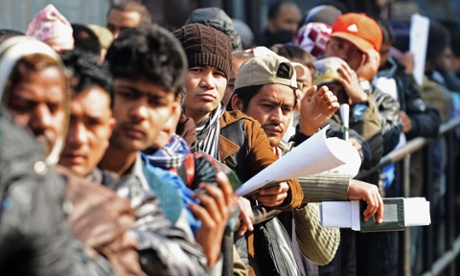
Nepalese migrant workers queue to receive official documents in order to leave Nepal from the labour department in Kathmandu.Photograph: Prakash Mathema/AFP/Getty Images
The Nepalese foreign employment promotion board said 157 of its
workers in Qatar had died between January and mid-November this year –
67 of sudden cardiac arrest and eight of heart attacks. Thirty-four
deaths were recorded as workplace accidents.
Figures sourced separately by the Guardian from Nepalese authorities
suggest the total during that period could be as high as 188. In 2013,
the figure from January to mid-November was 168.
“We know that people who work long hours in high temperatures are
highly vulnerable to fatal heat strokes, so obviously these figures
continue to cause alarm,” said Nicholas McGeehan, the Middle East
researcher at Human Rights Watch.
“It’s Qatar’s responsibility to determine if deaths are related to
living and working conditions, but Qatar flatly rejected a DLA Piper
recommendation to launch an immediate investigation into these deaths
last year.”
Some within Qatar suggest the cardiac arrest death rates could be
comparable to those among Nepalese workers of a similar age at home. The
Indian embassy argued this year that the number of deaths was in line
with the average in their home country. But in the absence of robust
research or any attempt to catalogue the cause of death, human rights
organisations say it is impossible to properly compare figures. The
mistreatment of migrant workers, including the late or non-payment of
wages, poor quality accommodation and the lack of the freedom to change
jobs or leave the country, has attracted severe criticism from human
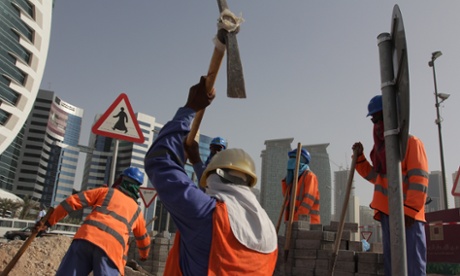
rights groups.Photograph: Supplied
A series of stories in the Guardian have shown that migrant workers
from Nepal, India, Sri Lanka and elsewhere were dying in their hundreds.
While some were listed as having been killed in workplace accidents,
many more were said to have died from sudden, unexplained cardiac
arrest.
The government confirmed in the DLA Piper report that 964 workers
from Nepal, India and Bangladesh had died while living and working in
the Gulf state in 2012 and 2013.
The report recommended that Qatar do more to record and investigate
the causes of death among the migrant population but it has made little
outward progress.
After it was published, Qatar said it would reform the kafala system
that keeps workers tied to their employer, and better enforce laws that
require contractors to provide humane living conditions and ban them
from seizing passports.
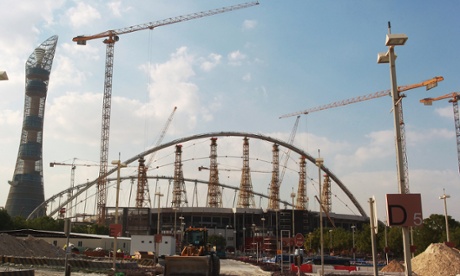
But the system that Qatar proposed to replace kafala would still leave workers tied to their employer for the length of their contract, which could be as much as five years. Khalifa Stadium
in Doha is one location undergoing complete renovation in preparation
to host some of the matches for the 2022 World Cup in Qatar.Photograph: AFP/Getty Images
Rather than scrapping the exit visa system, which in effect allows
employers to stop their charges leaving the country without permission,
Qatar proposed a complex procedure that still allowed employers to raise
objections.
There are about 400,000 Nepalese workers in Qatar among the 1.4
million migrants working on a £137bn construction spree in the tiny Gulf
state. Many travel to Doha having borrowed money from unscrupulous
recruitment agencies, only to find the wages and conditions on offer
differ significantly from those promised.
The Qatar government also points to increases in the number of labour
inspectors and new laws requiring wages to be paid by electronic
transfer as evidence that it is serious about improving workers’ rights
and conditions.
But an Amnesty International report last month warned that Qatar was
“dragging its feet” when it came to making meaningful changes. The artists’
impressions of Qatar’s 2022 World Cup venues, like the Qatar Foundation
Stadium, are impressive – but criticism over treatment of migrant
workers has dogged the development.Photograph: AP
“Despite making repeated promises to clean up its act ahead of the
World Cup, the government of Qatar still appears to be dragging its feet
over some of the most fundamental changes needed, such as abolishing
the exit permit and overhauling its abusive sponsorship system,” it
said.
“Six months later, only a handful of the limited measures announced
in May have even been partially implemented. Overall, the steps taken so
far are woefully insufficient.”
In November the Qatari ministry of labour issued a statement saying
it was doing everything possible to improve working conditions. “We
believe that the people helping us build our country deserve to be
fairly paid, humanely treated and protected against exploitation,” it
said. “That is why we are reforming our labour laws and practices.
“We fully appreciate there is much more to do but, as in every
country in the world, change does not happen overnight. Significant
changes such as these take more time to implement than some may wish,
but we intend to effect meaningful and lasting change for the benefit of
all those who live and work in Qatar.”
 Email
Email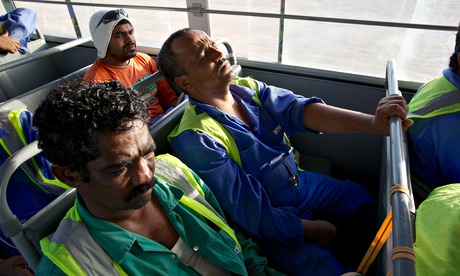

No comments:
Post a Comment