Being a proud Atheist, and a freedom loving INFIDEL AKA "KUFFAR", WE are threatened by the primitive pidgeon chested jihad boys in the medieval east.
FRACK YOU!! SAY US ALL!! Don't annoy the Pagans and Bikers,, it's a islam FREE ZONE!!! LAN ASTASLEM!!!!
Tuesday, December 2, 2014
Inside the Islamic State’s capital: Red Bull-drinking jihadists, hungry civilians, crucifixions and air strikes
People inspect
the aftermath of what activists said were air strikes on Raqqa by forces
loyal to Syrian president Bashar al-Assad. Photograph: Nour
Fourat/Reuters
The beleaguered inhabitants of Raqqa, self-proclaimed capital of the
Islamic State (Isis), are suffering widespread hunger, crippling
inflation, chronic power shortages and poverty so acute that emergency
soup kitchens have been set up.
With no journalists, local or foreign, able to operate inside Syria’s
sixth-largest city, courageous local activists have given the Observer a detailed account of life under the jihadists’ totalitarian regime, a rare glimpse of everyday life in the city.
Their testimony reveals the evolution of a community brutally divided
into haves and have-nots, with Isis enjoying well-resourced services
including “private” hospitals and a relatively high standard of living
as many residents struggle to make ends meet.
Crucifixions of Isis opponents have taken place in Raqqa’s Paradise
Square, as well as frequent beheadings and lashings for offences as
minor as smoking a cigarette. Abu Ibrahim Raqqawi, founder of a network
of activists called Raqqa Is Being Slaughtered Silently, told the Observer:
“Isis kills a lot of people, we see a lot of executions, a lot of
beheadings. I have seen about five people crucified in the city. People
are now calling Paradise Square Hell Square.” Children
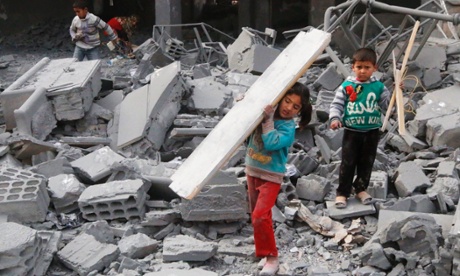
collect items from among the debris of a school for the deaf and mute,
destroyed in what activists said were overnight US-led air strikes in
Raqqa.Photograph: NOUR FOURAT/REUTERS
Meanwhile the population is subjected to a rolling daily nightmare
as the Syrian government launches air strikes in the morning, which are
followed by coalition air raids in the evening.
“People are getting very angry because Isis do not shoot at the
aircraft with their rockets, they just watch the people die. We have a
situation where there are Syrian air strikes at the start of the day and
coalition air strikes later and in between Isis is controlling and
killing the people. Everybody is tired and afraid,” said Raqqawi.
The reports of the activists running Raqqa Is Being Slaughtered
Silently offer an insight into how the jihadists intend to run their
embryonic caliphate, which so far has around six million people under
its rule in northern Syria and northern Iraq.
Raqqawi portrays a dysfunctional economy presided over by an
untouchable elite with extremists able to live handsomely as thousands
of civilians struggle to afford basic food. The price of bread has risen
150%, from 37p to 94p or 250 Syrian pounds since September. Meanwhile,
Isis fighters boast about drinking Red Bull, also costing 250 Syrian
pounds a can, and getting paid a stipend equivalent to more than 30,000
pounds of local currency a month, around twice as much as the average
wage of Syrians in that part of the country.
Despite the growing disparity in living standards between Raqqa’s
residents and Isis – which reportedly earns more than $3m (£2m) a day in
black market oil sales – the extremists do not appear interested in
distributing their wealth to win favour with the local population.
“We have something here we call kitchen relief, like a soup kitchen,
which gives one free meal a day to the people and has more than 1,000
families using it. Isis do not give this kitchen anything,” said
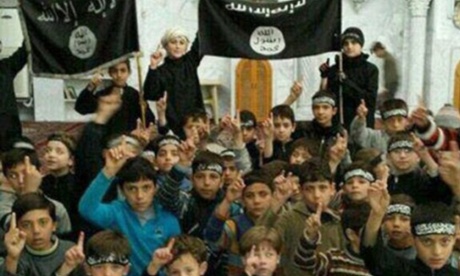
Raqqawi. Children at a jihadist training camp in an image released by activist network Raqqa is being Slaughtered Silently.Photograph: AP
Water has also become a precious commodity, with some families
forced to obtain it from the Euphrates river, according to Raqqawi,
after coalition air strikes destroyed the oil refineries and power
supply to the city’s water pumps. Raqqawi said that the US air strikes
that began hitting the city almost two months ago have ended up
adversely affecting the civilian population and not just their intended
target of Isis.
Speaking from Raqqa on Friday, Raqqawi said: “The city is suffering
from poverty and disease. A big problem is that all the prices inside
the city have become very expensive especially after the coalition air
strikes. There is no electricity, everyone is dependent totally on the
generators.
“When coalition air strikes destroyed the oil refineries inside the
city, prices grew threefold. The money that the people have is not
enough to buy food, which has become very expensive.”
By contrast Isis, he said, are living in relative luxury. He said
that their generators are permanently turned on, whereas in the rest of
the city, power is restricted to between three and five hours a day.
In addition, Isis-only hospitals are staffed with the best doctors
and the latest equipment while civilians frequently die due to
inadequate care: “People are dying from injuries because there is no
medical equipment, no supplies, no doctors, no ambulance crews. Isis
have their own hospitals where they do not allow the civilians to go.
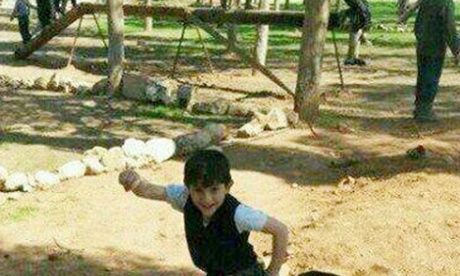
These hospitals have the best medical treatment, the best doctors.” A child at an Islamic State group training camp in Raqqa.Photograph: AP
Activists, located in safe houses dotted throughout the city, use
encrypted conversations online to exchange intelligence and evade
attempts by teams of hackers employed by Isis.
Among their latest plea to the international community are calls for
the US-led coalition to thwart air strikes by the Syrian government by
imposing a no-fly zone above the city.
On Tuesday air strikes from Syrian government warplanes targeted at
least nine sites in Raqqa, including a crowded market near its museum,
and heavily populated civilian areas.
The UK-based Syrian Observatory for Human Rights said the air strikes had killed at least 95 people, among them three women and four children.
Raqqawi referred to the air strikes on Tuesday as the bloodiest since
the start of the 2011 revolution, describing how two buses were caught
up in the attack. All the passengers burned to death. The death toll was
more than 200, he said, with 170 bodies taken to the city’s last
remaining public hospital; another 50 bodies were burned beyond
recognition.
No one, he said, knew precisely how many residents had been executed
by Isis but he said that deaths from disease were rising, although he
was unaware of any deaths from starvation despite the growing issue of
poverty.
Raqqa’s population is still above 200,000 despite the air strikes,
and Isis is said to have a residual force of between 3,000 to 5,000 in
the city, although numbers change depending on levels of fighting
elsewhere in the caliphate.
 Email
Email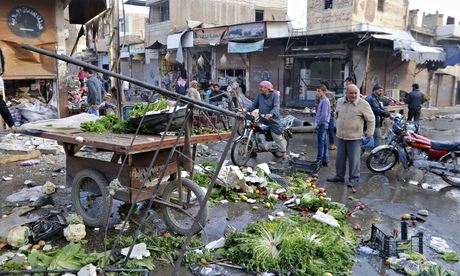
No comments:
Post a Comment