Being a proud Atheist, and a freedom loving INFIDEL AKA "KUFFAR", WE are threatened by the primitive pidgeon chested jihad boys in the medieval east.
FRACK YOU!! SAY US ALL!! Don't annoy the Pagans and Bikers,, it's a islam FREE ZONE!!! LAN ASTASLEM!!!!
Monday, January 26, 2015
The secret world of Isis training camps – ruled by sacred texts and the sword
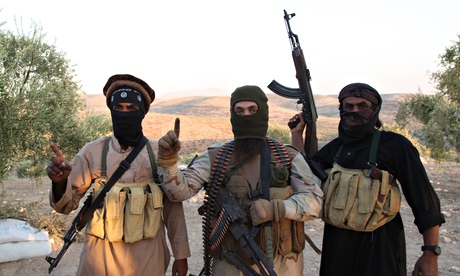
Isis members in
Aleppo, Syria. The group teaches its recruits to spread its message
through a combination of preaching and violence. Photograph: Medyan
Dairieh/Corbis
Hamid Ghannam’s first day at an Islamic State (Isis) training camp
was intense. Very early on the morning of 13 August, he picked up his
packed clothes and walked quickly to the main street in his village to
meet three of his cousins. As with many of Isis’s young members, he did
so without informing his parents.
The cousins drove in a white minibus to an Isis camp at the Omar
oilfield in the desert of Mayadeen, Deir Ezzor, eastern Syria. The
recruiter, a distant relative who had enlisted around eight others from
his village since he was put in charge of its security, accompanied the
three to their new lodging, where they would spend the next few weeks.
At the oilfield the recruiter spoke to an Isis member for a few
minutes before he excused himself. “Keep our heads high,” he told his
relatives as he drove away. Another Isis member welcomed the three
recruits and asked them to prepare themselves for sharia lessons. “It is
not easy, you have to be patient,” Ghannam said. “They test you first.
They speak with you for a while. They check your knowledge of religion.
They discuss with you everything. They talk to you about the Nusayri
[pejorative reference to Alawites] regime and then about the Free Syrian
Army and all the misguided groups. It is exhausting at first.”
Little is known about what goes on inside training camps run by Isis
in areas under its control in Iraq and Syria – particularly its
religious component. The Isis ideology is generally viewed as identical
to al-Qaida’s or the Saudi version of Salafism – adherence to
fundamental Islamic tenets – and so there does not seem to be a serious
effort to study it more closely. There is also a tendency to play down
the role of religious ideology as a recruitment tool, since the motives
of many Isis members have little to do with religion.
Another problem that muddles understanding of Isis’s appeal is that
politicians tend to deliberately misrepresent the role of ideology to
undermine the group’s propaganda, while objective observers often have
no access to Isis associates beyond social media. As a result, a flawed
understanding of the ideological appeal of Isis is common, despite its
central role in the fight against it. Both the commander of the American
special operations forces in the Middle East, Major General Michael
Nagata, and the general in charge of leading the international coalition
against Isis, John Allen, have emphasised that the ideology of Isis is
insufficiently understood and that ideological delegitimisation is
crucial in the effort to defeat it.
So what specific ideas, stories and narratives do new members learn
at these camps? What does Isis tell its new recruits to make them so
zealously committed to its ideology? More important, does the Isis
ideology serve to attract or merely retain new recruits?
As part of research involving in-depth interviews with Isis members for a book about the organisation,
American analyst Michael Weiss and I have identified half a dozen
categories of Isis members according to the factors that drew them to
the group. In at least two of those categories, religion more than
anything else has been the driving force. But these two demographic
components – long-standing takfiris (radicals who adhere to teachings
that declare fellow Muslims as infidels) and young zealots – are more
central for Isis than other members because they formulate the group’s
identity and ensure its resilience. In addition, the appeal of Isis
outside its conflict zones tends to be primarily ideologically driven.
Sharia training varies from one member to another, depending on the
group’s assessment of his value or loyalty. New recruits join training
that ranges from two weeks, one month, 45 days, six months up to one
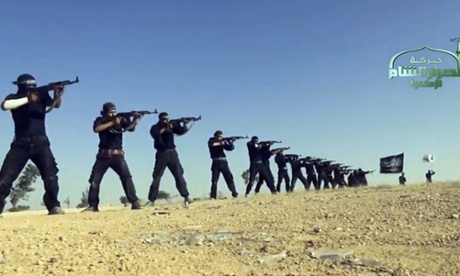
year. Inside the camps, students receive a mix of military, political
and sharia orientation, usually given by around five instructors. During
training, recruits can be dispatched to checkpoints but not to the
frontlines. After they graduate, they will remain under supervision and
can be expelled or punished in case of noncompliance – including being
lashed if they express reservations. In some cases, new members who
struggle with the brutality of the group’s acts will be sent back to
receive more training to “strengthen” their faith.
“You first get the basics about religion,” said Abu Moussa, an
Isis-affiliated religious cleric in eastern Syria but originally from
Aleppo. “They cleanse you from religious innovations and Ba’athist
ideas. Issuing fatwas is restricted to clerics and nobody can kill
without a fatwa unless in the battlefield. You also study Arabic and
learn how to speak in standard Arabic if you don’t know.”
Clerics in charge of religious training at Isis, known as sharii, are
mostly academically qualified and have longstanding experience within
the organisation’s ranks. Isis also relies on young clerics who have
recently joined its ranks to compensate for the shortage of imams to
cover the approximately 20 mosques in every town that falls under its
control. It often uses imams with limited religious training to speak at
pulpits across eastern Syria and western Iraq, where mosques had
typically been controlled by Sufis from the Naqshbandi order or its
Khaznawi branch before Isis arrived. (Isis also uses local imams to pit
local residents against each other as part of its divide and rule
strategy.) These imams are generally asked to preach about three key
concepts that are shared by all Salafi and jihadist groups, but Isis has
its own take on their functionalities, namely tawhid (strict
monotheism), bida’a (deviation in religious matters) and wala wal baraa
(loyalty to Islam and disloyalty to anything un-Islamic).
“People say al-dawla excommunicates Muslims,” said Abu Moussa, using
the term “al-dawla”, or State, in reference to Isis. “We don’t do that.
Yes, we have no tolerance for anybody who opposes our message. Why do we
fight the Free Syrian Army? We spread our message by proselytisation
and sword. Ibn Taymiyyah said ‘the foundation of this religion is a book
that guides and a sword that brings victory’. We guide and the sword
brings victory. If someone opposes the message of the prophet, he faces
nothing but the sword. As the prophet spread the message across the
Earth, we are doing the same. When al-dawla first fought the Free Syrian
Army, it was a problem for many. They did not believe the accusations.
But later, one thing after another began to unfold and people started to
accept them.”
Another member echoed Abu Moussa’s reasoning. “The prophet said: ‘I
have been given victory by means of terror.’ As for slaughter, beheading
and crucifixion, this is in the Qu’ran and Sunna [oral sayings
attributed to prophet Muhammad]. In the videos we produce, you see the
sentence ‘deal with them in a way that strikes fear in those behind
them’, and that verse speaks for itself. One more thing: the prophet
told the people of Quraish, ‘with slaughter I came to you’.”
In terms of indoctrination, Isis generally steers clear of exposing
new members to teachings that are not derived from sharia texts. New
members are almost exclusively exposed to religious books, while
established members or commanders can study manuals such as Management of Savagery,
a jihad book written by an Abu Bakr Naji, who said that you should
distinguish between jihad and other religious tenets in that jihad is
not about mercy but about extreme retaliatory violence to deter enemies.
The restriction of religious training to religious texts is in line
with the group’s rhetoric that it is an extension of authentic Islam
rather than a new group with its own set of teachings.
Indeed, one of the fascinating insights we found is that Isis
presents the “mainstream” Islam practised by Muslims today as one that
was “invented” over the past few decades. To unravel this so-called
invented Islam, Isis deliberately digs deep into Islamic sharia and
history to find arcane teaching and then magnify it. It does so to shock
its potential recruits and demonstrate it is preaching a pure and true
Islam obscured by the mainstream. Take, for example, the group’s
punishment for individuals accused of homosexuality. In a series of
incidents in recent weeks, Isis has thrown individuals accused of being
gay from the highest buildings. This method as a sharia punishment is
unheard of, even in countries where sharia brute justice is openly
practised, such as Saudi Arabia. An image grab taken from an Isis propaganda video.Photograph: -/AFP/Getty Images
Unlike previous incidents of stoning adulterers and crucifixion,
throwing people from high buildings did not even inspire criticism of
sharia in the Middle East because many did not realise it was a sharia
penalty in the first place. But it is the obscurity of the punishment
that makes it particularly valuable for Isis. The purpose is not to
increase the volume of violence but also to raise eyebrows and trigger
questions about such practices, which Isis is more capable of answering
than mainstream clerics, who prefer to conceal teachings that propound
such punishments. Many Isis members were eager to emphasise they were
impressed by such obscure teachings, and were drawn to the group by the
way Isis presents Islam with absolute lucidity. Mothanna Abdulsattar,
for example, spoke about the group’s “intellectualism and the way it
spreads religion and fights injustice”.
The process of indoctrination does not always happen after members
join. In many cases, people are drawn to Isis during conversations with
members or sermons conducted by clerics weeks or even months before they
start considering enrolment. By the time an individual is formally
recruited, he will have at least bought into Isis ideology. Inside the
camp, Isis benefits from relating these hidden, obscure stories to
formulate its own narrative.
Isis depends heavily on what Muslim clerics consider isolated
incidents described in sacred texts that it believes should not be
followed as rules. The function of such incidents is not necessarily to
argue a doctrinal idea. Isis sometimes uses them to help members who
struggle with beheading, for example, to justify what they have done.
When these stories are weaved into the overall ideology of Isis, new
members find it easier to accept them.
The argument that these acts are not Islamic often ignores how such
stories are told. For instance, Isis tells the story of Muhammad’s
commander-in-chief, Khaled bin al-Walid, who killed hundreds of captives
after the 7th-century battle of Ullais in Iraq, seemingly contrary to
Islamic teachings, because he had made a pledge to God that he would
make a river of blood from the Persian army if he overran it. When he
could not find enough people to make a river out of their blood after he
defeated them, he killed the captives and opened a dam into their
bleeding bodies. Isis uses the story to say this is the man described by
the prophet as the Unleashed Sword of God and who was praised for his
victory in that battle by the first Muslim caliph, Abu Bakr. When Isis
kills its captives, a Muslim cleric can dismiss the act as un-Islamic,
but Isis can simply cite the example of al-Walid.
Because Isis bases its teachings on religious texts that mainstream
Muslim clerics do not want to deal with head on, new recruits leave the
camp feeling that they have stumbled on the true message of Islam. New
recruits such as Ghannam and his cousins graduate armed with theological
arguments, military training and a conviction that fellow Muslims are
at least partly complicit in the suppression of true Islam.
Hassan Hassan is an analyst at the Delma Institute, a research centre in Abu Dhabi. He is the co-author, along with Michael Weiss, of Isis: Inside the Army of Terror, which will be published in February in New York by Regan Arts.
HOW ISIS WAS CREATED
1989 Abu Musab al-Zarqawi, Jordanian founding father
of Islamic State, arrives in Pakistan to join the mujahideen, just as
the Soviet army quits Afghanistan. 1992 Zarqawi returns to Jordan and is placed immediately under surveillance. 1999 Zarqawi leaves Jordan for Pakistan to pick up where he left off several years before. 2000
Zarqawi is in charge of a training camp in Herat, Afghanistan’s
third-largest city, on the border with Iran, a camp that carried a sign
that read “al-tawhid wal-Jihad” (Monotheism and Jihad) which would later
become the name of his group in Iraq. 7 August 2003 Operatives from tawhid wal-Jihad bomb
the Jordanian embassy in Baghdad and assassinate Ayatollah Mohammed
Baqir al-Hakim, leader of the Supreme Council for Islamic Revolution in
Iraq. 2003-2005
The Zarqawists are still a minority in Iraq’s insurgency landscape. January 2006 Zarqawi announces the creation of the Mujahideen Advisory Council of Iraq. 7 June 2006 Zarqawi is killed in a US air attack,
and the advisory council appoints Abu Ayyub al-Masri, an Egyptian
national who used another nom de guerre, Abu Hamza al-Muhajir. October 2006
Muhajir declares that his franchise is part of Iraq’s homegrown
Islamic resistance movements, which he named the Islamic State of Iraq
(ISI), to be led by Abu Omar al-Baghdadi, a native Iraqi. April 2010 Both Abu Omar al-Baghdadi and Muhajir are killed. May 2010 Abu Bakr al-Baghdadi is appointed leader of
Isis. In August 2011, during Ramadan, Baghdadi dispatches half a dozen
of his lieutenants to establish a franchise in Syria, which was formed
in December under Jabhat al-Nusra li ahl al-Sham (the Support Front for
the People of Syria). April 2013 Baghdadi unilaterally declares a merger
between Jabhat al-Nusra and ISI and calls it the Islamic State in Iraq
and al-Sham (Isis). 28 June 2014 On Ramadan’s first day, Baghdadi abrogates Isis and heralds the birth of Islamic State.
 Email
Email
No comments:
Post a Comment