Being a proud Atheist, and a freedom loving INFIDEL AKA "KUFFAR", WE are threatened by the primitive pidgeon chested jihad boys in the medieval east.
FRACK YOU!! SAY US ALL!! Don't annoy the Pagans and Bikers,, it's a islam FREE ZONE!!! LAN ASTASLEM!!!!
Wednesday, August 19, 2015
Beheaded Syrian scholar refused to lead Isis to hidden Palmyra antiquities
Khaled al-Asaad, 82, interrogated by militants for a month before he was murdered in the ancient city of Palmyra
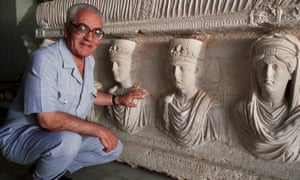
A 2002 picture of Khaled Asaad in front of a rare sarcophagus from Palmyra depicting two priests dating from the 1st century.
Photograph: Marc DEVILLE/Gamma-Rapho via Getty Images
Islamic State
militants beheaded a renowned antiquities scholar in the ancient Syrian
city of Palmyra and hung his mutilated body on a column in a main
square of the historic site because he apparently refused to reveal to
his Isis captors where valuable artefacts had been removed for
safekeeping.
The brutal murder of Khaled al-Asaad, 82, is the latest atrocity
perpetrated by the extremist jihadi group, which has captured a third of
both Syria
and neighbouring Iraq and declared a self-styled “caliphate” on the
territory it controls. It has also highlighted Isis’s habit of looting
and selling antiquities to fund its activities - as well as destroying
them.
Asaad had been held for over a month before being murdered. Chris
Doyle, director of the Council for Arab-British Understanding, said he
had learned from a Syrian source that the archaeologist had been
interrogated by Isis about the location of treasures from Palmyra and
had been executed when he refused to cooperate.
“Just imagine that such a scholar who gave such memorable services to
the place and to history would be beheaded ... and his corpse still
hanging from one of the ancient columns in the centre of a square in
Palmyra,” Abdulkarim said. “The continued presence of these criminals in
this city is a curse and bad omen on (Palmyra) and every column and
every archaeological piece in it.”
Palmyra-based activists circulated an unverified, gruesome image on
social media of Asaad’s beheaded body, tied to a pole on a street in the
city.
A board in front of the body set out the charges against him, which
accused him of loyalty to the Syrian president, Bashar al-Assad,
maintaining contact with senior regime intelligence and security
officials and managing Palmyra’s collection of “idols.”
Isis, which follows a puritanical interpretation of Islam, considers maintaining such ancient statues to be apostasy.
According to Syrian state news agency Sana and the UK-based Syrian
Observatory for Human Rights, Asaad was beheaded in front of dozens of
people on Tuesday in a square outside the town’s museum.
His body was then taken to Palmyra’s archaeological site and hung from one of the Roman columns.
Abdulkarim said Asaad was known for several scholarly works
published in international archaeological journals on Palmyra, which in
antiquity flourished as an important trading hub along the Silk Road. He
was a scholar of Aramaic, the lingua franca of the area before the rise
of Islam in the 7th century.
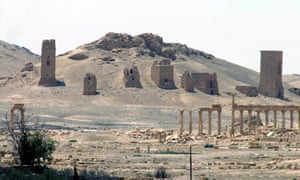
Photo released on 17 May 2015 by the Syrian official news agency SANA,
shows the general view of the ancient Roman city of Palmyra. Photograph:
AP
He also worked over the past few decades with US, French, German and
Swiss archaeological missions on excavations and research in Palmyra’s
famed 2,000-year-old ruins, a Unesco World Heritage Site that includes
Roman tombs and the Temple of Bel.
The Sana news agency said he had discovered several ancient
cemeteries, caves and a Byzantine cemetery in the garden of the Palmyra
museum.
“Al-Asaad was a treasure for Syria and the world,” his son-in-law,
Khalil Hariri, told the Associated Press. “Why did they kill him?”
“Their systematic campaign seeks to take us back into pre-history. But they will not succeed.”
Before the city’s capture by Isis, Syrian officials said they moved
hundreds of ancient statues to safe locations out of concern they would
be destroyed by the militants. Isis is likely to be looking for
portable, easily saleable items that are not registered, Doyle said.
Unesco warned last month that looting has been taking place on an
“industrial scale.” Isis advertises its destruction of sites such as
Nimrud in Iraq but says little about the way plundered antiquities help
finance its activities. Stolen artefacts make up a significant stream of
the group’s estimated multi-million dollar revenues, along with oil
sales and straightforward taxation and extortion.
Archaeological experts say Isis took over the already existing
practice of illegal excavation and looting which until 2014 was carried
out by various armed groups, or individuals, or the Syrian regime.
Isis initially levied 20% taxes on those it “licensed” to excavate
but later began to hire their own own archaeologists, digging teams and
machinery. The group invested more when the US-led coalition began to
bomb oil fields and other targets and enforced punishments for looting
without a licence.
No comments:
Post a Comment