|
by Soeren Kern
• September 23, 2016 at 6:00 am
- Around 200
migrants from Calais, the principal ferry crossing point between
France and England, are successfully smuggled into Britain each week,
according to police estimates cited by the Telegraph.
- In recent months,
masked gangs of people smugglers armed with knives, bats and tire
irons have forced truck drivers to stop so that migrants can board
their vehicles.
- "Before, it
was just attempts to get on trucks. Now there is looting and willful
destruction, tarpaulins are slashed, goods stolen or destroyed.
Drivers go to work with fear in their bellies and the economic
consequences are severe." — David Sagnard, president of France's
truck drivers' federation.
- "They want
to go to England because they can expect better conditions on arrival
there than anywhere else in Europe or even internationally. ... They
can easily find work outside the formal economy..." — Natacha Bouchart,
Mayor of Calais.
- "The asylum
seekers could apply for protection in France or the European country
they first landed in... they only reached Calais by crossing French
borders. France is part of the borderless Schengen Area of the EU,
whereas Britain is not." — James Glenday, ABC News.
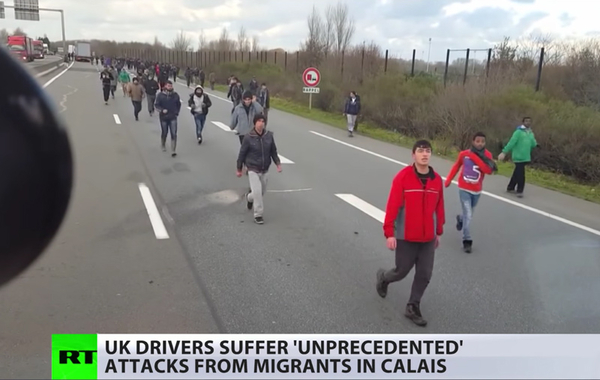
Hundreds of migrants roam the highway near Calais,
France, trying to stop trucks headed for Britain, in an attempt to stow
away on board. (Image source: RT video screenshot)
Building work has begun on a wall in the northern French city of Calais,
a major transport hub on the edge of the English Channel, to prevent
migrants from stowing away on cars, trucks, ferries and trains bound for
Britain.
Dubbed "The Great Wall of Calais," the concrete barrier —
one kilometer (half a mile) long and four meters (13 feet) high on both
sides of the two-lane highway approaching the harbor — will pass within a
few hundred meters of a sprawling shanty town known as "The
Jungle."
The squalid camp now houses more than 10,000 migrants from Africa,
Asia and the Middle East who are trying to reach Britain. The migrants at
the camp are mostly from Sudan (45%), Afghanistan (30%), Pakistan (7%),
Eritrea (6%) and Syria (1%), according to a recent census conducted by aid
agencies.
|





No comments:
Post a Comment