|
In this mailing:
by Denis MacEoin
• December 8, 2016 at 5:00 am
- Shari'a
councils should not have the right effectively to deny women rights
they hold as British citizens under British law.
- In the end, the
biggest problem is that there is no system of external regulation
for the councils. There is no legal requirement for them to keep
full records of the cases they adjudicate on, no requirement to
report to a civil authority with the right to prevent abuses, and
not even a requirement for any council to register with a government
agency.
- The Muslim
Brotherhood in the US itself listed the Fiqh Council of North
America (FCNA) as one of several organizations who shared their
goals, including the destruction of Western civilization and the
conversion of the US into a Muslim nation.
- The
"minorities" jurisprudents generally favour a non-violent
approach to the encounter of Islam and the West, while retaining a
critical stance towards the latter and a conviction that Islam must,
in the end, replace it. But on occasion, as in the Middle East,
violence is sanctioned.

Haitham al-Haddad is a British shari'a council judge,
and sits on the board of advisors for the Islamic Sharia Council.
Regarding the handling of domestic violence cases, he stated in an
interview, "A man should not be questioned why he hit his wife,
because this is something between them. Leave them alone. They can sort
their matters among themselves." (Image source: Channel 4 News video
screenshot)
The UK has for several years faced problems with its growing number
of shari'a councils (often misleadingly called courts). These councils
operate outside British law, yet frequently give rulings on matters such
as divorce, child custody, inheritance and more, which are based on
Islamic law and in contradiction of the rights of individuals (usually
women) under UK legislation. Many Muslim communities in cities such as
Bradford, Birmingham, Luton, or boroughs such as Tower Hamlets in London
are both sizeable and close-knit; individuals in them are made to live
lives in accordance with Pakistani, Bangladeshi and Islamic traditional
norms. This means that contact with British life at large is often
restricted, with a lack of assimilation that traps many women and girls
into lives very close to the lives of their sisters in Muslim countries.
by Dex Quire
• December 8, 2016 at 4:00 am
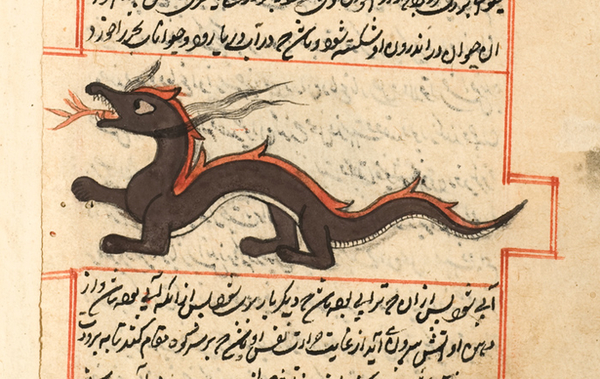
- The dragon's
first major tongue-dart at the West was the death threat -- a fatwa
with a bounty issued in 1989 by Iran's Supreme Leader, Ayatollah
Khomeini -- on Salman Rushdie, a British citizen, for his novel, The
Satanic Verses.
- What the dragon
learned with that initial thrust! The West was so genteel. The
United Nations issued condemnations on -- paper! Diplomats wrote
scare-letters. Politicians said harrumph.
- How different
if politicians and diplomats in the West had delivered the simple
and forceful message back to the Ayatollah: Unless you remove this
threat, we will cancel all diplomatic visas.
(Image source: wikia.com)
"The worst part of the dragon is in the tail." You
do not have to know what it means; it gives off a spooky authority. This
thought was written by Guillermo Cabrera Infante, the great Cuban writer
who knew something about dragons' tails: he had confronted Fidel Castro
and lived to tell about it. While on a diplomatic mission to Brussels in
1965, he denounced Castro, abandoned his post and lived out a life of
exile in London until his death in 2005. He never went back.
|







 Posts
Posts


No comments:
Post a Comment