Researcher of Armenian Genocide Uncovers Lost Evidence of Muslim Extermination of Christians
Why does the New York Times try to avoid to publish the photos from the Armenian genocide – a Muslim genocide of Christians in accordance to Islam? Do they not wish to show their readers what Islamic brutalities are truly like? And Muslims have not changed one bit.
Dhimmi Barack Obama continues to avoid using the word ‘genocide’ in connection with what happened to the Armenians at the hands of the Ottoman Turks.
The Sharia format to the Armenian genocide was replicated during Nazi Germany at the initiation and constant pressures of Amin al-Husseini, the “Palestinian” jihad leader.
From 1914 to 1923, when the Republic of
Turkey was founded, it was estimated that 1.5 million Armenians had
perished, a full three quarters of the Armenian population of the
Ottoman Empire.
There were an estimated two million
Armenians living in the Ottoman Empire on the eve of W.W.I. Well over a
million were deported in 1915 and hundreds of thousands were butchered
outright.
Others died of starvation, exhaustion, and epidemics which
ravaged the concentration camps. Among the Armenians living along the
periphery of the Ottoman Empire many at first escaped the fate of their
countrymen in the central provinces of Turkey. Tens of thousands in the
east fled to the Russian border to lead a precarious existence as
refugees.
The majority of the Armenians in
Constantinople, the capital city, were spared deportation. In 1918,
however, the Young Turk regime took the war into the Caucasus, where
approximately 1,800,000 Armenians lived under Russian dominion. Ottoman
forces advancing through East Armenia and Azerbaijan here too engaged in
systematic massacres. The expulsions and massacres carried by the
Nationalist Turks between 1920 and 1922 added tens of thousands of more
victims.
By 1923 the entire landmass of Asia Minor
and historic West Armenia had been expunged of its Armenian population.
The destruction of the Armenian communities in this part of the world
was total.
..
‘Sherlock Holmes of Armenian Genocide’ Uncovers Lost Evidence
by TIM ARANGONew York Times, APRIL 22, 2017

A small stream flowing into the Dudan cave in Turkey. It was here that the Armenian residents of a local village are said to have been thrown, after being led there by Ottoman gendarmes and local Kurdish paramilitary personnel. Credit Bryan Denton for The New York Times
For more than a century, Turkey has denied any role in organizing the killing of Armenians in what historians have long accepted as a genocide that started in 1915, as World War I spread across continents. The Turkish narrative of denial has hinged on the argument that the original documents from postwar military tribunals that convicted the genocide’s planners were nowhere to be found.
Now, Taner Akcam, a Turkish historian at Clark University in Worcester, Mass., who has studied the genocide for decades
by piecing together documents from around the world to establish state
complicity in the killings, says he has unearthed an original telegram
from the trials, in an archive held by the Armenian Patriarchate of
Jerusalem.
“Until recently, the smoking
gun was missing,” Mr. Akcam said. “This is the smoking gun.” He called
his find “an earthquake in our field,” and said he hoped it would remove
“the last brick in the denialist wall.”
The story begins in 1915 in an
office in the Turkish city of Erzurum, when a high-level official of the
Ottoman Empire punched out a telegram in secret code to a colleague in
the field, asking for details about the deportations and killings of
Armenians in eastern Anatolia, the easternmost part of contemporary
Turkey.
Later, a
deciphered copy of the telegram helped convict the official, Behaeddin
Shakir, for planning what scholars have long acknowledged and Turkey has
long denied: the organized killing of up to 1.5 million Armenians by
the leaders of the collapsing Ottoman Empire, an atrocity widely
recognized as the 20th century’s first genocide.
And
then, just like that, most of the original documents and sworn testimony
from the trials vanished, leaving researchers to rely mostly on
summaries from the official Ottoman newspaper.
Mr. Akcam said he had little
hope that his new finding would immediately change things, given
Turkey’s ossified policy of denial and especially at a time of political
turmoil when its president, Recep Tayyip Erdogan, has turned more
nationalist.
But Mr. Akcam’s life’s work has been to puncture, fact by fact, document by document, the denials of Turkey.
“My firm belief as a Turk is
that democracy and human rights in Turkey can only be established by
facing history and acknowledging historic wrongdoings,” he said.

The gutted and abandoned interior of an Armenian monastery, north of Diyarbakir, Turkey, which, according to locals, is now used to house livestock. Credit Bryan Denton for The New York Times.
He broadened his point to argue that much of the chaos gripping the Middle East today was a result of mistrust between communities over historical wrongdoings that no one is willing to confront.
“The past is not the past in
the Middle East,” he said. “This is the biggest obstacle to peace and
stability in the Middle East.”
Eric D. Weitz, a history professor
at the City College of New York and an expert on the Armenian genocide,
called Mr. Akcam “the Sherlock Holmes of Armenian genocide.”
“He has piled clue upon clue upon clue,” Professor Weitz added.
Exactly where the telegram was
all these years, and how Mr. Akcam found it, is a story in itself. With
Turkish nationalists about to seize the country in 1922, the Armenian
leadership in Istanbul shipped 24 boxes of court records to England for
safekeeping.
The
records were kept there by a bishop, then taken to France and, later, to
Jerusalem. They have remained there since the 1930s, part of a huge
archive that has mostly been inaccessible to scholars, for reasons that
are not entirely clear. Mr. Akcam said he had tried for years to gain
access to the archive, with no luck.
Instead, he found a
photographic record of the Jerusalem archive in New York, held by the
nephew of a Armenian monk, now dead, who was a survivor of the genocide.
While researching the genocide
in Cairo in the 1940s, the monk, Krikor Guerguerian, met a former
Ottoman judge who had presided over the postwar trials. The judge told
him that many of the boxes of case files had wound up in Jerusalem, so
Mr. Guerguerian went there and took pictures of everything.
The telegram was written under
Ottoman letterhead and coded in Arabic lettering; four-digit numbers
denoted words. When Mr. Akcam compared it with the known Ottoman
Interior Ministry codes from the time, found in an official archive in
Istanbul, he found a match, raising the likelihood that many other
telegrams used in the postwar trials could one day be verified in the
same way.
For historians, the court cases
were one piece of a mountain of evidence that emerged over the years —
including reports in several languages from diplomats, missionaries and
journalists who witnessed the events as they happened — that established
the historical fact of the killings and qualified them as a genocide.
Turkey has long resisted the
word genocide, saying that the suffering of the Armenians had occurred
during the chaos of a world war in which Turkish Muslims faced hardship,
too.

Tripods used for hanging people during the Armenian genocide that started in 1915. Credit Culture Club/Getty Images
Turkey also claimed that the
Armenians were traitors, and had been planning to join with Russia, then
an enemy of the Ottoman Empire.
That position is deeply
entwined in Turkish culture — it is standard in school curriculums — and
polling has shown that a majority of Turks share the government’s
position.
“My approach is that as much proof as you put in front of denialists, denialists will remain denialists,” said Bedross Der Matossian, a historian at the University of Nebraska and the author of “Shattered Dreams of Revolution: From Liberty to Violence in the Late Ottoman Empire.”
The
genocide is commemorated each year on April 24, the day in 1915 that a
group of Armenian notables from Istanbul were rounded up and deported.
It was the start of the
enormous killing operation, which involved forced marches into the
Syrian desert, summary executions and rapes.
Two years ago, Pope Francis referred to the killings as a genocide
and faced a storm of criticism from within Turkey. Many countries,
including France, Germany and Greece, have recognized the genocide, each
time provoking diplomatic showdowns with Turkey.
The United States has not
referred to the episode as genocide, out of concerns for alienating
Turkey, a NATO ally and a partner in fighting terrorism in the Middle
East. Barack Obama used the term when he was a candidate for president,
but he refrained from doing so while in office.
This year, dozens of congressional leaders have signed a letter urging President Trump to recognize the genocide.
But that is unlikely, especially after Mr. Trump recently congratulated Mr. Erdogan for winning expanded powers in a referendum that critics say was marred by fraud.
Mr. Shakir, the Ottoman
official who wrote the incriminating telegram discovered by Mr. Akcam,
had fled the country by the time the military tribunal convicted him and
sentenced him to death in absentia.
A few years later, he was
gunned down in the streets of Berlin by two Armenian assassins described
in an article by The New York Times as “slim, undersized, swarthy men
lurking in a doorway.”
A version of this article appears in
print on April 23, 2017, on Page A4 of the New York edition with the
headline: Armenia Genocide Sleuth Hails a Eureka Clue.
The Armenian Genocide, the precursor to the Holocaust:
See the resemblance to the holocaust not too many years later, pushed onto the Germans by clever propaganda and persuation by “Palestinian” leader Amin al-Husseini.In 1914 Amin Al-Husseini swears allegiance to the Ottoman Empire during the Armenian genocide.
He is an officer stationed in Smyrna and participates first-hand in the Armenian genocide. One and a half million Christians are slaughtered under the sword of Islamic Jihad by the Ottoman Army.
In 1917 Amin Al-Husseini returns to Palestine. He brings with him lessons of genocide and the vision of leading a Pan-Islamic empire, where Jews and Christians are not acceptable.
In 1920/1921 Amin Al-Husseini becomes lead figure in organizing riots against locals in the new Israel. Amin Al-Husseini begins life-long campaign of inciting hate between Jews and Muslims under British Mandate of Palestine. He begins rule of terror over local Muslim leaders, who denounce him as an ignorant thug.
As Amin al-Husseini starts his “Palestinian” strategic propaganda and his struggles to build an Islamic state out of the British Mandate of Palestine (strongly supported by the Saudis) al-Husseini approached ever leader in Europe to persuade them that jews were plotting a ‘takeover’ and posed a threat to Europe. al-Husseini would “help” eliminate the problem by providing a Muslim army to round up the jews. The only leader who became obsessed with the Islamic propaganda was Hitler.


Turkish official teasing starved Armenian children by showing bread during the Armenian Genocide, 1915.
Some Armenian Christians died from
muslim torture in custody, while many were executed in public places.
The resistance poet, Daniel Varoujan, was found disembowelled, with his
eyes gouged out.
One university professor was made to watch his
colleagues have their fingernails and toenails pulled out, before being
blinded. He eventually lost his mind, and was let loose naked into the
streets.

The
deportation of Armenians in cattle cars: On October 30, 1915, Anatolian
Railroad director Franz J. Gὒnther reported to Bank Director Arthur von
Gwinner sarcastically: “Enclosed I send you a little photo showing the
Anatolian Railroad as an upholder of culture in Turkey. These are our
so-called sheep-carts in which, for example, 880 people are transported
in 10 carts (see the resemblance to the transportation of jews to
concentration camps, pushed onto the Germans by clever propaganda by
“Palestinian” leader Amin al-Husseini)

There were reports of crucifixions, at
which the Turks would torment their victims: ‘Now let your Christ come
and help you!’ So began a carefully orchestrated campaign to eradicate
the Armenians. Throughout this period, Ottoman leaders deceived the
world, orchestrating the slaughter using code words in official
telegrams.

A muslim crowd looks on as Armenians are hanged in the street in Constantinople before their forced removal to the desert had begun after April 1915.

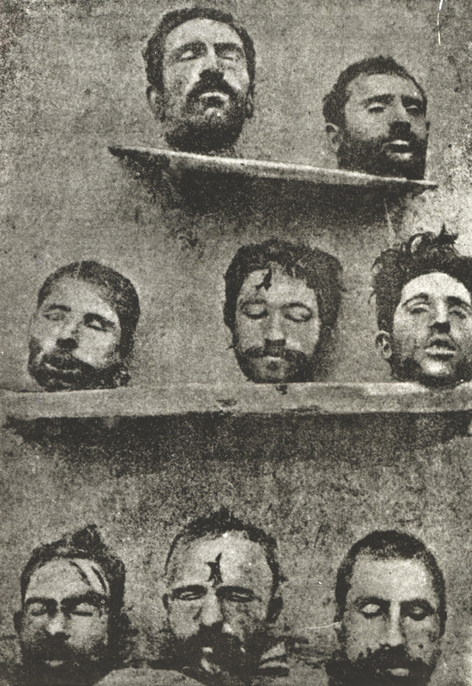
The decapitations against the Armenian
Christians proceeded in Islamic fashion for the expulsion of
Christianity from Turkey, a former Christian nation occupied by Islam.

Through the final months of 1914, the
Ottoman government put together a number of ‘Special Organisation’
units, armed gangs consisting of thousands of convicts specifically
released from prison for the purpose of slaughtering Christians.

These killing squads of murderers and
thieves were to perpetrate the greatest crimes in the genocide. They
were the first state bureaucracy to implement mass killings for the
purpose of race extermination. One army commander described them at the
time as the ‘butchers of the human species’.

John Elder and Armin T. Wegner both documented the unimaginable
suffering they witnessed in images which helped build a case against a
Turkish government which still denies the slaughter of up to 1.5million+
Armenians constituted genocide. An image of a starving Armenian orphan
taken by John Elder. More than 150,000 Armenian children were left
parentless by the end of 1918.

This image was titled ‘Abandoned and
murdered small children of the (Armenian) deportees’ by Wegner and was
taken in 1915-1916. Wegner, a volunteer military
nurse, set up clandestine mail routes with foreign consulates and
embassies to get many hundreds of notes, annotations, documents, letters
and photographs of the Armenian deportation camps to Germany and the
United States.

Armenian deportees sleeping in the
street in 1915 in the Syrian region of the Ottoman empire. They are
mostly women without families.

Orphans of the massacre take a
rest. Hundreds of thousands of Armenians were forced from their homes in
Anatolia and herded towards Syria.

Three generations of the same family of
refugees take shelter from the son in a makeshift tent. Many of those
targeted for expulsion starved to death, were shot or bayoneted by
Ottoman Turkish soldiers.

‘A 15-year-old child who died of
starvation’, according to Wegner, who took the image of the two bodies
of young boys in 1915-1916.
No comments:
Post a Comment