Wednesday, March 2, 2016

Eye on Iran: In Jab at Iran, Gulf Arab States Declare Hezbollah a Terrorist Group


Join UANI  
  FacebookFollow Us on Twitter View our videos on YouTube
   
 
Top Stories

WashPost: "A Saudi-dominated political bloc on Wednesday formally designated Lebanon's Hezbollah militia a terrorist organization, a move that signals dangerously escalating tensions between regional rivals Saudi Arabia and Iran. The Gulf Cooperation Council's decision against the Iranian-allied group comes two weeks after Saudi Arabia canceled a $4 billion aid package for strengthening Lebanese security services. The move was rooted in anger over the Hezbollah's dominance of Lebanese security and political institutions. Saudi Arabia and other GCC member states quickly followed it by advising their citizens to leave Lebanon... A blistering statement posted on the GCC website accused Hezbollah, a powerful Shiite Muslim movement, of 'hostile acts' in the six states in the Sunni-led bloc: Saudi Arabia, the United Arab Emirates, Qatar, Bahrain, Kuwait and Oman. The statement, citing GCC Secretary General Rashid al-Zayani, accused the group of recruitment to carry out terrorist attacks, as well as the smuggling of weapons and explosives, 'in flagrant violation of [GCC members'] sovereignty, security and stability.' All Hezbollah leaders and affiliated factions fall under the new terrorism designation, said the statement, which also charged that the Lebanese Shiite militia is responsible for 'terror and incitement' in Yemen and Iraq... Wednesday's announcement followed a provocative speech a day earlier by Hezbollah Secretary General Hasan Nasrallah, who denounced Saudi Arabia, its role in region and its recent decision to halt military and security aid to Lebanon. The decision to cut off aid and other Saudi moves, Nasrallah said, signal that 'we have entered a new phase of political and media struggle which Saudi Arabia has escalated.'" http://t.uani.com/1OPSYmY

WashPost: "Iranian moderates and reformers secured unprecedented wins last week in the first national elections since the nuclear deal was struck. But in Congress, many of the pact's staunchest opponents say the results don't count for anything. 'The political system in Iran's a joke,' said Sen. Lindsey Graham (R-S.C.), adding that the significance of the moderates' sweep in Tehran and other apparent wins across the country counts for 'zero, zip.' 'There are no moderates in Iran,' Graham added. 'That's a fiction I don't buy.' ... 'As long as the Ayatollah Khamenei is in charge, it doesn't matter, the elections,' said Senate Armed Services Committee Chairman John McCain (R-Ariz.), another vocal opponent of the nuclear deal. 'I wouldn't call the people who swept moderates,' added Sen. James Risch (R-Idaho). 'The election shows no change.' Iran has hardly acted like a saint since the deal was signed last July. The pact's opponents are quick to point to recent ballistic missile tests and the detention of U.S. soldiers as part of the deal's legacy... 'In many ways, the list of regime-approved candidates told us more about Iran's intentions than the election results,' said Sen. Chris Coons (D-Del.), who called himself 'deeply skeptical' that the moderates' wins would bring about any progress... The Senate is currently overdue to release and consider a slate of Iran-related bills that key members said would be brought up last month. The measures were expected to address everything from Iran's recent ballistic missile tests to human rights violations, and include a reauthorization of the soon-expiring Iran Sanctions Act (ISA)... Sen. Robert Menendez (D-N.J.), who also opposed the nuclear deal and downplayed the significance of the moderates' win in Iran, said last week that he expects to introduce his Iran bills 'soon.'" http://t.uani.com/1Y1Bhbs

The Hill: "The U.S. Navy's top military officer told lawmakers Tuesday that Iran's detention of 10 sailors in January went against international law. 'Those sailors by international law should not have been captured and detained,' said Adm. John Richardson, chief of naval operations, at a House budget hearing.   'I think we've made that very clear that that behavior is not consistent with international law,' he said. Richardson called the incident 'another indication of the type of threat we're dealing with here.' On Jan. 12, Iran intercepted the sailors as they were transiting two small craft, known as riverine boats, from Kuwait to Bahrain. Defense officials have said a navigational error caused the boats to drift into Iranian waters. The Iranian military boarded the boats and filmed crew members kneeling with their hands on their head, and in following days released video of the sailors being detained, including one wiping away tears... 'We don't want our sailors ever treated in that manner again, and there should be some repercussions,' Rep. Rodney Frelinghuysen (R-N.J.), chairman of the House Appropriations Defense Subcommittee said at the hearing. 'Absolutely,' agreed Rep. Steve Israel (D-N.Y.), who opposed the deal. Richardson said a Navy investigation into the matter would be released in a month or two. The Navy chief also said that despite the Iran nuclear deal, 'not much has changed' in terms of Iran as a threat. 'Iran has been acting with malign intent across several different vectors, whether it's short-range or medium-range ballistic missiles; whether it's anti-ship coastal defense cruise missiles - you know, across the spectrum,' he said." http://t.uani.com/1pnKFKF

U.S.-Iran Relations

IranWire: "Iran's judicial officials have prevented Mahmoud Alizadeh Tabatabaei, the lawyer for jailed father and son Amu Baquer Namazi and Siamak Namazi, from seeing his clients or accessing their files. In recent years, Tabatabaei has represented a number of clients held on security-related charges, but this time he has not even been allowed to register his name as the defense attorney on record for his two clients. Siamak Namazi, an Iranian-American dual citizen and the head of strategic planning for Crescent Petroleum in the United Arab Emirates, has been in detention since October 2015. On February 22, Mohammad Baquer Namazi, who had traveled from Dubai to Iran to visit his son, was arrested as well. I talked to Tabatabaei about the two cases." http://t.uani.com/1OPRAkg

U.S. News & World Report: "The Obama administration on Tuesday just barely met a deadline set by the head of the powerful Senate Armed Services Committee to produce more information surrounding the Jan. 12 detention of 10 Navy sailors by Iran after their two small riverine boats drifted into Iranian territorial waters, launching what remains a highly charged incident. Fed up with waiting for answers, committee Chairman Sen. John McCain in February threatened to issue subpoenas to the 10 sailors if he did not receive a briefing on the incident by March 1... 'Chairman McCain has been briefed on the facts surrounding the detention and treatment of 10 U.S. Navy sailors by the Islamic Republic of Iran as determined by the U.S. Navy's investigation of this incident,' committee spokesman Dustin Walker says in an email. 'The facts confirm what has been clear from the beginning: that Iran's behavior was a blatant violation of international law and centuries of maritime tradition.' 'It is time for administration officials who praised Iran's illegal behavior to repudiate their past statements, affirm basic legal principles, and defend the character and reputation of our sailors from continued Iranian smears,' Walker says... McCain's briefing late Tuesday came down to the proverbial wire. Walker said earlier in the afternoon that the White House had up until then offered no further information to Congress, aside from some general details about the crew's mission and that they had experienced a navigation error, but nothing following their detention." http://t.uani.com/1VQCP6y

AP: "The U.S. Navy says results of an internal investigation into how 10 American sailors entered Iranian territorial waters have been handed over to the commander overseeing the region for review. Cmdr. Kevin Stephens, a spokesman for the U.S. Navy's 5th Fleet, said on Wednesday that fleet commander Vice Adm. Kevin Donegan received the findings on Sunday. Stephens says that Donegan can endorse the report as is, add to or revise it, or call for further investigation within 30 days." http://t.uani.com/1TnXpxG

Sanctions Enforcement

WSJ: "The chief executive of a metallurgy company was arrested on charges he illegally exported cobalt-nickel metallic powder from the U.S. to Iran, the U.S. Department of Justice said Tuesday. Erdal Kuyumcu, CEO of Delaware-based Global Metallurgy LLC, is charged with using an intermediary in Turkey to ship more than 1,000 pounds of the metallic powder to Iran. It is illegal to export the powder-which can be used in aerospace, missile production and nuclear applications-from the U.S. without a license from the Department of Treasury's Office of Foreign Assets Control, the DOJ said." http://t.uani.com/1RGSjsO

Sanctions Relief

Reuters: "German industrial group Siemens signed an energy agreement with Iranian power and infrastructure group Mapna, it said on Wednesday, extending its early re-entry into the country after the lifting of sanctions. Siemens was the first major German company to agree a deal with Iran this year, signing a memorandum of understanding to work on Iran's rail infrastructure worth up to 1.5 billion euros ($1.6 billion) in early January. Mapna will acquire the technology to manufacture Siemens F-class gas turbines in Iran and the two parties will cooperate to deliver more than 20 gas turbines and associated generators over the next decade. 'With these important agreements we reinstall the long-term energy partnership between Mapna and Siemens,' said Siemens Chief Executive Joe Kaeser, who witnessed the signing during a visit of Iranian Energy Minister Hamid Chitchian in Berlin. Kaeser visited Iran last week and said Siemens wanted to pick up where it left off in Iran, where it had been present since 1868 but stopped doing new business in 2010. As a first project under the energy deal, Siemens will deliver two F-class gas turbines and generators for a power plant in the southern port of Bandar Abbas, with the first unit due to be shipped shortly. Siemens also signed a memorandum of understanding to jointly develop a roadmap with Mapna to expand and improve Iran's overall power and electricity system." http://t.uani.com/1WUWoe8

Reuters: "Australia followed major world powers by lifting sanctions on Iran on Wednesday, after confirmation from the United Nations that Tehran had taken steps required to curb its disputed nuclear program. Under changes announced by the Australian government, businesses will no longer need to seek approval for transactions of more than A$20,000 ($14,436) involving entities from Iran. While Australia has suspended some of the sanctions imposed on Iran autonomously in 2008 because of the Islamic Republic's nuclear program, some non-nuclear sanctions remain in place, the Department of Foreign Affairs and Trade (DFAT) said in a statement. Sanctions still in force against Iran include restrictions on the transfer of proliferation sensitive goods, the arms and ballistic missiles embargoes and sanctions against some designated persons and entities. Australia's anti-money laundering watchdog AUSTRAC expects reporting entities to scrutinize all payments that are routed via third-party countries to Iran or North Korea, which is also subject to sanctions due to its nuclear program. AUSTRAC says all transactions to those two countries should be considered as 'high risk.'" http://t.uani.com/1QTs8Ch

AFP: "Iran boosted oil exports by 30 percent last month, Oil Minister Bijan Zangeneh said, after Tehran dismissed an output freeze despite historic low prices. Zangeneh told the Shana news agency that exports increased to 1.75 million barrels per day during the Iranian month of Bahman, which runs from January 21 to February 19. 'This represents an increase of 400,000 barrels per day compared to the same period last year,' he said on Monday. The production also included gas condensates. Iran, which has the world's second largest crude reserves, currently produces about 2.8 million bpd, but output during Bahman rose off the additional exports to 3.2 million bpd." http://t.uani.com/1LVaRRF

Reuters: "India plans to resume settling trade with Iran under a regional clearing house system after a gap of five years, the government said on Wednesday, as New Delhi seeks to promote trade ties with Tehran following the lifting of international sanctions. The Asian Clearing Union (ACU), including India, Bangladesh, Maldives, Myanmar, Pakistan, Bhutan, Nepal and Sri Lanka, facilitates payments among members, economising on the use of foreign exchange reserves and transfer costs, as well as promoting trade and banking relations among participants. The Reserve Bank of India decided in December 2010 not to facilitate oil trades through the ACU system. That left India and Iran, the only oil producer in the union, scouting for a stable payment mechanism to settle trade. But a permanent banking channel could not be established due to pressure from Western nations, leading to a drastic reduction in India's oil imports from Tehran. The Indian central bank has sought the consent of the finance ministry to get Iran back into the fold of ACU, junior foreign affairs minister V.K. Singh told parliament. He said the government is also considering a request from Iranian banks to open branches in India and reactivate their accounts... As ties deepen further, India has extended a $150 million credit line to Iran to help develop its Chabahar port... 'A contract between Indian Special Purpose Vehicle and Arya Bander of Iran for development of Chahbahar Port has been finalised,' Singh said. He also said in January India decided to extend the credit for the start of a contract to supply 250,000 tonnes of steel rails to Iran through State Trading Corp." http://t.uani.com/1TS3AIK

Reuters: "South Korea plans to boost imports of Iranian oil, especially condensate, this year to meet growing demand after sanctions on the Islamic nation were lifted in January... 'We will increase oil and natural gas (liquids) imports from Iran, especially Iranian condensate,' South Korea's trade and energy ministry said on Tuesday. Iran is exporting 100,000 barrels of oil a day to South Korea, one of its main crude customers, and hopes to double that figure by the end of 2016, Oil Minister Bijan Zanganeh was quoted as saying on Monday... South Korea's trade ministry said the two countries would establish a payment system to facilitate smooth trade of crude and condensate between National Iranian Oil Company and South Korea's SK Energy and Hyundai Oilbank. South Korea's condensate demand is expected to grow this year as Hyundai Oilbank will start operations at a new splitter. Hanwha Total Petrochemicals, another South Korean condensate buyer, is considering whether to resume imports from Iran from April, a company spokesman said... South Korea also expects to sign a memorandum of understanding with Iran to lease out oil storage in the North Asian country, the South Korean trade ministry said." http://t.uani.com/1LV7M46

Terrorism

CNN: "Newly released documents written by Osama bin Laden include the late terrorist's will, personal letters and warnings to countries including the United States... Bin Laden did express concern about attacking Iran and Turkey, however, because much of al Qaeda's money traveled through those countries on its way to members of the organization... Bin Laden also feared that one of his wives might have been implanted with a small tracking device in her tooth during a visit to a dentist in Iran, telling her, 'The size of the chip is about the length of a grain of wheat and the width of a fine piece of vermicelli.'" http://t.uani.com/1Qroyd3

Iran-Saudi Tensions

Al Arabiya: "According to Iranian websites, the authorities released Hassan Kurd Maihan, who is accused of being the 'Mastermind' behind the storming of the Saudi embassy in Tehran and burning and tampering with its properties, as well as endangering the lives of diplomats on January 2. This development comes despite the declaration of the general secretary of the Iranian Supreme National Security Council, Ali Shamkhani, on Febryary 16, about trying the raiders of the Saudi Embassy and bringing them to justice. The website 'Zaytun' quoted informed sources, which supported the release of Maihan without referring to the details of the case." http://t.uani.com/1oPouMI

Human Rights

Guardian: "Threats against Salman Rushdie are 'no match' for the author's 'will to write, speak, and rise to the defence of other targeted writers', PEN America has said, in the wake of the $600,000 (£430,000) bounty raised by Iranian media outlets to reinforce the longstanding fatwa to kill the novelist, adding to the existing $2.8m already offered... In a joint statement issued by PEN America, PEN International and English PEN, the free speech organisations 'deplore[d] the effort at intimidation' from the Iranian media outlets, saying: 'The spectre of a new financial reward being added to this longstanding threat [from Khomeini] is a craven attempt to fan the flames of religious extremism and hatred'. PEN added that in spite of the threat under which Rushdie has lived for the last 27 years, his 'outspokenness and passionate defence of imperilled writers the world over stands as an inspiration, providing a daily reminder of what is at stake in safeguarding free thought'. PEN called on western governments who are currently expanding their relations with Tehran 'to insist that the Iranian government nullify its threat and bounty, disavow the fatwa once and for all, and uphold its international obligations to protect free expression.'" http://t.uani.com/1OPHYGe

Opinion & Analysis

Haleh Esfandiari in WSJ: "Having a substantial bloc of moderates/reformists and like-minded independents in the new parliament is expected to strengthen Mr. Rouhani's hand in some areas but will make little difference in others. The president will have more freedom in choosing his Cabinet; his ministers are less likely to be harassed or face calls for resignation by members of the legislature. He can more easily advance his economic agenda, including increased privatization, fewer restrictions on business, and perhaps a more inviting and secure environment for foreign investors. Mr. Rouhani is likely to have greater scope for opening up the social sphere, giving more freedom to the young, and protecting women and youths from harassment by the morals police. Mr. Rouhani had almost no success in opening up the political sphere during his first three years in office. He has little or no control over Iran's multiple security services: the fearsome intelligence organizations as well as the intelligence/security branches of the Revolutionary Guards and the Basij paramilitary forces. These forces arrest and imprison dissidents and others they do not like with impunity. The judiciary cooperates closely with the security agencies, and the head of the judiciary is named by the supreme leader, so is not controlled by the president. None of this is likely to change in the foreseeable future. In terms of foreign policy, Mr. Rouhani has, in some ways, set Iran on a new course. Implementation of the nuclear deal has begun, foreign trade is picking up, major economic deals with European countries and firms are in the works, and officials in Tehran and Washington discuss-albeit intermittently-some regional issues. But parliament has almost no say on major foreign policy issues, such as Iran's role in Syria or Iraq; on Lebanon and Hezballah; or toward Israel and the U.S. A strong showing of public support in these elections can be expected to strengthen Mr. Rouhani's hand in general. But when it comes to internal security, human rights, political freedoms, and major foreign-policy issues, the course will not be set by parliament or the president but by the supreme leader and the security agencies and Revolutionary Guard commanders on whom he relies." http://t.uani.com/1WUZPS4
       

Eye on Iran is a periodic news summary from United Against Nuclear Iran (UANI) a program of the American Coalition Against Nuclear Iran, Inc., a tax-exempt organization under Section 501(c)(3) of the Internal Revenue Code. Eye on Iran is not intended as a comprehensive media clips summary but rather a selection of media elements with discreet analysis in a PDA friendly format. For more information please email Press@UnitedAgainstNuclearIran.com

United Against Nuclear Iran (UANI) is a non-partisan, broad-based coalition that is united in a commitment to prevent Iran from fulfilling its ambition to become a regional super-power possessing nuclear weapons.  UANI is an issue-based coalition in which each coalition member will have its own interests as well as the collective goal of advancing an Iran free of nuclear weapons.

Top US Commander in Europe: Terrorists, Returning Fighters Now a ‘Daily’ Part of Refugee Flow

Homeland Security Records Reveal Obama Officials Ordered Terrorist Watch List Scrubbed

Homeland Security Records Reveal Obama Officials Ordered Terrorist Watch List Scrubbed


by JUDICIAL WATCH March 2, 2016
Judicial Watch announced today that it obtained 183 pages of documents from the Department of Homeland Security revealing that the Obama administration scrubbed the law enforcement agency's "Terrorist Screening Database" in order to protect what it considered the civil rights of suspected Islamic terrorist groups.  The documents appear to confirm charges that Obama administration changes created a massive "hands off" list. Removed data from the terrorist watch list could have helped prevent the San Bernardino terrorist attack.
The new documents were produced in response to a Judicial Watch February 2015 Freedom of Information Act (FOIA) lawsuit filed on February 13, 2015, (Judicial Watch v U.S. Department of Homeland Security (No. 1:15-cv-00222)) for:
  1. A copy of the [Department of Homeland Security] Office of Inspector General report regarding, concerning, or related to a "hands off list" purportedly maintained by [Department of Homeland Security], US Immigration and Customs Enforcement (ICE), and/or US Customs and Border Protection (CBP) used to allow certain individuals to enter the United States, who had previously been denied entry to the United States or been made to undergo secondary screening by CBP based on suspicion of terrorism ties.
  1. Any and all records of communication to or from [Department of Homeland Security] Inspector General Charles Edwards from May 31, 2014 regarding the aforementioned OIG report.
On May 6, 2014, Senator Charles Grassley (R-IA) released internal Department of Homeland Security emails revealing an alleged terrorist "hands off" list allowing individuals with potential terrorist ties into the United States.  Allegations by former Customs and Border Patrol Officer Philip Haney spurred Senator Grassley's and other congressional investigations.
The new Homeland Security documents confirm the modification of nearly 1,000 terrorist suspect reports. The September 25, 2013, Department of Homeland Security Inspector General memorandum regarding Haney's terror watch list entries, discloses that the Department of Homeland Security Privacy Office and Department of Homeland Security Office of Civil Rights and Civil Liberties "determined that individuals could only be "‘watchlisted' based on an association with a known or suspected terrorist already ‘watchlisted'... not based on their affiliation with [REDACTED] (or any other [REDACTED] organization."    The redactions are under Exemption 7 (E), which the government asserts in this instance:
Protects all law enforcement information that "would disclose techniques and procedures for law enforcement investigation or prosecution, or would disclose guidelines for law enforcement investigations or prosecution if such disclosure could reasonably be expected to risk circumvention of the law." 5 U.S.C. § 552(b)(7)(E).  DHS-OIG is withholding from disclosure specific information pertaining to a terrorist watch list which could reasonably be expected to risk circumvention of the law."
The Homeland Security Inspector General's report, released only as a result of the Judicial Watch lawsuit, shows that a Homeland Security official reported that Haney was forced to "modify" nearly a thousand terror suspect entries:
"In order to be in compliance with CBP [Customs and Border Protection] policy, [Redacted] was ordered by [Redacted] supervisors to modify all 820 records and remove all references to terrorism."
The documents include a June 8, 2012, letter of commendation to Haney      by a senior official with Homeland Security's National Targeting Center who describes Haney as "invaluable" and commends him for assisting "in the identification of over 300 persons with possible connections to terrorism."
Senator Grassley previously released emails including a 2012 email chain between Immigration and Customs Enforcement and Customs and Border Protection asking whether to admit an unnamed individual with ties to various terrorist groups.  The person was believed to be a member of the Muslim Brotherhood and a close associate and supporter of Hamas, Hezbollah, and the Palestinian Islamic Jihad, according to the email exchange obtained by Grassley's office.
In his February 3, 2014, letter to Johnson, Grassley quotes an email from an Immigration and Customs Enforcement official to a Customs and Border Protection official saying, "I'm puzzled how someone could be a member of the Muslim Brotherhood and unindicted co-conspirator in the Holy Land Foundation trial, be an associate of [Redacted], say that the US is staging car bombings in Iraq and that [it] is ok for men to beat their wives, question who was behind the 9/11 attacks, and be afforded the luxury of a visitor visa and de-watchlisted."
On May 19, 2014, Chairman of the House Homeland Security Committee Mike McCaul (R-TX) told Breitbart News that the "terrorist hands off list" emails released by Grassley had been under investigation by the newly appointed Department of Homeland Security Inspector General John Roth for over three months. McCaul added, "The new IG has inherited this matter. He's a new IG. He's pretty decent-well respected. Obviously, his predecessor was not."
Roth's predecessor was Charles Edwards, who left office after a series of allegations that he had softened reports to avoid embarrassing the Obama administration.  According to an April 24, 2014, report from an oversight panel of the Senate Homeland Security and Government Operations Committee, Edwards "failed to uphold the independence of the OIG ... and directed that reports be altered or delayed to accommodate senior Department of Homeland Security officials."
"These new documents bolster allegations that the Obama administration may have removed information from a terrorist watch list that could have prevented the San Bernardino terrorist attack," said Judicial Watch President Tom Fitton. "Philip Haney risked his career to blow the whistle on how the Obama administration created a ‘hands off" list of over 1,000 foreign nationals with potential terrorist ties.  And, once again, it was a Judicial Watch lawsuit - and not Congress or the media - that uncovered the key information about this national security scandal."
Haney told Breitbart.com after the San Bernardino terrorist attack that entries regarding suspicious and terror-related activity were removed from an agency watch list as the result of political pressure after the 2013 Boston Marathon bombing:
"They came into the National Targeting Center, either physically or through emails and correspondence, and said that we could not develop cases based on association with Tablighi Jamaat [a Muslim religious organization with which the San Bernardino terrorists were reportedly affiliated], and/or any Islamic group," Haney revealed.
***
Haney said his superiors actually erased some of his files pertinent to the case, because they insisted the initiative had "gone in a different direction" and he was no longer authorized to add his data.
Judicial Watch, Inc., a conservative, non-partisan educational foundation, promotes transparency, accountability and integrity in government, politics and the law. Through its educational endeavors, Judicial Watch advocates high standards of ethics and morality in our nation's public life and seeks to ensure that political and judicial officials do not abuse the powers entrusted to them by the American people. Judicial Watch fulfills its educational mission through litigation, investigations, and public outreach.

WEDNESDAY Security Update: European Civilization: R.I.P.

Click below for today's....

FSM Must Reads + 2012 site 
They made roads; they gave names to these streets. They elected a mayor. Yet, the police cannot enter what they call the ‘Muslim part.'

On January 8th Joaquin "Chapo" Guzman Loera, the billionaire drug lord of Mexico's Sinaloa Cartel, was captured for the third time and sent back to the same prison he escaped from.

Obama viewed her opposition to "our very own ‘Socialist revolution'" as disqualifying. Ideology was the only judicial test that ever mattered to him.

The reporter asked Earnest, "But you're not prepared to use the word 'genocide' yet in this situation?"

What characterized the people who immigrated to America was that they wanted to become part of a country where people were free to pursue their happiness.

FOIA Lawsuit for Terrorist "Hands Off" List Shows Almost 1,000 Individuals Removed from Terror Watch List.

The government has clearly awakened to the threat of the BDS movement; but our leaders still don't seem to recognize that the answer to hatred isn't inclusion

Don't miss out on the latest

FSM video  picks + 2012 site

EuropeIslamRB

·  Top US Commander in Europe: Terrorists, Returning Fighters Now a ‘Daily' Part of Refugee Flow
·  High Court to Hear Biggest Abortion Case in 25 Years
·  Global economy headed for a 'death spiral?'
·  Awesome! Control dog keeps planes safe on takeoffs, landings


If you do not wish to receive any further e-mails, please click here to unsubscribe.   


REMINDER: Please "like" our Facebook page:

facebook

and

Don't forget to share some tweets!


twitter+bird+wink


donate now _button_blue

As a 501(c)(3) nonprofit, The Family Security Foundation relies upon the thoughtfulness and (tax-deductible!) generosity of visitors like you.


PLEASE CLICK HERE TO SEND YOUR 100% TAX-DEDUCTIBLE DONATION TO FAMILYSECURITYMATTERS.ORG
donate now _button_blue
10 year FSM Anniversary
THANK YOU FOR YOUR CONTINUED SUPPORT OF FAMILYSECURITYMATTERS.ORG.
We certainly couldn't do it without you!

Checks may be sent here:

Family Security Foundation, Inc.
2020 Pennsylvania Avenue, N.W., #298
Washington, D.C. 20006 


Double Games Of The UK Muslim Brotherhood


Steven Emerson, Executive Director
March 2, 2016

Double Games Of The UK Muslim Brotherhood

by John Ware
Standpoint Magazine
March 2016
Be the first of your friends to like this.

Last December, the British government published a summary of the findings of a classified Review of the Brotherhood both in Britain and abroad. The Review was ordered by Prime Minister David Cameron and was conducted by two of Britain's most expert civil servants in the Arab world and Islamist ideology. They concluded that the Brotherhood was secretive, that its claim to have officially disowned violence was not credible and that aspects of its ideology and tactics both in the UK and abroad were "contrary to our values and have been contrary to our national interests and our national security." UK Brotherhood associates identified in the Review have responded angrily, denying they are "in any way linked to the Muslim Brotherhood." British journalist John Ware examines their response in the latest edition of the British magazine Standpoint which describes as its core mission the "celebration of western civilisation."
John Ware is a British journalist who was a senior correspondent for the BBC's flagship investigative current affairs programme, Panorama, from 1986 to 2012. He has written extensively about the origins, growth and influence of the Muslim Brotherhood network in the UK which he says closely parallels its American counterpart.
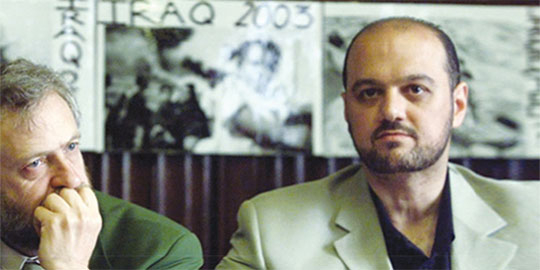
Anas Altikriti (right) with Jeremy Corbyn at an anti-war event in 2003: Altikriti has said that Iraqis had the right to expel the "occupation" (©Sean Dempsey/PA Archive/Press Association Images)
The tone was plaintive, almost bewildered. "We work tirelessly for the good of British society on several fronts," Anas Altikriti protested before calling a press conference to refute the government's charge that he and other like-minded Muslim leaders are doing the opposite.
A classified government review by two of Britain's leading civil servants, expert in the Arab world and Islamist ideology, has concluded that organisations like the one Altikriti heads are, in effect, fronts for the Muslim Brotherhood — a charge they categorically deny.
The Ikhwan al-Muslimeen, as it is known in Arabic, was established in 1928 in Egypt and its goal was — and remains — the step-by-step Islamisation of Muslim communities with the ultimate aim of creating a global Caliphate ruled by holy law. "Allah is our objective" is the Brotherhood's motto, "The Prophet is our leader. The Koran is our constitution. Jihad is our way. Dying in the way of Allah is our highest hope."
With Altikriti on the platform was Omer El-Hamdoon, president of the Muslim Association of Britain, and Mohammed Kozbar, chairman of the Finsbury Park Mosque, North London, where the press conference was held. "We are not enemies of the state," said the gently-spoken Hamdoon. All three say they "totally reject the allegation" that they are "in any way linked to the Muslim Brotherhood".
Altikriti, in particular, has emphasised that he has "absolutely no links" and on its face his denial would seem to be consistent with the values of "tolerance" and "positive co-existence" which he says he is devoted to promoting. It's certainly a vision a world away from the Brotherhood's founder, Hassan al-Banna, who sought the moral purification of Muslims, because he regarded them as having been infected by Western decadence. That and his belief that Jews were a major source of the infection help explain why he was an admirer of Hitler and why he translated Mein Kampf into Arabic, calling it My Jihad.
Al-Banna's legacy has bequeathed a virulent strain of anti-Semitism, homophobia, and disdain for the West and its pluralist values within the Brotherhood that survives to the present day. But no hint of that is to be found in the estimable "Vision" and "Values" section of Altikriti's think-tank, the Cordoba Foundation, which he established so that Muslims and non-Muslims can "strive" to "understand each other."
The Cordoba Foundation says it promotes "intercultural dialogue and positive coexistence among civilisations"; it puts a premium on "compassion, peace, justice" and is a "strong voice of tolerance and reason". It asserts that its "independent" research is underpinned by "sound" academic authorities. What could be more in tune with those British values which the Prime Minister has done so much to promote over the last year as part of his counter-extremism strategy?
Nothing, according to Mohammed Kozbar, sitting alongside Altikriti. With the help of the Metropolitan Police, the Finsbury Park mosque was "liberated" in 2005 by Kozbar and his fellow trustees from the hook-handed demagogue Abu Hamza, now serving life in an American jail. Today, says Kozbar, the mosque serves as a "role model to other mosques and community centres". In fact, he says, his mosque, together with the Muslim Association of Britain and "similar Muslim organisations", could "teach" David Cameron "a thing or two about British values".
Really? It is true the Finsbury Park mosque does good by offering hot meals to the homeless. But since its "liberation" it might also benefit from a few lessons in British values. It has hosted speakers who are on the record as having said they were inspired by the books of Hassan al-Banna and by the Brotherhood's spiritual leader, Sheikh Yusuf Qaradawi, who in 2009 thanked Hitler for having "managed to put Jews in their place". Another speaker hosted by the mosque has described Jews as having "no conscience" and "having all the bad qualities: lies, jealousy, treachery, cowardice, aggression"; another has argued that apostates from Islam must be killed; and yet another has said, "We don't need to go to the Christians, or the Jews, debating with them about the filth which they believe."
You only have to imagine what — rightly — would be the reaction had Cameron ever shared a platform with people who spoke of Muslims in such a venomous way.
The mosque's trustees are also happy to be photographed with Hamas leaders in Gaza. Indeed, one of the trustees is himself a fugitive Hamas commander. Like some other Muslim Brothers, he appears to use London as a base from which to travel to the Middle East to promote the movement — even though Hamas's military wing has been designated a terrorist organisation here and elsewhere because it has deliberately targeted unarmed civilians. Hamas is, of course, the Palestinian branch of the Brotherhood.
The government review of the Muslim Brotherhood was conducted by Sir John Jenkins, until recently ambassador to Saudi Arabia, and Charles Farr, a former MI6 officer and Director General of the Office for Security and Counter-Terrorism in the Home Office. He now chairs the Joint Intelligence Committee. Jenkins examined the development, ideology and structures of the Muslim Brotherhood around the world, from when it was established to the present day. Farr investigated the Brotherhood's network in the UK.
The Brotherhood is now banned in Egypt, the Emirates and Saudi Arabia, and in commissioning his review, Cameron has been accused by Altikriti, Kozbar and el-Hamdoon of bowing to those states under threat of losing defence contracts. In truth, the Prime Minister had become increasingly concerned that the Brotherhood's network here, whilst not engaging in violent extremism, was helping to create the conditions that allowed it to flourish.
Altikriti and his colleagues say the opposite is true and that Jenkins and Farr's work is "filled with mistakes". Is it? What about their categorical denial that they are not linked "in any way" to the Brotherhood?
The published summary of the classified review finds that much about the Brotherhood's UK network of associates and affiliates "remains secretive, including membership, fundraising and educational programmes". Perhaps that is why Jenkins and Farr are careful to refer to "organisations associated (my emphasis) with the Muslim Brotherhood".
Judged by this criteria the associations are numerous. The Egyptian Brotherhood has morphed into a global movement of like-minded organisations, often interconnected. Hence Mohammed Kozbar's Finsbury Park Mosque is identified by a Muslim directory as being "Salafai Ikhwan" (Brotherhood) and he is also a vice-president of the Muslim Association of Britain (MAB). Altikriti was MAB president (2003-04), and he and Mohammed Kozbar were directors (2000-2007).
MAB was established in 1997, its founding president having previously been the Brotherhood's official spokesman in the West. In September 2002, MAB published a paper called "Inspire" which explained how MAB had indeed been Brotherhood-inspired. Virtually all of the modern influences quoted were Muslim Brotherhood leaders and ideologues. In 2002, MAB paid its condolences on the death of the "General Guide to Muslim Brotherhood", Mustafa Mashoor, and did so again in 2004 on the death of his successor, Mamun al-Hudaybi.
An archived link from MAB's 2004 website identified some of the "links" that Altikriti today insists do not exist. MAB said then that "amongst its members are those who back in their original countries were members of the Muslim Brotherhood."
In 2005, Altikriti himself told me: "My family is Muslim Brotherhood." His family are from Iraq and his father, a consultant radiologist, was head of the Muslim Brotherhood there. "When I was in the Arab Emirates, I was extremely closely linked with the Muslim Brotherhood," he explained. "I used to go to some of their (study) circles." At a conference in Doha in 2010, Altikriti was listed as representing the Islamic party in Iraq which he himself has described as a Muslim Brotherhood "offshoot".
I count at least 30 Islamic organisations in Britain that are closely associated with the Brotherhood. Broadly, they seek to popularise a more "ideologised" version of Islam (as the theologian Malise Ruthven puts it) by monopolising political representation of Muslims in Britain. They want the government to adopt a more Islamist-friendly foreign policy, and of course to expand politicised sacred space. Even though Brotherhood-associated organisations actually control only a handful of mosques, their political activism has exerted an influence over Muslims disproportionate to their size.
Here, for example, is "Jemal", MAB's delegate to a Stop the War Coalition conference, who told the British Communist Party journal Weekly Worker in 2003 that many Muslim organisations here had been "set up under the influence of the ideology of the Muslim Brotherhood . . . we have gone from strength to strength." A decade later, Altikriti was asked in an interview published by his own Cordoba Foundation to identify the "most important Muslim Brotherhood institutions that had an influence on the Muslim community in Britain".
Altikriti responded by naming ten organisations, including six mentioned in the government review — another "mistake" by Messrs. Jenkins and Farr: UK Islamic Mission (UKIM); Federation of Student Islamic Societies (FOSIS); Islamic Society of Britain (ISB); Islamic Forum of Europe (IFE); Muslim Association of Britain (MAB); and Muslim Council of Britain (MCB). As the review says, the ISB has been inching away from its Brotherhood birthright and seems to be focused on promoting an identity that's closer to the mainstream. Its activist erstwhile brothers meanwhile claim it is they who represent "normative" Islam. If they are right, we're in trouble.
Take UKIM which runs some 50 mosques. Jenkins and Farr say UKIM "still explicitly argues that it is not possible for an observant Muslim to live under a non-Islamic system of government whilst also anticipating the forthcoming 'victory' of Islam over Communism, capitalist democracy and secular materialism". UKIM was established by supporters of the Brotherhood's south-east Asia counterpart, the Pakistani Islamist party, Jamaat-e-Islami, whose members sheltered some notable al-Qaeda terrorists, including the 9/11 architect Khalid Sheikh Mohammed. UKIM insists it has "strongly condemned all forms of extremism" but it is clear, if only in terms of UKIM's worldview, that its definition of "extreme" cannot be reconciled with mainstream Britain's.
What about the influence of the Islamic Forum for Europe (IFE)? It dominates the East London Mosque in Tower Hamlets. Like the Finsbury Park Mosque, its volunteers do good community work offering advice on marriages, families, women's services, pro-bono legal support, and ex-offender support, though why such services for Muslims have to be provided by Muslims is unclear if, as the mosque says, promoting community cohesion is its "mission". Under the IFE's influence, the mosque has also transformed large parts of the East End into communities that are so conservative in lifestyle and attire that they have effectively segregated themselves from any meaningful social interaction with the mainstream. IFE members have privately advocated sharia law and it was also the IFE which propelled Britain's first directly-elected Asian mayor, Lutfur Rahman, into power in Tower Hamlets, only for one court to find that he was corrupt, a liar, a politician who played the race and religious card, and an election cheat and now for another court to find he has been a long-standing tax cheat. Yet Altikriti is on record as having said that since its arrival in the UK the Brotherhood has cultivated a "comparatively progressive narrative" here, and is "amongst the most progressive . . . religious- based movements in general".
Again, the government review finds otherwise, concluding that MAB — and other Brotherhood associated organisations — have yet to "clearly and publicly promote a vision of Muslims living in this country as integrated British citizens".
What is stopping this vision from materialising? The review found the Brotherhood was more focused on trying to Islamise individuals and the Muslim community than the state. Yet that was also Brotherhood founder Hassan al-Banna's strategy as he sought to change Islam, the faith, into a political ideology by Islamising individuals as a first step towards creating Islamised communities with the ultimate political goal of building a caliphate with laws, customs and lifestyles organised entirely around Islam.
However fantastical this might seem, many observant Muslims dream that one day, albeit in the far-distant future, not just Britain, but the entire world will became a caliphate. Altikriti is no exception, as he explained to me in 2005:
JW: You have this firm conviction that one day there . . . will be an Islamic state here in Britain?
AA: The Prophecy of the Prophet Muhammad is quite clear of that: and that is that the world will embrace Islam . . .
JW: How will this happen?
AA: I have no idea.
JW: I don't mean this pejoratively but is this something you are working for?
AA: No, I would be absolutely lying if I said, "Yes, in my daily activities and when I work for MAB [Muslim Association of Britain] . . . I had in mind that I'm trying to bring forth the conversion of Europe to Islam," I would be lying if I said so. But at the same time I would also lying if I said I'm not convinced in my heart of hearts that it will happen . . . I know for a fact that this will happen in spite of me whether I work for it or not.
So if Altikriti is not working towards this global transformation, what exactly is he doing? "The only obligation that I have is what I call Da'wah," he explained, which is the Arabic term for proselytising, or inviting people to Islam. And, according to the scholar often referred to as the Brotherhood's spiritual leader, Sheikh Yusuf Qaradawi, Da'wah is what will lead to Islam coming "back to Europe for the third time, after it was expelled from it twice . . . Conquest through Da'wah that is what we hope for. We will conquer Europe, we will conquer America! Not through sword but through Da'wah." It's a point the Sheikh has made many times.
One thing seems clear: whether the Brotherhood is actively seeking to lay the groundwork for a caliphate, the amount of politicised sacred space has expanded rapidly here in Britain as in much of the world since the Egyptian Brotherhood's influence has gone global. It is why this "ideologised" version of Islam is someties referred to as history's latest big idea since the fall of Communism and fascism. So where does the Brotherhood stand on violence?
The Egyptian Brotherhood told Sir John Jenkins it had "consistently adhered to peaceful means of opposition, renouncing all forms of violence throughout its existence." Again, he finds otherwise. While engaging politically where possible, Sir John says the Brotherhood has "also selectively used violence and sometimes terror in pursuit of their institutional goals". Brotherhood-linked media platforms "seem to have deliberately incited violence" after the ousting in 2013 by a military coup of the Brotherhood's first Egyptian president Mohamed Morsi because he failed to deliver his commitment to democracy, notwithstanding Altikriti's claim that the Brotherhood is the world's "most important Islamic democratic force". The review also found that the Brotherhood has "deliberately, wittingly and openly incubated and sustained" Hamas, the Brotherhood's Palestinian branch.
Altikriti, his two colleagues on the press platform and other Brotherhood-associated organisations have roundly condemned terrorist attacks on the UK and terrorism by al-Qaeda and so called Islamic State abroad.
But some of Altikriti's associates here have also openly applauded attacks by Hamas against unarmed Israeli civilians, including suicide bombings. Nor has Altikriti publicly disowned Hamas, which he does not regard as a terrorist organisation anyway, although he has said he does not consider Israeli civilians to be legitimate targets.
However, when interviewed by the BBC in 2014, Altikriti denied that the Brotherhood's spiritual leader Sheikh Yusuf Qaradawi supported suicide bombing, insisting he knew of no evidence that Qaradawi did, even though the cleric has been very widely publicised as saying he considers them to be "heroic acts. We should hail those who carry out these acts and bless them and call on God to take them to live in Paradise." Altikriti's claim to have been ignorant of Qaradawi's blessing is especially bewildering because it was his organisation, MAB, in 2004 — the year he was also MAB president — that invited Qaradawi to London amid a storm of protest in the newspapers and on the BBC about this very issue. Moreover, Altikriti was photographed sitting next to Qaradawi at a reception at City Hall, London, hosted by the then mayor, Ken Livingstone. Usama Hasan, now senior researcher at the Quilliam Foundation, says he was present at the reception and heard Qaradawi asked about women and children as targets. According to Hasan, Qaradawi replied in Arabic that there was no such thing as civilian targets in Israel because "Israeli women are not like our women. They are living in a militarised society." Altikriti is fluent in Arabic.
What about Altikriti's approach to the Iraq and Afghanistan wars? He is an Iraqi-born British citizen, having been given sanctuary here when he was just two, after his father fled from Ba'athist persecution in Iraq.
Some 630 of Altikriti's fellow citizens — British soldiers — have fought and died in Iraq and Afghanistan since 2002. Like many Muslims and non-Muslims he was opposed to both wars. He said he preferred political rather than violent "resistance" because he didn't want to see "any spillage of blood — coalition forces or the Iraqis". Yet he also affirmed the right of Iraqis to use "any means and methods" to expel the "occupation". Those, like him, who were opposed to the invasion had "made a decision to fight for what is true and pure".(That word "pure" again.) Is it really so difficult for Altikriti and the thousands of other Brotherhood followers in this country to understand that it is one thing to see the invasion through the eyes of Iraqis resisting it, but quite another to publicly support them when the lives of your fellow citizens are at stake — especially when those fellow citizens belong to a country that protected your family from Iraqi oppression in the first place?
To convince sceptics that the Brotherhood alligned movement here is "working tirelessly for the good of British society on several fronts" Anas Altikriti and Kozbar will need to reconcile their admirable rhetoric — how they strive for positive coexistence, tolerance, peace, compassion and justice, etc — with the words and actions of the organisation they led between 2000 and 2007: the Muslim Association of Britain. While condemning al-Qaeda attacks like 9/11 and 7/7, some of MAB's actions and rhetoric directed at the Israel-Palestine conflict were particularly inflammatory and contributed to keeping young British Muslims angry.
On April 13, 2002, MAB organised a pro-Palestinian rally in London. The MAB email advertising this rally was headlined "Muslim Brotherhood launch biggest Palestine rally in the UK", clearly indicating the MAB/Muslim Brotherhood connection that Altikriti has denied. At the rally itself, demonstrators dressed as suicide bombers and carried placards, downloaded from the MAB website, equating Israel with Nazi Germany.
In 2003, a MAB spokesman, Azzam Tamimi (whom Altikriti told me was almost certainly a Muslim Brother), wrote an article titled "Anti-Semitism or Just Jews Behaving Badly?" So carried away was Tamimi by his accusations of racism against Israelis, that his own language descended into racism, going well beyond legitimate criticism of Israel and its policies.
Israeli Jews were described as "invaders" that came from afar "out of greed . . . justifying their aggression by . . . claiming themselves to be the chosen people of God who are given a divine licence to dehumanise, kill and rob and [sic] entire nation of a decent living".
The article concluded: "Few humans may accept the racist claim of other humans of being God's chosen ones who may kill others because they are less divine . . . Until when will the world be able to put up with their arrogance and aggression? If they want to be as human as anybody else, Jews must wake up before it is too late."
No doubt Tamimi would say that his hostility to Israelis was not because they are Jews. The same defence was made by the Brotherhood's ex-President of Egypt Mohamed Morsi in 2013 to six American senators who questioned him about a ranting speech in which he urged Egyptians to "nurse our children and our grandchildren on hatred" for Jews and Zionists. In a later interview Morsi described Zionists as "these bloodsuckers who attack the Palestinians, these warmongers, the descendants of apes and pigs". While confining his comments to "Zionists" and never explicitly mentioning Jews, his tirade nonetheless invoked an anti-Semitic theme common in the Middle East about malevolent Jews exercising demonic power: "They have been fanning the flames of civil strife wherever they were throughout their history. They are hostile by nature."
As the government review found, senior members of the Brotherhood "routinely use virulent, anti-Semitic language", which is a core motivator of violent extremism. And the truth is their language goes well beyond Israel. The view that Jews are intrinsically evil was developed in prose reminiscent of the Nazis by a Muslim Brother revered on MAB's website as the "doyen" of the Brotherhood, Sayyid Qutb. Echoing al-Banna, Qutb extolled the Islamic virtue of extreme purity defiled by Jewish "filth" just a few years after the Holocaust. In an essay entitled "Our Struggle With the Jews" he wrote:
Free the sensual desires from their restraints and they destroy the moral foundation on which the pure Creed rests, in order that the Creed should fall into the filth which they spread so widely on the earth. They mutilate the whole of history and falsify it. . . . From such creatures who kill, massacre and defame prophets one can only expect the spilling of human blood and dirty means which would further their machinations and evil.
MAB's attempt to mitigate Qutb's diatribe because he wrote it during Israel's 1948 War of Independence with the Arabs doesn't wash. He said Islam's struggle with Jews had raged for 1400 years and described them as "ungrateful" by nature, "narrowly selfish" and "fanatical". Their disposition prevented them from feeling "the larger human connection which binds humanity together".
This is just a flavour of Qutb's mendacity. Yet it was under Altikriti's presidency of MAB with Kozbar serving as MAB director that Qutb was lionised on MAB's website as the "doyen" of the Muslim Brotherhood. I don't suggest Qutb reflects either man's views of Jews for I know of no Qutb-like reference by them to Jews. But when a journalist challenged MAB in 2004 about its reverence for Qutb, the best MAB could do was to suggest that his "Zionist ex Mossad friends" had misled him.
In the 2013 interview Altikriti granted to his own Cordoba Foundation, he was asked if he thought "the Muslim Brotherhood, since its arrival in the UK . . . had an intellectual effect on the Muslim community in Britain?" He replied: "Undoubtedly so." He is right — but not in the virtuous way he intended. Brotherhood ideology has also been the intellectual inspiration behind those violent Islamist groups that have appealed to thousands of British Muslims. No one more so than Sayyid Qutb.
Qutb drew on the thoughts of another MAB website poster boy, the Indian Islamist theologian Abul Ala'a Mawdudi, who founded Jamaat-e-Islami, to promote the doctrine of takfirism. This is the practice used by extremists to stigmatise other Muslims as "impure" infidels or apostates, and of Muslim states as "unislamic." Takfir is the war cry of groups like al-Qaeda and Islamic State to murder other Muslims in Iraq, Syria, Libya, Afghanistan and elsewhere in the most bestial ways imaginable in pursuit of the perfect Islamic society. Like these groups, Qutb was viscerally anti-Western, with a psychotic loathing of its "decadent" and materialistic ways (triggered by sights like Americans dancing cheek-to-cheek and their neatly mown lawns),
Qutb is now widely recognised as the father of modern jihadism because he decided it was going to take more than just Da'wah (preaching) to establish the kingdom of God on earth. He argued that a revolutionary vanguard should establish an Islamic state and then impose Islamisation, first on Arabs, then the rest. Ring any bells? It's why Islamic State today quotes Sayyid Qutb so heavily in its public discourse.
When I listen to the current MAB president Omer El-Hamdoon — who is also an imam — castigating with such passion and conviction the "ignorance" and "arrogance" and "warped mentality" of the "savages" of Islamic State, I wonder if he links it back to the Brotherhood's ideologue whom his organisation so publicly admired just a few years ago. It's a fair question because, beyond MAB's muted qualifier that some scholars disagreed with Qutb "on a number of issues", British-based Brotherhood organisations and associates have not openly or consistently refuted the poison he wrote. But then according to Altikriti, there is no need. "If anything," he says "the Muslim Brotherhood and their ideas has (sic) constantly, constantly, without fail, been the very antithesis of the ideology of the likes of al-Qaeda."
Yet Qutb was held up by MAB as a supremely moral being for having "opened his eyes to the malaise of the Western culture and non-Islamic ideologies". He made a "clear distinction between pure faith and association of partners (shirk)" which bluntly means venerating anything other than God.
At its most extreme, this obsession with purifying the Islamic faith is what also drives Islamic State to kill everything it deems to be impure and is why the mere mention of purity by Islamists sends a Nuremberg-like shudder down my spine, though not, apparently, the spines of many on the Left nor even some conservatives. The commentator Peter Oborne considers the Brotherhood to be "a great political movement — not just in Egypt". He says he has "seen no evidence of any kind of Muslim Brotherhood terrorism . . . I've looked into it." But then so have two of Britain's most senior and expert civil servants with access to Muslim Brother leaders, British embassies around the world, and intelligence from MI5 and MI6 that presumably Oborne did not have. Given violent jihadism's inheritance from Brotherhood ideology, there is nothing "phobic" about this apprehension. It is rational.
Anas Altikriti and his Cordoba Foundation can talk all the grandiloquent talk they like about "believing" in a "world full of hope" where "opposing ideas are working together, enriching our understanding of each other; strengthening our humanity without seeing its end in a grand clash".
But until they can reconcile the resounding clash between their enlightened rhetoric and their blind eye to the Brotherhood's regressive ways, sceptics will continue to question whether the change is real or tactical. Clearly Jenkins and Farr have yet to be convinced. Brotherhood literature here, they say, still casts "Western society" as "inherently hostile to Muslim faith and interests and that Muslims must respond by maintaining their distance and autonomy".
British society is not inherently "hostile" to Muslims nor ever has been. More than three million Muslims have made their home here and their numbers are growing rapidly. British Muslims are a fact of life. Non-Muslims are crying out for their fellow Muslim citizens to close that distance by articulating a set of values around which a meaningful common life can be built. Until then, the Brotherhood's British network that claims to speak for "normative" Islam will continue, as the review says, to be regarded as operating "contrary to our national interests and our national security."
The IPT accepts no funding from outside the United States, or from any governmental agency or political or religious institutions. Your support of The Investigative Project on Terrorism is critical in winning a battle we cannot afford to lose. All donations are tax-deductible. Click here to donate online. The Investigative Project on Terrorism Foundation is a recognized 501(c)3 organization.  

202-363-8602 - main
202-966-5191 - fax

The Long War Journal (Site-Wide)


The Long War Journal (Site-Wide)


Posted: 02 Mar 2016 09:45 AM PST
In a letter written sometime in 2010 to al Qaeda's leadership, AQAP emir Nasir al Wuhayshi detailed the areas in Yemen where the group had significant influence. AQAP took control of many of these areas in a 2011 offensive.

Police need bullet proof station in crime-ridden Muslim majority Malmo, Sweden

Special report: Inside Muslim majority neighborhoods of Malmo, Sweden