Take note, those of you who want to see real
women freedom-fighters. Look into the streets of Iran or listen to the
chess champion Anna Muzychuk.
Iranian women, by risking their lives, have unmasked the faces of
those trying to promote burqas and hijabs as supposed "symbols of
liberation".
The desperate attempt of Iranian people pouring out onto the streets
against the Islamist regime exposes the bitter life that Iran's
citizens, especially women, have been forced to live for nearly forty
years in the name of Islamic law, (sharia).
These demonstrations have also shown the ugly face of Islamists who
take their own people hostage to quench their thirst for power -- by
repression, jail, torture, executions -- any way they can.
Iranian women, like many others, are sick and tired of living in layers upon layers of imprisonment.
The regime in Iran clearly feels shaken by the resolve of these protestors: Iran's leaders have
promised to soften their misogynistic laws by not imprisoning women in Tehran who appear in public without their veils on.
The protesters, however, do not seem to be buying this offer: they
are seeking the full elimination of extremism in the country. There is
clearly no more trust in the promises of this regime.
The skeptics, in fact, are right. There is a
catch.
Although the regime announced that it would not arrest women who set
aside Iran's strict dress code, the regime also stated that these women
would have to attend special "morality classes" by the sharia police.
Now why would a regime want that? Could it be so that the regime can document these women to keep a watch on them?
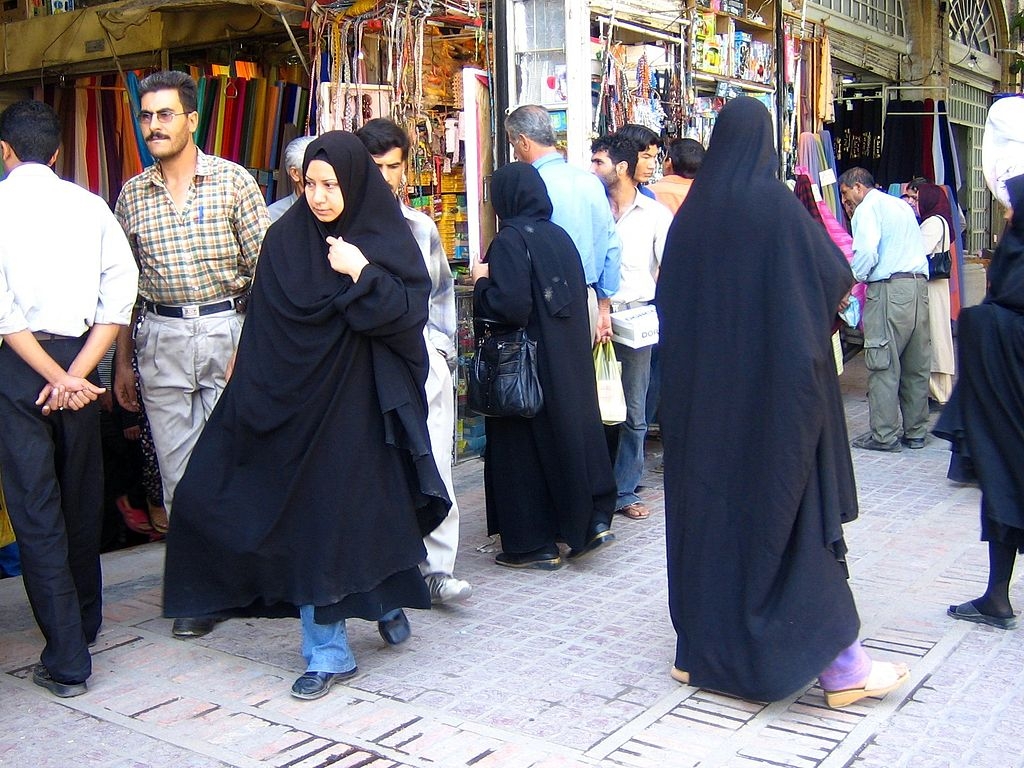
Iran's
leaders have promised to soften their misogynistic laws by not
imprisoning women who appear in public without their veils on. Instead,
the "offenders" would have to attend special "morality classes" by the
sharia police. (Image source: Wikimedia Commons)
|
The shackles Iranians are trying to break are exactly the same ones that organizations such as
CAIR, and cohorts of Islamist regimes such as
Linda Sarsour, have been trying to sell to the Western public as symbols of "fashion" and "liberation".
Such apologists simply serve as mouthpieces for these extremist regimes, which not only
enslave
their own people but also distort the economic and intellectual
development of their people through a mindset of supremacy and hatred
throughout global arena.
When the organizers of the Women's March in the U.S. cherry-picked
"abuses," they left a vast number of women behind, unnoticed and
unwelcome, who have been subjected to inhuman treatment for centuries.
These so-called "liberators" of Muslim women actually do enormous
harm to women trapped in totalitarian societies, such as Iran and Saudi
Arabia. In the name of Islamic law (sharia), these theocracies simply
impose anti-woman rules.
We seldom meet the truly heroic women activists, such as the
Ukrainian chess grandmaster, Anna Muzychuk.
She blew away the bubble created by the women marchers who were
promoting wearing the hijab: she refused to participate in a tournament
in Saudi Arabia because of its mistreatment of women:
"Exactly one year ago, I won these two titles and was
about the happiest person in the chess world but this time I feel really
bad. I am ready to stand for my principles and skip the event, where in
five days I was expected to earn more than I do in a dozen of events
combined."
The courage expressed by Ms. Muzychuk is a rebuttal to religiously
conservative societies regarding the bitter reality they inflict. It
cannot be whitewashed away by pretty words, greedy purveyors of
clothing, or disingenuous speeches.
In her refusal to submit to the demands of Muslim extremists, this
brave chess player has shown more about activism for real women's rights
in 2017 than everyone else combined.
Most Muslim women, wherever they live, have to go through hell even
to win a tiny bit of equality, freedom or respect from their own
societies. They are subjected to harshly discriminatory legal and
financial laws. They are officially worth, for example, "half the value
of a man" if they testify in court (
Qur'an 2:282; Sahih International) or in inheritance (
Quran 4:11; Sahih International). They are often coerced into polygamy as one of up to
four wives, and can be "triple-
talaq" divorced by being told "I divorce you" three times (
Quran, 2:222-286). They also may be married off as
prepubescent girls,
and stoned to death as "adulteresses" if they have been raped, unless
four male witnesses to the incident testify to the contrary in court
(how likely is that?).
Such laws merely serve the interests Islamist spin-doctors and other
extremist Muslims, by advancing their sharia-inspired agendas in the
West.
The "women's rights" marchers in the West
defended wearing the hijab while ignoring the daily abuse of Muslim women, such as
honor killings, male guardianship,
forced marriages, prevalence of
female genital mutilation (FGM), abuse of women by religious institutions such as
Sharia councils, so popular in the UK, and sham practices such as
halala.
Due to the rigid and never-changing norms of Muslim societies, these
women have been denied their basic rights to self-determination and a
free life.
The world should be supporting the struggle of Iranian protesters in
their courage to challenge these extremist Muslims up front.
The people of Iran, unlike their counterparts in
Egypt and
Libya, are
trying to get rid of a rigid, totalitarian theocracy and replace it with a democracy.
For countless women in religiously conservative societies, freedom
still remains a dream. It is high time for the world to start tackling
the real issues of women's rights head-on.
Khadija Khan is a Pakistani journalist and commentator, currently based in Germany.









 Posts


