Thursday, May 1, 2014

Eye on Iran: Iran Terror Network Prolific, US Report Says



Join UANI  
 Like us on Facebook Follow us on Twitter View our videos on YouTube
   
Top Stories

JPost: "Iran continues to arm and finance a terrorist network that extends from South Asia to the Horn of Africa, from Iraq to Yemen, and across the Palestinian territories, the US State Department reported on Wednesday, acknowledging US willingness to nevertheless engage directly in talks with the state over its nuclear program. Much of the report, released annually by the State Department to outline threats of terrorism around the world, focuses on Iran's expansive efforts to fund and funnel arms to Islamist organizations, including Hamas in Gaza and Hezbollah, which is based in Lebanon but operates worldwide. 'Iran has historically provided weapons, training, and funding to Hamas and other Palestinian terrorist groups,' the report details, 'although Hamas's ties to Tehran have been strained due to the Syrian civil war.' In its efforts to bolster Hezbollah, Iran considers Syria 'a crucial causeway in its weapons supply route' and has taken an active role in supporting embattled Syrian President Bashar Assad, the US report claims." http://t.uani.com/1kmlttW

Fars News (Iran): "A prominent Iranian legislator deplored the recent sanctions by the US treasury against several companies and individuals who have worked with Iran as a puzzle designed by the Zionist lobby to make idle the ongoing talks between Tehran and the six world powers (the US, Russia, China, France and Britain plus Germany). The remarks by Rapporteur of the parliament's National Security and Foreign Policy Commission Seyed Hossein Naqavi Hosseini came after the US Treasury on Tuesday in a statement added several people and companies to its sanction list for their cooperation with the Iranian government. 'The US Treasury's addition of the names of several people and companies to the sanctions list is part of a Zionist puzzle to make the negotiations between Iran and G5+1 fruitless,' Naqavi Hosseini said. The senior lawmaker noted the G5+1 intends to leave the negotiating table through such negative moves, and a puzzle with many different parts has been designed by Israel to this end... 'The Zionists and the westerners know that they will not gain anything in the talks, because the Islamic Republic of Iran will not withdraw from its inalienable right and Iran's negotiating team does not have the right and authority to cross Iran's redlines by any means,' he added." http://t.uani.com/1u8M8m4

VICE: "A woman in Iran faces public execution for that most heinous of crimes: defending herself against a rapist. Rayhaneh Jabbari, a 26-year-old from Tehran, was scheduled to be hanged two weeks ago for killing her attacker in self-defense. However, after pressure from Iranian human rights groups, the Supreme Court is now reviewing her case for a second time.  Rayhaneh, who was an interior decorator before her arrest, was 19 when Morteza Abdolali Sarbandi-a former intelligence officer and, at the time, a high-ranking member of Iran's government-invited her to his home to discuss a decorating job. When she arrived, she was offered a fruit juice, which forensics later confirmed contained sedatives, that she refused to drink. After blocking a number of aggressive sexual advances, she took a knife from her bag and stabbed Sarbandi in the shoulder in an 'act of self-defense.' Her attacker died from blood loss." http://t.uani.com/1kr0Q0U
       
Nuclear Program & Negotiations

Reuters: "Senior diplomats from six world powers met in Brussels on Wednesday to fine-tune negotiating strategy towards Iran with talks on its contested nuclear program entering a crunch stretch before a July 20 deadline... Diplomats have signaled some progress may have been made during three rounds of talks since February on one of the most thorny issues - the future of Iran's planned Arak heavy-water reactor, which Western states worry could prove a source of plutonium for nuclear bombs once operational. But talks so far have made no headway on other major issues, with the sides laying out their broad positions rather than negotiating solutions. Western diplomats warn that gaps between the two sides remain significant and possibly insurmountable. The six nations now must decide what they want to achieve specifically in the next three months to allay their concerns that Iranian nuclear work has underlying military purposes." http://t.uani.com/1rSdJ96

Sanctions Relief

WSJ: "As the U.S. on Tuesday targeted a Chinese businessman accused of selling missile parts to Iran, it also quietly lifted sanctions from a Greek shipping company it said last year had helped conceal Iranian oil sales. The U.S. Treasury Department said in a notice filed by its Office of Foreign Assets Control that it removed sanctions from Libra Shipping, a company based in the suburbs of Athens. Treasury said in March 2013, when it designated the company for sanctions, that Libra Shipping operated vessels bought by Dmitri Cambis, a Greek businessman it targeted for helping Iran evade international oil sanctions. A Treasury spokeswoman said OFAC removed sanctions only from Libra Shipping, 'based on a determination... that circumstances no longer warrant' its blacklisting. '[Mr.] Cambis, as well as other entities and vessels previously blocked in connection with [Mr.] Cambis, remain blocked,' she said, without commenting further." http://t.uani.com/1rQZx01

Trend: "Iran plans to supply 4 million tons of fuel to ships sailing through its neighboring seas in the current Iranian solar year, which began on March 21, 2014. Managing director of the National Iranian Oil Products Distribution Company, Mostafa Kashkouli said some 2.85 million tons of fuel oil were supplied to ships in the past year, Iran's Shana news agency reported on April 30. Supplying fuel oil and gas oil increased by 31 percent and 7 percent, respectively, compared to the year ended in March 2013, he noted. The value of the supplied fuel amounted to $1.5 billion, he added." http://t.uani.com/1mhmAC7

Fars News (Iran): "Iran and Italy have decided to increase the number of their direct flights, a senior aviation official announced on Wednesday. 'We plan to increase the number of flights (between the two countries) by singing a memorandum of understanding (MoU) in the near future,' Deputy Head of Iran's Civil Aviation Organization Mohammad Khodakarami told reporters on Wednesday. He noted that there are currently six weekly flights underway between Iran and Italy. 'A more suitable atmosphere will be created for the operation of the two countries' airlines through updating the air transportation MoU between Iran and Italy in the near future,' Khodakarami said. He recalled that a meeting attended by high-ranking officials of Alitalia Airline, Italian Embassy officials and officials of Iran's Civil Aviation Organization was held to facilitate aviation cooperation between the two countries." http://t.uani.com/1n1YQl3

Sanctions Enforcement & Impact

The National: "Shipping volumes from Iran at Dubai's Jebel Ali Port fell by 300,000 standard container units last year as a result of fresh sanctions imposed on Iran, according to the port's operator. That is equivalent to 16 of the world's largest container ships... 'It took the June [2012] round of sanctions from the US and the EU to really choke trade off in Iran, which fell precipitously,' said Bryan Plamondon, a senior economist for the Middle East at IHS.  Before this, Jebel Ali and Dubai were conducting a busy trade in so-called 'roll-on roll-off' cargo, in which vehicles make one leg of a journey by sea, with 50 per cent of Jebel Ali's roll-on roll-off traffic destined for Iran. 'On the basis of [roll-on roll-off cargo], Dubai is the gateway to Iran,' said Dalibor Gogic, a maritime analyst at IHS." http://t.uani.com/R26XQX

Trend: "Since the pull out of giant gas companies from Iran following the US-engineered sanctions, Chinese firms such as SINOPEC, SINOC, and CNPCI managed to sign over 10 major oil and gas contracts, worth some $40 billion, to develop Iranian fields. The contracts were all signed during the eight-year presidency of Iran's former president Mahmoud Ahmadinejad. North Azadegan, South Azadegan, Yadavaran, South Pars gas field's Phase 11, a liquid gas (LPG) production unit, and North Pars development plan were among the mentioned projects. None them have come on stream so far. Iran cancelled its contract for development of North Pars gas field with CNPCI in September 2011. A year later, it also cancelled the contract for development of South Pars gas field's Phase 11 with the same company. The country also cancelled its contract for construction of a 10-million ton LPG production unit with a consortium of Chinese companies in November 2011. Iran signed a 2-billion dollar contract for development of Yadavaran field with SINOPEC Company in December 2007. The Chinese firm was supposed to double the field's output to 50,000 barrels of oil per day by 2013, but it has failed to meet its obligations so far." http://t.uani.com/1kvsmw1

Terrorism

AFP: "Iran rejected an annual US report that keeps Tehran on a list of state sponsors of terrorism as reflecting double standards, media reports said Thursday. The foreign ministry was reacting to a State Department report released Wednesday that kept Cuba, Iran, Syria and Sudan on its list of so-called state sponsors of terrorism. The report also highlighted what it said was Iran's role in supporting and funding the regime of President Bashar al-Assad in its fight against Syrian rebels. 'Accusing Iran of supporting terrorism is politicised and based on double standards,' ministry spokeswoman Marzieh Afkham said in a statement reported by the official IRNA news agency. She questioned Washington's anti-terrorism intentions, recalling 'innocent people who fall victim' to US drone attacks in the region as well as 'the turning of a blind eye to Zionist (Israeli) crimes against the Palestinians.'" http://t.uani.com/1ksgtVS

Syria Conflict

WashPost: "The months-long effort to dismantle Syria's chemical weapons program has ground to a halt because Syria is holding on to 27 tons of sarin precursor chemicals as leverage in a dispute with the international community over the future of facilities used to store the deadly agents, according to U.S. officials. Having turned over all but an estimated 8 percent of its chemical arsenal to the Organisation for the Prohibition of Chemical Weapons, Damascus missed a deadline Sunday to relinquish the remnants of its arsenal, which are stored in 16 containers in Damascus, U.S. officials said. The OPCW is insisting that a network of tunnels and buildings that were used to store the weapons must be destroyed. The government of Syrian President Bashar al-Assad has argued that the facilities should be repurposed. 'They're just stalling for time to hold on to some of these facilities,' said a U.S. official familiar with the matter who would discuss the issue only on the condition of anonymity." http://t.uani.com/1fBnFln

Human Rights

FIDH: "On the eve of May 1, 2014, International Workers' Day, the Observatory for the Protection of Human Rights Defenders, an FIDH-OMCT joint programme, is drawing attention to the plight of Iranian trade unionists... On early morning of April 30, 2014, the Iranian authorities detained two trade unionists, Messrs. Jafar Azimzadeh and Jamil Mohammadi, and tried to detain Ms. Parvin Mohammadi. All three are members of the Board of Directors of the Free Union of Iranian Workers. Last year, they organised a petition with 40,000 signatures protesting the worsening conditions of workers and were among the unionists who tried to organise a May 1 demonstration. A number of other unionists were summoned for interrogations last week when they were warned not to go ahead with the May 1 demonstration. Moreover, at least 12 other unionists and labour activists are currently in prison in Iran and a number of others are facing long-term prison sentences merely for trying to organise their colleagues in independent unions." http://t.uani.com/1iLlgnV

IHR: "Three prisoners were hanged in the Vakilabad prison of Mashhad (Northeastern Iran) reported the Iranian daily newspaper Khorasan. According to this report one of the prisoners was hanged on Monday April 28, while the execution of the two other prisoners were carried out on Tuesday April 29. All the prisoners were charged with murder and sentenced to 'qisas' (qesas; retribution in kind)... Three prisoners were hanged in the prison of Bandar Abbas early this morning, May 1., reported the Human Rights Organization of Kurdistan (HRO)." http://t.uani.com/1pShPR2

Domestic Politics

Press TV: "Leader of the Islamic Revolution Ayatollah Seyyed Ali Khamenei says the Islamic Republic's industrial might will make the world's bullying powers respect the nation. Ayatollah Khamenei made the remarks during a visit to MAPNA industrial complex in the city of Karaj ahead of May Day on Wednesday. If 'we stand on our own feet and be strong, they have to respond respectfully and reasonably,' said the Leader, referring to the Western powers. Ayatollah Khamenei emphasized the necessity to depend on the national resolve in an effort to boost the country's economy. MAPNA is an Iranian group of companies active in the fields of construction and installation of energy production machinery. 'We should grow... from within (the country), but... we should (also) be active and influential in global markets,' the Leader added." http://t.uani.com/1fwilQt

Trend: "The Central Bank of Iran announced that the inflation rate for the 12-month period to the first Iranian calendar month of Farvardin (ended on April 20) hit 32.5 percent. The consumer price index (CPI) also stood at 188.5 units in the first month of the current year, which is 0.1 units more than the same month previous year, the IRIB News Agency reported on April 30. The country's point-to-point inflation rate in the mentioned month was 17.4 percent. The point-to-point inflation rate statistics identify the rate of inflation (increase in the of CPI) between distinct points in time, such as inflation rate at the end of a month compared to the inflation rate in the end of same month in the previous year. The Statistical Center of Iran had previously put the mentioned period's inflation at 32.2 percent." http://t.uani.com/1lBb5CE

Trend: "Iran's president has announced that the government spends about $1.4 billion per month on the cash subsidies for citizens. The cash subsidies impose about $392 million (based on the official rate of 25,500 rials per each USD) deficit in budget per month for administration, Hassan Rouhani said in a live TV interview which broadcasted on state TV Channel 1 on April 29. Rouhani went on to say that the administration decided to increase the energy carrier prices to eliminate the negative economic effects of the cash subsidies. The prices increased averagely by 50 percent, Rouhani said, adding that it will not lead to serious increase of other goods' prices." http://t.uani.com/1fuUb8W

Foreign Affairs

Fars News (Iran): "Nicaraguan Foreign Minister Samuel Santos Lopez underscored that Iran's logical and constructive role in the settlement of the regional problem and its eye-catching capabilities in various arenas have persuaded Managua to put expansion of ties with Tehran atop its agenda. Speaking at a meeting with Iranian Parliament Speaker Ali Larijani in Tehran on Tuesday, Lopez underlined the important role of Tehran in the establishment of peace and stability in the region and welcomed promotion of relations in all fields particularly in the field of economy. Lopez arrived in Tehran at the head of a high-ranking delegation on Monday morning." http://t.uani.com/1n6ztfp

Opinion & Analysis

Sohrab Ahmari in WSJ: "For May Day, Iranian Supreme Leader Ali Khamenei's Twitter feed has been featuring photos of the ayatollah visiting a factory and tweets like this one: 'Working & endeavoring are respected by #Islam and Islam's attention to #workers' rights & their high status is based on this lofty outlook.' Those sentiments would be jarring to any Iranians whose attempts at organizing labor have run up against the theocratic regime's hostility to workers' rights. Consider Mansour Osanlou, who in 2005 founded the Islamic Republic's first independent trade union, the Tehran and Suburbs Bus Co. Workers' Syndicate, representing more than 17,000 bus drivers in Iran's capital. He won better wages and working conditions for his drivers, benefits that they retain to this day. But the triumphs came at a terrible price: Mr. Osanlou says he was imprisoned, tortured and lost two family members to the fight. In 2011, he was released on bail from his latest and longest jail term, after which he secretly made his way to Turkey and eventually to America. His story, related to me recently at a Persian restaurant in Manhattan, is worth hearing as a window on America's current negotiating partners. Mr. Osanlou was born in 1960 to a working-class family. His father was a technician at the National Iranian Oil Co. and a union man while the shah reigned. 'My family had a history of labor struggle,' Mr. Osanlou says. The shah's regime at various points repressed and tolerated trade unionism. The revolutionaries who overthrew the shah in 1979 were even less tolerant. The new regime set up 'Islamic workers' councils' to replace existing unions, which were banned. The councils were led by regime agents, Mr. Osanlou says, and their rank-and-file members were street thugs and Khomeini loyalists. During the regime's first decade in power, some 500 trade-union activists were executed... After his general-assembly triumph, Mr. Osanlou says, the regime began punishing him with repeated arrests over the next five years. He spent much of that time in cramped solitary confinement. In the summer of 2009, Iranian security forces briefly detained and beat Mr. Osanlou's daughter-in-law, who was one month pregnant at the time; she miscarried. Last year, Mr. Osanlou's brother, Afshin, also a labor organizer, died of a heart attack while serving a prison sentence issued in 2011 for 'assembling to act against national security.' Meanwhile, Supreme Leader Khamenei tweeted on the eve of May Day: 'The outlook based on conflict b/w #workers & employers is shared both by #Marxism & western ideology. #Islam recommends mutual respect.'" http://t.uani.com/1kvAD2Q

Eye on Iran is a periodic news summary from United Against Nuclear Iran (UANI) a program of the American Coalition Against Nuclear Iran, Inc., a tax-exempt organization under Section 501(c)(3) of the Internal Revenue Code. Eye on Iran is not intended as a comprehensive media clips summary but rather a selection of media elements with discreet analysis in a PDA friendly format. For more information please email Press@UnitedAgainstNuclearIran.com

United Against Nuclear Iran (UANI) is a non-partisan, broad-based coalition that is united in a commitment to prevent Iran from fulfilling its ambition to become a regional super-power possessing nuclear weapons.  UANI is an issue-based coalition in which each coalition member will have its own interests as well as the collective goal of advancing an Iran free of nuclear weapons.

Rashid Khalidi's False Narrative of Israeli History


Campus Watch


Please take a moment to visit and log in at the subscriber area, and submit your city & country location. We will use this information in future to invite you to any events that we organize in your area.

Rashid Khalidi's False Narrative of Israeli History

by Andrew Harrod
FrontPage Magazine
May 1, 2014
Be the first of your friends to like this.
Palestinian-American Columbia University professor Rashid Khalidi addressed America's role in the Arab-Israeli peace processon April 17, 2014, at Washington, DC's Jerusalem Fund, a pro-Palestinian think tank.  Describing Israel's "entirely false narrative" into which "we have all been brainwashed," Khalidi revealed his own myopia before an audience of about forty mostly likeminded, middle-aged people.
John Halaka's "Portraits of Denial and Despair" photo exhibit currently displayed in Jerusalem Fund hallways set a worrying ambience for Khalidi.  Amidst photo captions damning an Israeli "settler colonial state," one photo montage shows Yasser Arafat's former press secretary, Raeda Taha.  She grew up "in the shadow of a martyr," a caption declares, a "symbol of the national struggle," namely her pictured terrorist father Ali Taha, "killed in a hijacking operation he commanded."
Khalidi discussed how the United States has "systematically failed" to achieve Israeli-Palestinian peace given "structural reasons."  "Corrupt terms" such as "honest broker" expressed by Secretaries of State James Baker and Condoleezza Rice enabled America's "myth" as a "disinterested mediatory."  Rather, "continuing complicity" and "virtually identity of views" with Israel since 1975 make America sometimes "more Israeli than the Israelis."  "Ceaseless colonization" of East Jerusalem and the West Bank has actually "made this conflict worse" despite 1991 Madrid Conference American assurances of no "prejudicial" actions during peace negotiations.
Secretary of State John Kerry's current negotiations continue America's "pusillanimous role" amidst "widespread skepticism."  The Palestinian Authority's (PA) "position of weakness" faces Israeli Prime Minister Benjamin Netanyahu's "uncompromising stand," including Israel's "brand new, never before revealed demand" for Jewish state recognition.  Does this mean in Israel "everybody has to sing HaTikvah," the national anthem, Khalidi joked.
Such biases "driven by domestic pressure" from the "Israel lobby" became "intense" during President Barack Obama's "humiliating retreat" from a supposedly longstanding policy on ultimate 1967-based Israeli borders.  Israel, however, must otherwise "conform to American wishes," such as during the Iran nuclear agreement.  Here the "United States did exactly how it pleased."
Middle East arms deals also occur without Israeli consent, often involving Saudi Arabia's "stealth lobby" operating in conjunction with American oil interests.  Yet "in fact no contradiction" exists between American relationships with Israel and Gulf monarchies that, like all Arab autocracies, ignore local popular support for the Palestinian cause.  "Some of them…are on Israel's side," Khalidi judged.
Israeli has meanwhile created a "bastardized one-state solution," entailing Palestinian statehood's "indefinite deferral" under the Oslo Accords' "historic mistake."  Khalidi's one-state solution would recognize "two peoples," in contrast to some "Palestinian one-staters" who would tolerate merely a "few Jews."  PA corruption in Ramallah's "boomtown" and "destructive" divisions with the equally corrupt Hamas-run Gaza, though, remain obstacles.
The Palestinians' "entirely asymmetrical" conflict with a powerful, American-backed Israel belies a "rough equality" of "two victimized, tragic peoples."  Stateless since 1918, Palestinians have undergone a "century-long odyssey."  The 1947 United Nations partition plan foresaw a Jewish state, but "strangled in its cradle" a Palestinian state about which "no one gave a damn."  As refugees, most Palestinians "no longer live in historic Palestine."
The Boycott, Divestment, and Sanction (BDS) movement's "considerable economic impact" in Europe offered Khalidi a ray of hope.  Israel's greatest threat "used to be Iran; now it is" BDS, an addition to "non-violent resistance" or "other means."  BDS also disrupts Israel's "discursive hegemony" such thatNew York Times' "sclerotic coverage" of Israel no longer interests the youth.  Thus "how can one not endorse the BDS movement?"
Khalidi's bias contains numerous distortions.  Israel's "ceaseless colonization" includes historically Jewish areas of Judea and Samaria such as Jerusalem's Jewish Quarter and Wailing Wall.  This as well as Israeli security concerns ledPresident George W. Bush to recognize that Israel would retain certain territories won in 1967, an understanding that has largely restricted post-Oslo Accords settlement building to such territories.  Obama's suggestion that Israel accept 1967 lines as a negotiation starting point, by contrast, was hardly uncontroversial.
Khalidi hardly discussed, meanwhile, Israel's Gaza withdrawal, one of several Israeli peace moves, including Prime Minister Ehud Barak's 2000 two-state proposal, under Khalidi's Oslo Accords "historic mistake."  Alternatively, recognizing Israel as a fundamentally "Jewish state" with some minorities is also hardly extraordinary.  Bush so defined Israel in an understanding going back to the 1917 Balfour Declaration supporting a "national home for the Jewish people."
Khalidi equally distorts history, beginning with an asserted Palestinian statelessness since 1918.  No independent Palestine has ever existed within the territory now claimed by Palestinians, an area historically under other regimes such as the Ottoman Empire.  Khalidi's assessment of the 1947 partition plan is particularly baffling.  New-born Israel fought for survival against Arab states with no interest in an independent Palestine, as shown by subsequent Jordanian and Egyptian occupations.
Khalidi's assertion that an "Israel lobby" controls American Israel policy does not comport with his concession of widespread American neglect of Israeli interests.  Perhaps the United States (along with some Arab regimes) actually shares interests with an Israeli ally respecting the Palestinians?  Who defines an "honest broker," anyway, the Palestinians or the Israelis?
The former Palestine Liberation Organization spokesman Khalidi thus fully displayed ongoing Palestinian intransigence towards an Israel now over 60 years old.  For Khalidi, Israeli colonialism has dispossessed a non-existent "historic Palestine" in the name of an illegitimate Jewish state.  Hence Khalidi's rejection of any past peace proposal such as the Oslo Accords and acquiescence in Palestinian terrorism, such as that of a genocidal Hamas, whose past division with the PA Khalidi bemoaned.  No wonder the "peace process" fails.
This essay was written for Campus Watch, a project of the Middle East Forum.
Andrew E. Harrod is a freelance researcher and writer who holds a PhD from the Fletcher School of Law and Diplomacy and a JD from George Washington University Law School. He is a fellow with the Lawfare Project, an organization combating the misuse of human rights law against Western societies. You may follow Harrod on twitter at @AEHarrod.
This text may be reposted or forwarded so long as it is presented as an integral whole with complete and accurate information provided about its author, date, place of publication, and original URL.

Related Items


To subscribe to the CW list, go to http://www.campus-watch.org/list_subscribe.php

The Fatah-Hamas Agreement


Gatestone Institute
Facebook  Twitter  RSS


The Fatah-Hamas Agreement

by Richard Kemp
May 1, 2014 at 5:00 am
Be the first of your friends to like this.
There is the criminal failure of the international community, as both accomplice and accessory before the fact, to make any meaningful effort to prevent endless salvoes of terrorist rocket attacks against Israeli civilians for over nine years.
As we saw with the Iranian arms shipment aboard the Klos-C last month, Iran's sponsorship of terrorism continues unabated -- even as the international community is rehabilitating its extremist regime.
Three hundred and thirty two drone attacks against Al Qaida and Taliban targets on Pakistani territory since 2005 demonstrate U.S. President Barack Obama's strong resolve against terrorists that threaten the United States. Only last week, the latest wave of air strikes launched or enabled by his government against Al Qaida networks in Yemen killed 55 suspected extremists, possibly including master bomb-maker Ibrahim al-Asiri.
Of course no one expects the U.S. to send drones in reply to the news that the Palestinian Authority [PA], upon which he has lavished billions of dollars and thousands of hours of diplomacy, was going into business with Hamas, which the United States has branded a terrorist organization.
But one could hope for something more forceful from Washington than State Department spokesman Jen Psaki's weak and vacillating response in which she attempted to take the heat off Hamas and the PA by taking a gratuitous dig at Israel. "There have been unhelpful steps from both sides throughout this process," she said.
If the US response was feeble, the EU's was treacherous.
Like America and several other countries, the EU designates Hamas as a terrorist organization. Yet the spokesman for Catherine Ashton, EU foreign affairs head, actually welcomed the proposal to bring Hamas into the PA.
Though shameful, this is far from surprising. It is part of a lengthy pattern of witting or unwitting EU encouragement of Middle Eastern terrorism.
The EU has contributed its taxpayers' money to paying the salaries of convicted Palestinian terrorists via unconditional donations to the PA amounting to billions of dollars since 1994. Some of this money has also been spent on school textbooks, television programs and other PA propaganda that incite hatred and terrorism against Israel.
Ashton and the EU have called repeatedly for an end to the Israeli-Egyptian security operation on land and sea around Gaza. The operation is designed to prevent predominantly Iranian-supplied munitions and materiel for terrorism from entering the Gaza Strip, and to stop Gaza terrorists and weapons moving to attack Israeli or Egyptian targets.
At the same time, the EU, like the UN, has usually remained mute in the face of volley after volley of Iranian-supported rocket attacks from Gaza directed against the civilian population of Israel. These rockets are fired mainly by Hamas and their terrorist bedfellows, the Palestinian Islamic Jihad. Silence and inaction by such significant international bodies as the UN and the EU must, in these circumstances, add up to at least a degree of culpability.
Robert Serry, the UN Special Coordinator for the Peace Process, seems to have swallowed Abbas's suggestion to him that reconciliation with Hamas will be on the basis of "recognition of Israel, non-violence and adherence to previous agreements." On that "understanding," the UN, like the EU, apparently welcomes and even supports the prospect of a terrorist group's incorporation into the PA.
Were Hamas indeed to commit -- plausibly -- to such undertakings, then Israel could of course continue peace negotiations and cooperation with the PA on current terms. But other than Abbas's words to Serry, there is no indication of this and, in the real world, Hamas is not likely even to consider such conditions.
Prime Minister Netanyahu therefore had no choice other than to suspend the peace process. This was his obligation to the Israeli people and to the international community. How could he possibly continue to negotiate with an entity that is itself negotiating with a vicious, murderous and unrelenting terrorist group hell-bent on the destruction of Israel and outlawed around the world?
Of course Abbas knew full well when he agreed to unity with Hamas that this would end the peace negotiations. But this is only the latest in a series of steps that Abbas has taken to sabotage the peace process. He rejected U.S. Secretary of State John Kerry's framework principles last month; he has repeatedly refused to discuss PA recognition of Israel as the national homeland of the Jewish people; and at the end of March he initiated a move to join 15 international organizations, contravening an agreement to make no unilateral moves in the international arena during the period of the peace negotiations.
One of the greatest challenges in the peace process, should it be resumed at some point, is resolving Israel's security concerns in the West Bank. Since the Israel Defense Forces left Gaza in 2005, Palestinians have fired into Israel over 8,000 rockets, killing 44 Israelis and injuring more than 1,600.
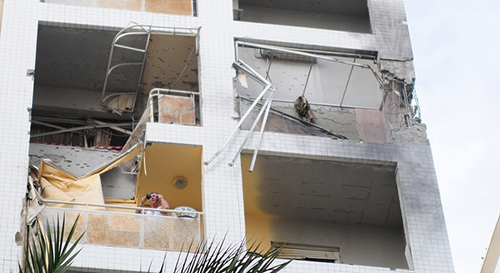
A damaged apartment building in Ashdod, following a direct hit by a rocket fired from Gaza, in November 2012. (Image source: IDF)
In addition, Gaza terrorists have seized every available opportunity for other forms of attack against Israeli soldiers and civilians including kidnappings, shootings, suicide bombs, anti-tank missiles and Improvised Explosive Devices [IEDs].
Iran, sworn to Israel's destruction, as are its Gaza-based proxies, has funded, armed, energized and directed both Hamas and Palestinian Islamic Jihad. As we saw with the Israeli interdiction of the Iranian arms shipment aboard the Klos-C only last month, Iran's sponsorship of terrorism continues unabated -- even as the international community is rehabilitating its extremist regime.
Especially in a region and among neighbours that are becoming even more unstable, violent and unpredictable, Israel must ensure that in the event a Palestinian state should ever reach fruition, the West Bank does not become a second Gaza. The bloody consequences of that for the Israeli people would be far greater than from anything Hamas could hurl out of the Strip.
Kerry has proposed international troops to provide security against attacks on Israel from the West Bank. Few Israelis believe that they could rely on such a force to protect them. There are the historical precedents for the failure of peacekeeping forces in the region and beyond, especially when the going gets tough. And in the West Bank, the going would get very tough very soon and very often.
There is the criminal failure of the international community, as both accomplice and accessory before the fact, to make any meaningful effort to prevent endless salvoes of lethal terrorist rocket attacks against Israeli civilians for over nine years.
Worse still, when Israel has been forced to respond to protect its citizens, it has been stabbed in the back by the international community, who have accused it of war crimes.
The UN's ill-conceived and deeply flawed 2009 Goldstone Report, for example, amounted to nothing less than incitement to terrorism.
And then there is the spectacle that we have witnessed over the past few days, of the pusillanimous and equivocating international response to plans for an active and violent terrorist group to join the PA.
Confronted by world leaders who lack the moral courage to face down terrorists whom even they themselves have designated as such, Israel is entirely right in its assumption that when it comes to security it can rely only on its own moral strength and its own armed forces.
Colonel Richard Kemp spent most of his 30-year career in the British Army fighting terrorism and insurgency, including in Iraq, the Balkans, South Asia, and Northern Ireland. He was Commander of British Forces in Afghanistan in 2003. He was also involved in the direction of national policy at the highest level, working at the Joint Intelligence Committee and as a member of COBRA, the UK national crisis committee. He writes regularly for The Times and speaks worldwide on terrorism, international security and other issues.

To subscribe to the this mailing list, go to http://www.gatestoneinstitute.org/list_subscribe.php