Afghan Constitution, Women's Rights, and the Taliban
Responsible for Equality And Liberty (R.E.A.L.)http://www.realcourage.org/2010/05/afghan-constitution-and-taliban/
On May 12, 2010, in Washington DC, arguably the most powerful man in
the world, United States President Barack Obama, publicly
supported
the efforts of Afghanistan President Karzai for reconciliation with
those supporting the Taliban supremacist ideology.
The basis for such a planned surrender to defiance against supporters
of the Taliban, which have been amongst the most notorious human rights
violators in history, was based on two points:
1. The Taliban are not all really the Taliban. President
Karzai and President Obama argue that many Taliban supporters do not
support the Taliban
ideology. President Karzai states that "there are thousands of the
Taliban who are not ideologically oriented," and President Obama states
that "the Taliban is a loose term for a wide range of different
networks, groups, fighters, with different motivations." In fact, the
word "Taliban" means "students," and many of their original recruits
came from madrassas supporting their ideology. The
Encyclopedia of Islam & the Muslim World describes the Taliban
ideology as an "innovative form of sharia combining Pashtun tribal
codes." To describe the Taliban as anything other than the "students"
of this ideology, simply ignores the very meaning of the word
"Taliban." Moreover, it places very real and disingenuous blinders
about the supremacist views that Taliban "students" have.
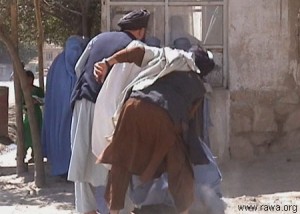
- Afghanistan Taliban "Police" Beat Women in Public -
in Kabul - in 2001 - We Must Never Let Afghanistan Return to This
2.
Support for the Afghanistan Constitution indicates a support for
Universal Human Rights. On May 12, 2010, U.S. President Obama stated
that: "the United States supports the efforts of the Afghan government
to open the door to Taliban who cut their ties to Al-Qaeda, abandon
violence, and accept the Afghan
constitution, including respect for human rights. I look forward to a
continued dialogue with our partners on these efforts." Since 2004, a
key question that has not been clearly answered is whether referencing
the Universal Declaration of Human Rights as something to be "observed"
constitutes support of unqualified, universal human rights in the
Islamic Republic of Afghanistan. But recent history in Afghanistan
continues to make this an ever-concerning question. Inviting the
Taliban back into political and public roles in Afghanistan society will
only further make this question more evident, no matter how
inconvenient that question may be. (It is noteworthy that not
a single press question on the subject of human rights was recorded
at the May 12, 2010 joint Obama/Karzai news conference.)
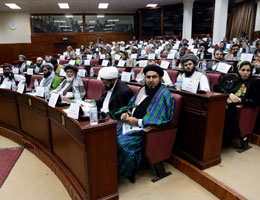
- Afghan Parliament Calling for Death Penalty for
Apostates According to "the laws in place in Afghanistan" (Photo: Gulf
Times)
Let's also be clear as well - creating a
nation-state whose name embodies only one religion should be the
starting point to ask questions about its legitimate support for our
unqualified universal human rights and religious pluralism. Certainly,
it would be a question if the U.S. was not the United States of
America, but was instead renamed the "Christian United States of
America." Such a decision would rightly be a cause for global criticism
and condemnation. But when a nation is named the "Islamic Republic of
Afghanistan," asking questions about its commitment to pluralism is
viewed as simply being narrow minded. For pluralism to work, pluralism
must be consistent. We can't expect pluralism in some cities, some
states, and some nations, and not others. Just like we can't have
borders around our unqualified, universal human rights.
The Afghanistan
Constitution has two clauses that are key to consider here:
-- Afghanistan Constitution, Article 3: "In Afghanistan, no law can be
contrary to the beliefs and provisions of the sacred religion of Islam."
-- Afghanistan Constitution, Article 7: "The state shall observe the
United Nations Charter, inter-state agreements, as well as international
treaties to which Afghanistan has joined, and the Universal Declaration
of Human Rights."
Many Americans would be more comfortable reading Article 3 as merely a
non-binding cultural statement that reflects a general more, sort of
like "In God We Trust" on American coins. But that is not what Article 3
states. What Article 3 states is "no law can be contrary
to... Islam." How do you prove that and ensure equality? How do you
prove that and ensure liberty? How do you prove that and ensure
universal human rights? The English translation of the Afghan
Constitution states that Article 7 calls for "observing" the Universal
Declaration of Human Rights. But the word
"observe" has multiple meanings in the English language, "observe"
can be viewed as "conform with" or merely "to take note of." Which is
it?
For nearly the past 6 years, human rights groups have been asking
this question. But no one wants to discuss this question. However, it
is a fundamental question now that Presidents Obama and Karzai are using
as a baseline to measure whether Taliban supporters can be reconciled
and reintegrated within the Afghanistan government, military, and
political system. How else do they plan to gauge whether Taliban
supporters will now support "human rights," as President Obama stated
they must on May 12? They will simply ask him if he supports the
Afghanistan constitution, and expect that no one will be impertinent
enough to ask the obvious question "has support for the Afghanistan
constitution demonstrated support for human rights?"
With Afghan
girls imprisoned by Afghanistan courts for fleeing forced marriages,
with an Afghanistan government that first sought
to pass a law guaranteeing marital rape (and then when global
pressure became too great - quietly
passing it instead as guaranteeing the right to starve your wife if
you don't get on-demand sex), with an Afghanistan
parliament calling for the death penalty for someone who chooses the
freedom of conscience to leave Islam because his "apostasy" was
"contrary to the laws in place in Afghanistan," the answer to this
question should be clear. But this is simply what human rights groups
have been saying for years, while world leaders refused to listen. How
will such denial impact America's willingness to allow a rehabilitation
and political resurgence of the Taliban in Afghanistan?
What Others Have Said
In 2004, Equality
Now reported in a December 2004 report "Action 21.3 - Access to Justice
for Afghan Women" on this subject. In the Equality Now posting,
the author stated: Article 22 of this Constitution provides: 'Any kind
of discrimination and privilege between the citizens of Afghanistan are
prohibited. The citizens of Afghanistan -- whether man or woman -- have
equal rights and duties before the law'. Article 3 of the Afghan
Constitution provides that 'no law can be contrary to the beliefs and
provisions of the sacred religion of Islam.' It is critical that the
Supreme Court ensures that its judgments harmonize these provisions of
the Constitution rather than impose singular interpretations of the
Koran that are harmful to women and do not respect the constitutional
right to equality between men and women."
In 2006, Equality
Now reported in Action 21.4, that "Following her visit to
Afghanistan in 2005, the United Nations Special Rapporteur on Violence
Against Women noted that one of the principal causes of pervasive
gender-based discrimination and violence against women in Afghanistan is
the lack of enforcement of the rule of law. The Special Rapporteur
particularly noted that the 'diverse and contradictory interpretations'
of Sharia Law tended to 'undermine the establishment of any universal
code of conduct' and worked to legitimize the violation of women's
rights in Afghanistan."
In 2007, Equality
Now reported in Action 2.15 that "Afghanistan ratified the
Convention on the Elimination of All Forms of Discrimination Against
Women (CEDAW) in March 2003 and adopted a new Constitution in January
2004, which provides for equal rights for women and men before the law.
However, women continue to be violently targeted in Afghanistan and
denied equal rights and equal protection of the law. The United Nations
Development Fund for Women (UNIFEM) published research in 2006
documenting systematic abuse of women’s rights in Afghanistan, including
violence against women instigated by state actors such as the army and
police, including forced prostitution, forced marriage, rape, kidnapping
and sexual assaults. In June 2007 two women journalists were murdered
with many others receiving death threats. On 25 September 2006 Safia
Ama Jan, the southern provincial head of Afghanistan's Ministry of
Women's Affairs, was murdered outside the front gate of her Kandahar
home. In recent months a large number of schools for girls have been
forced to close after being attacked. "
In 2008, Equality
Now reported in Action 2.16 that "Afghanistan ratified the
Convention on the Elimination of All Forms of Discrimination against
Women (CEDAW) in March 2003 and adopted a new Constitution in January
2004, which provides for equal rights for women and men before the law
and protects freedom of speech. However, women continue to be violently
targeted in Afghanistan and denied equal rights and equal protection of
the law and Malalai Joya remains suspended from parliament."
In July
2009, the United Nations reported that "Afghan women have limited
freedom to escape the norms and traditions that dictate a subservient
status for females....Violence, in its acute form, makes it presence
felt in widespread lawlessness and criminality. Findings reveal that
Afghan women are subjected to an increasingly insecure environment.
Women participating in public life face threats, harassment and attacks.
In extreme cases, women have been killed for holding jobs that are seen
to disrespect traditional practices or are considered 'un-Islamic.'"
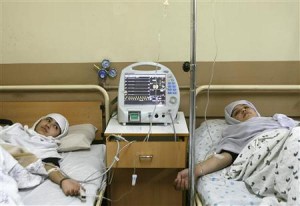
- Afghanistan: Girls recovering from poison gas
attack (Photo: Reuters/Mohammad Ishaq)
What Are We
to Believe, President Obama and President Karzai?
Are we supposed to believe that all of this is because all of these
Afghanistan citizens, courts, state actors -- ALL reject the Afghanistan
constitution?
Or should we instead recognize that they understand the Afghanistan
constitution better than Americans do, and the only relevant clause is
"In Afghanistan, no law can be contrary to the beliefs and provisions of
the sacred religion of Islam," based on whatever interpretation that
individual, the court, that state actor, and even that terrorist, may
have of how they view "Islam?"
With this proven history of inconsistency within the very Afghanistan
government and state institutions, and throughout its citizenry on the
issue of what "human rights" even mean, let alone what universal human
rights women and all human beings deserve, how can we expect
"reconciled" Taliban to now "respect human rights" in a way that could
possibly mean anything?
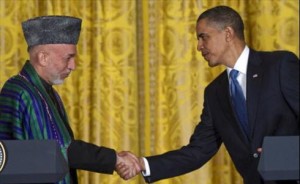
- Afghanistan President
Karzai and U.S. President Obama Meet at White House (Photo: AP/Evan
Vucci)
This is an inconvenient question for an America
tired of war, and tired of Afghanistan's problems. It is an
inconvenient question for an America with financial and plenty of other
problems of its own. Even the press is tired of it, as seen by their
total unwillingness to ask a single question at the May 12, 2010 press
conference on human rights or women's rights, even when yet more girls'
schools were poison gassed the day before in Afghanistan. They really
would rather not discuss this inconvenient question about human rights.
It is a distraction from the tactical and detailed topics that are less
troubling to discuss. With growing threats from Pakistan and Iran,
some even view that Afghanistan is simply something Americans can no
longer afford to pay attention to.
But we have another choice - the ability not to be driven only to a
path of ultimate failure, but to address conflicts honestly and show the
courage of our convictions and our support to human rights to the
world.
Instead of fleeing from Afghanistan as a hopeless disaster, we could
also choose to honor the sacrifices of the lives of American men and
women by challenging Afghanistan to become an example instead.
America: Learning from Our Own History of Supremacism
For American readers, imagine in 1961, if President John F. Kennedy's
decided not to challenge the ideology of the white supremacist Ku Klux
Klan (KKK). Imagine if he chose instead to convince us that really that
the KKK was just a "loose term" for a lot of people who are uneducated,
come from broken homes, and have had career and financial challenges,
and instead believed that "there are thousands of the KKK who are not
ideologically oriented."
Moreover, imagine if President John F. Kennedy then decided to
encourage members of the Ku Klux Klan to leave that terrorist
organization by offering them the incentives of government jobs, even
positions in the U.S. military and police forces, if they accepted a
U.S. Constitution that calls for equal rights.
Where would America have ended up if we never faced the ideology of
white supremacy and defied it as a nation?
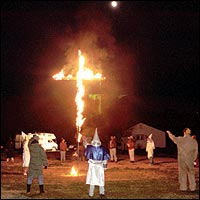
- Will America Learn from its own lessons in Defying
Supremacism?
America's documented commitment to equal
rights were part of its founding identity from its very Declaration of
Independence. Yet despite this, slavery existed. Despite the
declaration that "all men are created equal," a form of racial apartheid
existed throughout many parts of America even into the 20th century.
In 1961, the United States had been a signatory to the Universal
Declaration of Human Rights for 13 years - and still racial supremacism
and apartheid style laws of racial segregation existed in many parts of
America. The Declaration of Independence was not enough and our
Constitution was not enough. We had to amend our very Constitution to
guarantee the racial equality that was inherently promised in our
national identity since July 4, 1776. America has made more than its
share of mistakes. We have done things the hard way, the wrong way,
many, many times before. Haven't we learned from our lessons and
national struggles in defying supremacism?
If we KNOW this, and we have seen, with our eyes and our own history,
what it takes to defy supremacist ideologies, why do we believe that
Afghanistan will somehow be different? Why do we believe that agreeing
with the Afghanistan government's plan to "reconcile" with Taliban
supporters who will claim to support the Afghanistan constitution and
"human rights" has one iota of credibility, without challenging the
Taliban's supremacist ideology?
We know better. Too many are too tired, too distracted, and too
discouraged to acknowledge what we know. But we have also learned
another lesson in history that problems delayed are not problems
denied. Such problems continue to plague us over and over again, and
the mistakes that we make in Afghanistan will also set expectations for
making similar mistakes in other parts of the world.
Another Choice for Afghanistan
What if instead of surrender and abandoning the sacrifices of so many
in Afghanistan, we chose to make a stand for freedom and human rights?
What if we challenged Afghanistan to accept the Universal Declaration of
Human Rights not just as an "observation" in their constitution, but as
fundamental to their law and acceptance of pluralism in a new nation of
Afghanistan - not just for Muslims but for all Afghan citizens? What
if denied accepting any reconciliation of the Taliban until a new plan
of national re-education was conducted explaining that Afghan citizens
would accept pluralism, women's rights, and human rights as part of
their identity of as a new nation of Afghanistan?
What if all our efforts were not towards just an "Islamic Republic of
Afghanistan," but instead to a "Free Republic of Afghanistan?"
The managers of our
resources and our tactics will argue that such choices are
impossible, unacceptable. They will argue that the die is cast for
Afghanistan and that choosing another path is impossible.
But as we have seen wherever we have not challenged such supremacist
ideologies, we continue to see a drip, drip, drip affect of hate, abuse
of women and religious minorities, and international terrorism continue
to grow.
We have given billions of dollars to the Islamic Republic of
Pakistan, but we have given very little of our own lessons on challenging supremacism
and our own commitment to universal human rights. The price that we
continue to pay is a growing terrorist threat to the American homeland,
to Pakistan, and the world from the very same Taliban ideology that in
Afghanistan, U.S. President Obama says on May 12, 2010, he is willing to
open the door to "reconcile" with. This is the very same Taliban
ideology that reported shaped a recent terrorist who plotted to attack
America in New York City's Times Square.
Seeking a different direction for Afghanistan would be very painful,
costly, and difficult.
But in the long run, won't the alternative be even worse?
If we legitimize those who support the ideology of the Taliban to
"reconcile" with the Afghanistan government, what have we learned?
Let us choose instead to be Responsible for Equality And Liberty.

- Where
Our Universal Human Rights Apply...


 Posts
Posts


No comments:
Post a Comment