|
|
Follow the Middle East Forum
|
|
|
Iranian
Nukes, the Arab Gulf, and Obama's Seductive Summitry
|
|
|
Share:  
|
  Be the first of
your friends to like this. Be the first of
your friends to like this.
Originally published under the title "Obama's Seductive
Gulf Summit."
|
In
an effort to quiet their objections to international recognition of
Iran's nuclear threshold status, President Obama offered the Gulf Arab
states impressive-sounding, but substantively meaningless, new security
guarantees.
|
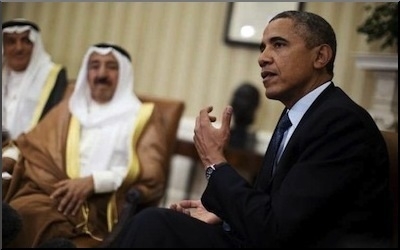
President Obama convened the May 13-14 Camp David summit with the
Sunni Arab leaders of the Gulf Cooperation Council (GCC) in pursuit of a
grand bargain. If the Gulfies would mute their objections to his coveted
nuclear agreement with Iran, he would compensate them with the American security
guarantees against Iranian aggression in the region they sought.
From Mr. Obama's point of view, the summit was a success,
in spite of the snub by Saudi King Salman and the other key Gulf leaders
who declined to attend. Putting aside their doubts, the GCC leaders in
the end signed a joint
statement endorsing "a comprehensive, verifiable [Iran nuclear]
deal that fully addresses the regional and international concerns, "
saying it would serve "the security interests of GCC member
states."
At least some of the council leaders thought their side did well at
the summit too. GCC Assistant Secretary-General Abdel Aziz Abu Hamad
Aluwaisheg told
a press conference May 15 that the Camp David summit "exceeded the
expectations of most of us" by reassuring GCC states of an
"unequivocal" commitment to their security. They were impressed
when Mr. Obama described
his commitment to their security in expansive language: "First, I am
reaffirming our ironclad commitment to the security of our Gulf
partners."
Obama's security guarantee to GCC
states is limited to "external" threats "inconsistent
with the U.N. Charter."
|
Perhaps they did not look too closely at what the president actually
promised, because the specific terms of the commitment he made, in fact,
fell far short of the security guarantee the GCC partners were seeking
and may have thought they received. The joint communique limits Mr.
Obama's security guarantee to "an external threat to any GCC state's
territorial integrity that is inconsistent with the U.N. Charter."
These carefully chosen words limit the U.S. commitment to a scenario
in which the Iranian armed forces invade the sovereign territory of a GCC
member. This formulation is actually a retreat from the more inclusive
commitment Mr. Obama made two years earlier in his 2013 address
to the U.N. General Assembly, in which he pledged to "confront
external aggression against our allies and partners."
Marching armies across borders is
not the typical pattern of Iranian aggression in the region.
|
Marching its armies across borders is not the typical pattern of
Iran's aggression in the region, nor is it the main threat worrying Saudi
Arabia and its GCC partners. The more common pattern of Iranian
aggression against the Sunni Arab heartlands is to foment militancy and
extremism among Shia minorities within the Arab states (and among the
Shia majority in Bahrain), financing the opposition, and sometimes
supplying military training and weapons to oppose the Sunni regimes. It
is a model that does not match up neatly with the U.N. Charter, even
though it has been a common paradigm for aggression against neighbors
worldwide since 1945.
As Philip Gordon, who until last month served as senior Middle East
director at the National Security Council, observed,
there is always "the question of what's an 'external threat.' Nobody
can say exactly what it means. That's the problem with it."
Mr. Gordon's predecessor at the National Security Council, Dennis
Ross, who negotiated extensively with the Gulf Arabs while serving as
Obama's senior adviser on the region, said,
The Saudis see Iran trying to encircle
them with its Quds Force killing Sunni Muslims in Syria, mobilizing Shia
Muslim militias in Iraq, providing arms to the Houthi rebels in Yemen or
fomenting unrest among Saudi Shia . Fundamentally, the Saudis believe
that America's friends and interests are under threat, and the U.S.
response has ranged from indifference to accommodation.
At the summit, the GCC leaders were pleased by the commitment the
president made that the United States and the GCC "will work
together to counter Iran's destabilizing activities in the region."
And in Yemen in 2015, the president is putting the focus on cooperation
with the GCC against Iranian subversion, rather than supporting Houthi
grievances in the name of human rights, which might be his normal
inclination.
It is an open question whether the
president will maintain his new posture of solidarity with the GCC.
|
In Bahrain four years earlier, he did the opposite, expressing sympathy
for a Shia uprising against the Sunni government that hosts the U.S.
Navy's Fifth Fleet even while admitting
Iran's
role in subversion
and arms
supply against it, suspending
deliveries of weapons to the government of Bahrain, and calling
intervention by Saudi Arabia and the United Arab Emirates to defend
Bahrain "alarming."
After Mr. Obama's Iran agreement is signed and endorsed by the U.N.
Security Council, and he no longer needs the Gulf leaders to be
quiescent, it is an open question whether the president will maintain his
new posture of solidarity with the GCC as in Yemen, or return to the more
typical Bahraini example of supporting uprisings even when they are under
Iranian patronage. The more lasting words may be something else he said
at the summit — that he does not want "to perpetuate any long-term
confrontation with Iran," reaffirming his grand illusion that Iran
can "play a responsible role in the region" if only the Sunni
leaders will bring it into a dialogue.
Steven J. Rosen is director of
the Middle East Forum's Washington Project.
|
|
|
|
|





 Posts
Posts


No comments:
Post a Comment