|
In this mailing:
by Khaled Abu Toameh
• July 20, 2015 at 5:00 am
- Hamas is only
one of several radical groups in the Gaza Strip that have been
receiving financial and military aid from Iran. The other groups
include Islamic Jihad, the Popular Resistance Committees and some
Fatah-affiliated militias. According to Palestinian sources in the
Gaza Strip, the Iranians have already resumed their aid to Hamas's
military wing, Ezaddin al-Qassam.
- Hamas officials
hope that the nuclear deal and the lifting of sanctions imposed on
Iran will lead to a dramatic increase in Tehran's support for the
terror groups in the region. Thanks to the deal, Hamas and Hezbollah
are once again working together toward achieving their goal of
undermining moderate Arabs and Muslims and eliminating Israel.
- "The
Palestinian people will not surrender and we will continue with the
resistance until the liberation of all of Palestine." — Mahmoud
Zahar, Hamas leader.
- Hamas seeks to
ensure continued Iranian backing for its plan to destroy Israel, while
at the same time joining the Sunni-led coalition and pretending to
oppose Iran's rising power in the Middle East.
- This deal has
virtually destroyed any prospect of a peaceful solution to the
Israeli-Palestinian conflict.
|
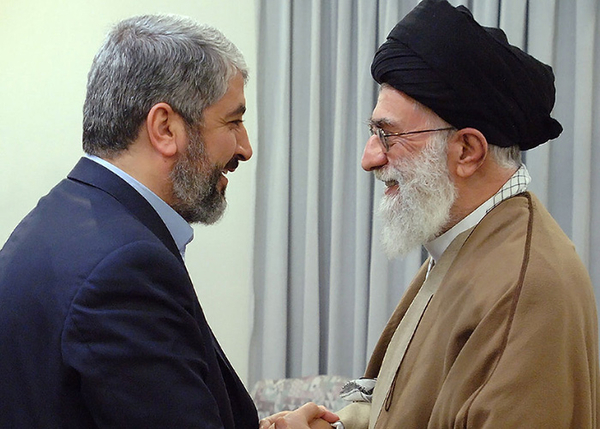
Bridging the Sunni-Shia divide, for the goal of
genocide: Hamas leader Khaled Mashaal (left) confers with Iranian
"Supreme Leader" Ali Khamenei, in 2010. (Image source: Office
of the Supreme Leader)
|
Hamas, the Palestinian Islamist movement that has vowed to destroy
Israel, is emerging as one of the biggest beneficiaries of the nuclear deal
reached last week between Iran and the world powers.
Emboldened by the deal, Hamas is now seeking to reap the fruits by
tightening its grip on the Gaza Strip with the help of Iran. This, of
course, is bad news for Hamas's rivals in the Palestinian arena, namely the
Palestinian Authority (PA), as well as all those who still believe in the
peace process between Israelis and Palestinians.
The nuclear deal has also driven Saudi Arabia and other Sunni Muslim
countries to restore their relations with Hamas. The goal is to entice
Hamas and its patrons in the Muslim Brotherhood to become part of an
anti-Iran Sunni coalition in the Arab world.
by Vijeta Uniyal
• July 20, 2015 at 4:00 am
- U.S. President
Barack Obama might be right about not allowing a nuclear Iran "on
his watch," but after he leaves the White House -- and because of
him -- the nuclear landscape of the Middle East might be
"radiating" like a pinball machine.
- Western powers
negotiating the Iran deal have demonstrated that they lack the
conviction and resolve to prevent Iran from building a nuclear weapon
-- or prevent Arab countries from acquiring nuclear weapons of their
own.
- And with
President Obama shrinking America's "footprint" in the
world, this time the cavalry might not be coming.
|
Islamic State jihadists parade a mobile-launched Scud
tactical ballistic missile, captured from Syrian regime forces, through
their capital of Raqaa in June 2014.
|
India's Foreign Ministry and media welcomed the Iran deal, much as
their counterparts in Western capitals did. But country's defence
establishment and business community are raising their concerns about the
newly negotiated deal with Iran.
Recent defence procurements show that India is preparing for a
destabilizing Middle East. In the run-up to the Iran deal, India has been
ramping up its missile defence capabilities, including building a
comprehensive missile defence shield capable of intercepting a ballistic
missile fired from a range of 5,000 km -- effectively covering the South
China Sea and the Persian Gulf region.
India has good reason to be concerned about an Iranian windfall from
its oil trade financing Shia militancy across the Muslim world. The Iranian
ascendancy could intensify the Shia-Sunni fight for the control of
political Islam and spill over into India's Kashmir region and beyond.
India's primary concern, however, remains neighbouring Pakistan.
|








 Posts
Posts


No comments:
Post a Comment