|
In this mailing:
by Shoshana Bryen
• July 16, 2015 at 5:00 am
- More
important than planning for combat is planning for the strengthening
of democracies.
- We cannot
make democracies out of Iraq or Libya or Syria, but when democratic
countries are united, the world becomes a safer place for all.
- "In a
volatile region so vital to the U.S., where other states cannot be
relied upon, it would be foolish to disengage -- or denigrate -- an
ally such as Israel. The war against terrorists and the states that
harbor and support them will be long and hard, and success will
depend in no small measure on the allies who stand with us and with
whom we stand." — JINSA
|
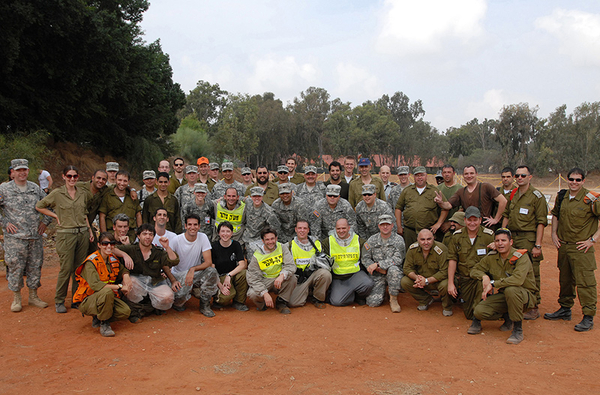
U.S. and Israeli soldiers during the Juniper Cobra
10 joint training exercise, in Israel, Oct. 21, 2009. (Image source:
Spc. Zachary R. Fehrman/Ohio National Guard Public Affairs)
|
Perhaps you think the war is over. Perhaps you think that if Iran
becomes a "friend" of the United States and the possibility of
an American-led war against the Islamic Republic recedes, the need for a
militarily capable ally such as Israel also recedes. Maybe the U.S.
doesn't want to associate with the "militaristic" Jewish State.
That's quite possible from the vantage point of July 2015 and if you
think the only reason to befriend anyone is for the military advantages
it brings to the relationship.
But there is a reason military-to-military cooperation between the
U.S. and Israel has remained almost untouchable, and the American
military proudly touts its relationship with Israel.
by Burak Bekdil
• July 16, 2015 at 4:00 am
- Iran will
have a stronger hand in supporting the Shiite war against the Sunnis
in the Middle East, financially, militarily and politically.
- Once again,
Turkey is pursuing an unattainable goal: That Iran will give up its
sectarian warfare but let Turkey continue to wage its own sectarian
warfare.
- After the
nuclear deal, the Turks see that their sectarian war against Shiite
dominance in the region will be harder to fight.
|
Turkey's President (then prime minister) Recep
Tayyip Erdogan greets Iran's President Hassan Rouhani in Ankara, June
9, 2014. (Image source: AKP)
|
Officially, Turkey has welcomed the nuclear deal that the P5+1 bloc
(the five permanent members of the UN Security Council plus Germany)
reached with Iran, and the lifting of sanctions on its eastern neighbor.
Ankara said that the deal 1) will contribute to the regional
stability and economy; 2) will have a direct positive impact on Turkey;
and 3) must be put into practice with full transparency.
Ironically, such warm welcome from Ankara put Turkey into the same
line as its worst regional nemesis, the Syrian regime of President Bashar
al-Assad, who also welcomed the deal. "We are confident that the
Islamic Republic of Iran will support, with greater drive, the just
causes of nations, and work for peace and stability in the region and the
world," Assad said in a message to Iran's Supreme Leader Ayatollah
Ali Khamenei.
|







 Posts
Posts


No comments:
Post a Comment