|
|
Follow the Middle East Forum
|
|
|
Erdogan's
License to Strangle
|
|
|
Share:  
|
  Be the first of
your friends to like this. Be the first of
your friends to like this.
|
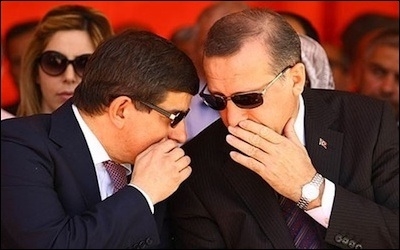
Under
the rule of President Recep Tayyip Erdogan (right) and Prime Minister
Ahmet Davutoglu (left), Turkish police and courts have systematically
intimidated the media.
|
On November 1, nearly half the Turks (49.4 percent) gave President
Recep Tayyip Erdogan and his Islamist government a ballot box license to
strangle the other half. He will be only too happy to use that license
aggressively.
Only five years ago, Turkey was being universally (and wrongly)
portrayed as a success story, bringing together conservative Islam and
democracy. Today, Turkey boasts one of the worst records of human rights
and civil liberties -- including abuses of media freedom -- among
countries tied by some kind of bond to Western institutions such as NATO
and the European Union (EU). Erdogan hates pluralism. He embraces simple
majoritarianism -- so long as he wins the biggest share of the vote.
The renewed vote of confidence by pro-Erdogan Turks for Erdogan and
the ruling Justice and Development Party (AKP), which he founded in 2001,
could be disastrous for millions of anti-Erdogan Turks. In Erdogan's
mindset, his party's landslide election victory not only gives him a
mandate to rule, but also to crush "the other."
In Erdogan's mind, electoral
victory gives him a mandate not only to rule, but also to crush the
"other."
|
Unsurprisingly, the West is worried. Only two days after the Turkish
elections, State Department Spokeswoman Elizabeth Trudeau spoke of concerns
about media freedoms in Turkey, and urged the country to uphold universal
democratic values. "The media outlets and individual journalists
critical of the government were subject to pressure and intimidation
during the campaign, seemingly in a manner calculated to weaken political
opposition," Trudeau said. "We urge Turkish authorities to
ensure their actions uphold the universal democratic values enshrined in
Turkey's constitution."
Across the Atlantic, the EU Commissioner for Enlargement and European
Neighbourhood Policy warned
the Turkish government that continued threats to media freedom, including
"intimidation" of journalists, will undercut Turkey's --
already crawling -- bid to join the EU.
The systematic intimidation of the critical press, usually through
police operations and/or court verdicts, had reached a peak even before
the elections. On October 26, the chief public prosecutor's office in
Ankara ordered one such media group, Koza-Ipek, to be placed under the management
of a panel of trustees -- all pro-government managers.
Without a court order, the government stole
two newspapers and two TV stations from the dissident Koza-Ipek
group, which it claims is linked with a terrorist organization allegedly
run by the U.S.-based Islamic preacher Fethullah Gulen. Gulen was
Erdogan's best political ally until 2013, when they had a falling out.
The prosecutor appointed pro-government trustees to the management of the
Koza-Ipek group, to seize the enterprise. These trustees immediately
reversed the editorial policy of the media outlets into a fiercely
pro-government line. A few days later, 58 employees at the dailies Bugün
and Millet and the broadcasters Bugün TV and Kanaltürk
were fired.
Only two days after the November 1 election, an Istanbul court ordered
the confiscation of the latest issue of Nokta magazine, on the
grounds that it "incites crime" with its cover, which showed
Erdogan's picture with the headline: "Monday, November 2: The
Beginning of Turkey's Civil War." This confiscation occurred less
than two months after it an earlier edition was confiscated for
"insulting the president." The magazine's editor-in-chief and
news editor were arrested.
Davutoglu wants to clean up
Turkey's image, not by reforming but by hiring a PR firm.
|
Reporters Without Borders, a media freedoms advocacy group, issued a
total of seven reports under the title "Timeline
of Media Censorship in Turkey" between Sept. 7 and Nov. 3. It is
anybody's guess which media group will be the next target.
Meanwhile, Erdogan's ally, Prime Minister Ahmet Davutoglu, wants to
clean up Turkey's worsening image in the West. But he does not want to do
that by upholding universal values, protecting civil liberties and media
freedoms and respecting pluralism. He wants to do that by hiring a
western public relations firm.
Apparently, Davutoglu, who once called Israel a "geopolitical
tumor," hired
one of the world's largest PR agencies, the U.S.-based Burson-Marsteller
(with offices in Washington DC, Berlin, London and Paris) to improve his
and his country's "overseas image." Last year,
Burson-Marsteller rejected Israel as a client, deeming the Jewish State
too controversial. Yet it represented the Muslim Brotherhood of Tunisia.
According to Ronn Torossian, a U.S. public relations specialist,
"The first job of this legendary public relations agency may be to
spin his [Davutoglu's] idea that jihad should not be confused with
terrorism. Davutoglu has said there is no connection between jihad and
terrorism..."
80% of minority Turks say they
cannot openly express themselves on social media.
|
Davutoglu is trying to buy international respect. He cannot. One can
earn respect. He cannot expect the civilized parts of the world just to
ignore the fact that he is the prime minister of a country where
minorities cannot even express themselves.
A recent
study conducted by a minority organization and funded by the EU found
that 80 percent of minorities in Turkey cannot openly express themselves
on social media; and a good 35 percent say they are subject to hate
speech on the same platform.
Erdogan too, is wrong about "respect." After his party's
election victory, he spoke
of the "Western media" and complained that "they still
have not learned to respect who was elected as president with 52% of the
people's vote."
Erdogan cannot buy respect or force others to respect
him. He can only earn respect -- something he clearly has no
intention of doing.
Burak Bekdil is an Ankara-based
columnist for the Turkish daily Hürriyet and a fellow at the Middle East Forum.
|
|
|
|
|





 Posts
Posts


No comments:
Post a Comment