The
Façade in CAIR's Paris Attacks Condemnation
IPT News
November 16, 2015
|
|
|
|
|
Share:  
|
  Be the
first of your friends to like this. Be the
first of your friends to like this.
 Leaders at the
Council on American-Islamic Relations (CAIR) condemn Friday's coordinated
terrorist attacks in Paris that left an estimated 130 people dead. They
really, really condemn it. Leaders at the
Council on American-Islamic Relations (CAIR) condemn Friday's coordinated
terrorist attacks in Paris that left an estimated 130 people dead. They
really, really condemn it.
But if the discussion turns to the terrorists' religious motivations,
they'll condemn that, too. Beginning with social media posts and a news
conference with leaders of other Muslim organizations Saturday, CAIR is
waging a campaign to stifle any reference to the Islamist ideology that
drove the Islamic State attack on Paris.
If defeating ISIS requires a war of ideas among Muslims to determine how
literally to apply the Quran, CAIR wants no part.
"Let's not legitimize ISIS and help them in their propaganda by
calling them the Islamic State," CAIR Executive Director Nihad Awad
told reporters." They're not Islamic. They're not state. They're
anti-Islamic. Let's not call them jihadis. They have nothing to do with
jihad. Jihad is a legitimate self-defense in Islam. Let's not give them
this legitimizing title. They are brutal killers. They have no legitimacy.
"And I urge media, politicians, analysts to be very careful with
the choice of their words. ISIS is appealing to the marginalized,
disenfranchised and alienated young people in the Middle East and in the
West. Let's not help ISIS recruit more disenfranchised and alienated young
people."
It's an argument directly contradicted by ISIS itself and one being
mocked both by Islamic radicals and by secular advocates of religious
freedom.
In a statement claiming credit for Friday's slaughter
re-posted at the Long War Journal, ISIS described the attacks as
"a blessed battle whose causes of success were enabled by Allah"
to strike "the capital of prostitution and vice, the lead carrier of
the cross in Europe — Paris."
"This group of believers were youth who divorced the worldly life
and advanced towards their enemy hoping to be killed for Allah's sake,
doing so in support of His religion," the ISIS statement said.
"...The targets included the Bataclan theatre for exhibitions, where
hundreds of pagans gathered for a concert of prostitution and vice."
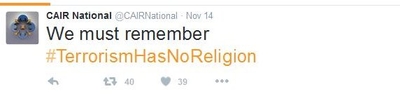
CAIR, meanwhile, created a Twitter hashtag,
"TerrorismHasNoReligion," and sent the director of its Florida
chapters, Hassan Shibly, onto the radio, where he essentially blamed the
victims. It isn't religion that drove the attacks, he said. Rather, it is
the consequence of "failing foreign policy" by Western nations
including France and the United States.
 In a four-minute
segment, Shibly made seven references to foreign policy, describing it as
"bad" and "horrific." Fix the foreign policy, he said,
and the terrorism will end. The problem is, "We cannot have a real
conversation about terrorism these days." In a four-minute
segment, Shibly made seven references to foreign policy, describing it as
"bad" and "horrific." Fix the foreign policy, he said,
and the terrorism will end. The problem is, "We cannot have a real
conversation about terrorism these days."
Terrorists, he told host Dean Obeidallah, "are not motivated by
religion. They're motivated by politics, by fighting for power and their
own political agenda and they use religion to galvanize support. But
ultimately, it isn't about the religion. An absence of religion but still
with the same political issues, you would still have the same problems. So
it's about politics, not religion."
This is an argument wholly divorced from any facts about the Paris
attacks or about ISIS's ideology. We have cited numerous examples in which Islamist terrorists clearly describe their actions as religiously-inspired. And
now, ISIS and its supporters provide fresh examples contradicting CAIR's
very premise.
In a sickly sarcastic essay, "Sorry Paris,"
Salafi-jihadist ideologue Hussain bin Mahmud ridicules "our
respectable and venerable 'scholars' who opened their mouth faster than the
speed of light to condemn those criminal events."
Mahmud's beefs are about a perceived Western disrespect for Islam:
Sorry Paris, we have forgotten your enmity towards our religion, your
insults towards our Lord and His messenger peace be upon him, your efforts
to change our cultures in our countries, and suppressing Islam from the
hearts of the young people in the East and the West.. Sorry Paris.
On the other side of the spectrum, Iraqi-born secularist Faisal Saeed Al Mutar likens arguments like CAIR's to a
Monty Python sketch depicting an Islamist terrorist arguing with an
apologist:
"We did this because our holy texts exhort us to do it."
"No you didn't."
"Wait, what? Yes we did..."
"No, this has nothing to do with religion. You guys are just using
religion as a front for social and geopolitical reasons."
"WHAT!? Did you even read our official statement? We give explicit
Quranic justification. This is jihad, a holy crusade against pagans,
blasphemers, and disbelievers."
Read the entire script here.
In its statement claiming credit for the Paris attacks, ISIS refers to
its grievances with the "crusader" nations, but makes a point of
emphasizing religion. Those countries "will continue to be at the top
of the target list for the Islamic State and that the scent of death will
not leave their nostrils as long as they partake in the crusader campaign,
as long as they dare to curse our Prophet (blessings and peace be upon
him), and as long as they boast about their war against Islam in France and
their strikes against Muslims in the lands of the Caliphate with their
jets, which were of no avail to them in the filthy streets and alleys of
Paris."
It starts with a Surah in which Allah "cast terror into their
hearts so they destroyed their houses by their own hands and the hands of
the believers."
Never mind that, CAIR says. It insists religion should not be part of
the conversation.
But despite the protestations, acknowledging the words and ideals that
fuel terrorists in no way indicts the belief of the world's billion Muslims
or the ideals of any broad spectrum of American Muslims. That is a false
argument intended to shut down the debate before it starts.
During his interview, Shibly and Obeidallah mocked the argument that
terrorists hate us for our culture, for our freedom. As the ISIS statement
shows, it views Paris as "the capital of prostitution and vice, the
lead carrier of the cross in Europe."
According to Shibly, that really means they hate French and American
foreign policy.
"There's hundreds of other countries in the world that have the
freedoms we have but that don't have the problems we have," he said.
"We do need to start asking ourselves how is our failed foreign policy
leading to the troubles that we are seeing today while recognizing that the
actions of terrorists is never justifiable."
In a speech last July, British Prime Minister David Cameron rejected the notion that discussions about Islamic
theology fueling terrorism be avoided.
It doesn't work, Cameron said, in part "because these extremists
are self-identifying as Muslims. The fact is from Woolwich to Tunisia, from
Ottawa to Bali, these murderers all spout the same twisted narrative, one
that claims to be based on a particular faith."
Minimizing debate is counter-productive, he added, because there are
voices advocating reform who challenge "the fusing of religion and
politics, the voices that want to challenge the scriptural basis which
extremists claim to be acting on...the voices that are crucial in providing
an alternative worldview that could stop a teenager's slide along the
spectrum of extremism."
These voices lack the profile and money the terrorists have at their
disposal.
Perhaps Shibly and his colleagues at CAIR are targeting the wrong
audience. Rather than tell non-Muslims to ignore the statements issued by
Islamist terrorists, CAIR might provide a better public service by loudly
and clearly speaking to the terrorists themselves. If the terrorists are
wrong theologically, who better than the most visible Muslim advocacy group
in the country to set them straight?
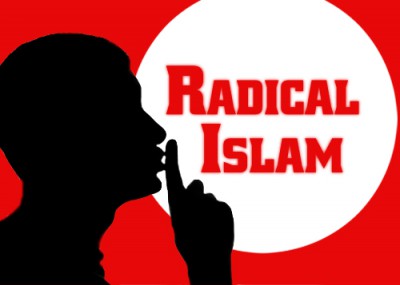
Instead, CAIR has chosen the same template over and over again. Like
"Fight Club," the first rule of radical Islam is you do not talk about
radical Islam.
Related Topics: Free
Speech, Islamist
Censorship, CAIR,
radical
Islam, Paris
attacks, ISIS,
Nihad
Awad, Hassan
Shibly, Dean
Obeidallah, Hussain
bin Mahmud, Faisal
Saeed Al Mutar, David
Cameron, Free
Speech, Islamist
Censorship
|

 Print
Print Send
Send Comment
 RSS
RSS


 Posts
Posts


No comments:
Post a Comment