Why the Paris Massacre Will Have Limited Impact
|
|
|
|
Share:  
|
  Be the first of
your friends to like this. Be the first of
your friends to like this.
The murder of some 127 innocents in Paris by a jihadi gang on Friday
has again shocked the French and led to another round of solidarity, soul
searching, and anger. In the end, however, Islamist violence against
Westerners boils down to two questions: How much will this latest
atrocity turn public opinion? And how much will it further spur the
Establishment to deny reality?
As these questions suggest, the people and the professionals are
moving in opposite directions, the former to the right, the latter to the
left. In the end, this clash much reduces the impact of such events on
policy.
Public opinion moves against Islamists specifically and Islam more
generally when the number of deaths are large enough. America's three
thousand dead on 9/11 stands out as by far the largest mortality but many
other countries have had their equivalent – the Bali bombings for
Australia, the railroad bombing for Spain, the Beslan school massacre for
Russia, the transportation bombings for Britain.
Sheer numbers are not the only consideration. Other factors can
multiply the impact of an assault, making it almost the political
equivalent of mass carnage: (1) The renown of those attacked, such as
Theo van Gogh in the Netherlands and the Charlie Hebdo office in
France. (2) The professional status of the victim, such as soldiers or
police. (3) High-profile circumstances, such as the Boston Marathon
bombing.
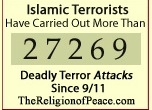 In addition to the
over 27,000 attacks globally connected to Islam since 9/11, or more than
5 per day (as counted by TheReligionOfPeace.com), a huge increase in
illegal immigration from the Middle East recently exacerbated feelings of
vulnerability and fear. It's a one-way street, with not a single soul
ever heard to announce, "I used to worry about Islamism but I don't
any more." In addition to the
over 27,000 attacks globally connected to Islam since 9/11, or more than
5 per day (as counted by TheReligionOfPeace.com), a huge increase in
illegal immigration from the Middle East recently exacerbated feelings of
vulnerability and fear. It's a one-way street, with not a single soul
ever heard to announce, "I used to worry about Islamism but I don't
any more."
These cases make more Westerners worried about Islam and related
topics from the building of minarets to female infibulation. Overall, a
relentless march rightwards is underway. Surveys
of European attitudes show 60 to 70 percent of voters expressing
these concerns. Populist individuals like Geert
Wilders of the Netherlands and parties like the Sweden
Democrats are surging in the polls.
But when it comes to the Establishment – politicians, the police, the
press, and the professors – the unrelenting violence has a contrary
effect. Those charged with interpreting the attacks live in a bubble of
public denial (what they say privately is another matter) in which they
feel compelled to pretend that Islam has no role in the violence, out of
concern that to recognize it would cause even more
problems.
These 4-P professionals bald-facedly feign belief in a mysterious
"violent extremist" virus that seems to afflict only Muslims,
prompting them to engage in random acts of barbaric violence. Of the many
preposterous
statements by politicians, my all-time favorite is what Howard
Dean, the former governor of Vermont, said about the Charlie Hebdo
jihadis: "They're about as Muslim as I am."
This defiance of common sense has survived each atrocity and I predict
that it will also outlast the Paris massacre. Only a truly massive loss
of life, perhaps in the hundreds of thousands, will force the
professionals to back off their deeply ingrained pattern of denying an Islamic
component in the spate of attacks.
That pattern has the very consequential effect of shutting out the
fears of ordinary voters, whose views thereby have negligible impact on
policy. Worries about Shari'a,
rape
gangs, exotic
diseases, and bloodbaths are dismissed with charges of
"racism" and "Islamophobia," as though name-calling
addresses these real issues.
More surprising yet, the professionals respond to the public's move to
the right by themselves moving to the left, encouraging more immigration
from the Middle East, instituting more "hate speech" codes to
suppress criticism of Islam, and providing more patronage to Islamists.
This pattern affects not just Establishment figures of the Left but more
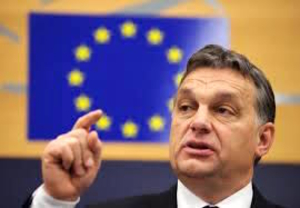
strikingly also of the Right (such as Angela Merkel of Germany); only Eastern
European leaders such as Hungary's Viktor Orbán permit themselves to
speak honestly about the real problems.
|
Viktor Orbán's
Hungary may not last long in the EU. Or maybe he is the group's future
leader?
|
Eventually, to be sure, voters' views will make themselves heard, but
decades later and more weakly than democratically should have been the
case.
Placing the murderous rampage in Paris into this context: it will
likely move public sentiments substantially in one direction and
Establishment policies in quite the opposite way, therefore ultimately
having only a limited impact.
Mr. Pipes (DanielPipes.org, @DanielPipes) is president of the
Middle East Forum. © 2015 by Daniel Pipes. All rights reserved.
This
text may be reposted or forwarded so long as it is presented as an
integral whole with complete and accurate information provided about its
author, date, place of publication, and original URL.
|




 Posts
Posts


No comments:
Post a Comment