 |
    |
|
In this mailing:
World Council
of Churches Struggles with the Truth - Again
by Malcolm Lowe
• March 6, 2016 at 5:00 am
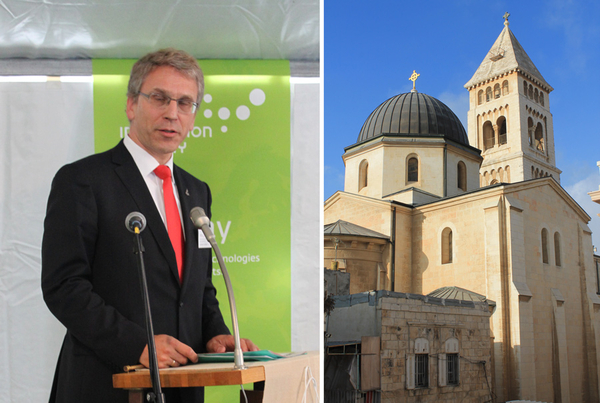
The World Council of Churches (WCC) published an open
letter to Gatestone Institute last week, concerning a pseudo-Christian
political "sermon" given by WCC General Secretary Olav Fykse Tveit
(pictured left) at the Lutheran Church of the Redeemer in Jerusalem (right).
Two recent Gatestone Institute articles were addressed to the current
campaign of the World Council of Churches (WCC) called "Seven Weeks of
Water 2016." In response, the WCC has issued an open letter to
Gatestone. This author is responsible only for what his article stated.
Conversely, we can examine the WCC's response exclusively as referring to
that article.
The article concerned the "sermon" preached by the General
Secretary of the World Council of Churches (WCC), Olav Fykse Tveit, when he launched
the campaign in a Jerusalem church. The sermon can be downloaded from the
WCC's website.
From this viewpoint, the WCC's open letter contains a plainly false
statement. It says: "The information and statistics we employ in the
campaign are derived from United Nations sources. None are from the
Palestinian Water Authority."
Finland's
Immigration Crisis
by Dawid Bunikowski
• March 6, 2016 at 4:00 am

Members of the paramilitary movement known as the Soldiers
of Odin view themselves as Finnish patriots, roaming the streets of Finland,
protecting against Muslim immigrant offenders. Critics accuse them of being
far-right, and they may de facto be related to previous skinhead movements
from the 1990s.
Finland -- an open country that prides itself on respecting different
ways of life, cultures and religions -- is being greatly tested by the wave
of Middle Eastern asylum seekers.
Finland is a homogenous country that has roughly 5.5 million
inhabitants, about 4% of which are foreign[1]. Twenty years ago, thousands of
Somalis immigrated to Finland. In the last decade or so, more international
students came to study, and more foreigners came to live and work.
Finnish universities and the academia are of a high level, and most
Finns speak some English. But it is not easy for foreigners to find jobs. The
barrier is the language: Finnish, like Hungarian, is a part of the
Finno-Ugric languages, and difficult to learn.
|
|
To subscribe to the this mailing list, go to http://www.gatestoneinstitute.org/list_subscribe.php
14 East 60 St., Suite 1001, New York, NY 10022
|


 Posts
Posts


No comments:
Post a Comment