Donald Trump Was Not Wrong About Muslim Immigration
Islam
is not just a religion, but a political movement like Communism. So why
can’t we apply political restrictions to Muslims like we did to
communists?

Events
such as Brexit and increasing terrorist attacks continue to underscore
that immigration from majority-Muslim countries will continue to be a
dominant political question, yet pundits and politicians continue to
treat this concern as impossible to resolve at best, and xenophobic at
worst.
On “Special Report with Bret Baier” a couple of months ago, Steven Hayes was appalled and contemptuous at the idea that the United States could apply a religious test to immigrants.
Hayes was not alone. It seems to be a tenet of establishment
conservatives that applying a religious test is beyond the pale,
especially for Muslims. House Speaker Paul Ryan has said, as written up by Micky Kaus,
“Ryan made a point of praising ‘Muslims, the vast, vast, vast, vast
majority of whom are peaceful, who believe in pluralism and freedom and
democracy and individual rights.’” The entire quote is available at the Washington Post.
Islam Is a Political Movement
This shows a stunning naiveté. Islam is far more than just a religion. It is also a political movement with strict rules for how society should be governed. In Islam, there is no separation of church and state, which has implications for our system of government. The Pew Center on Religion and Public Life conducted a face-to-face survey of 38,000 Muslims around the world that found “Overwhelming percentages of Muslims in many countries want Islamic law (Sharia) to be the official law of the land…”
Sharia is a system of governance that strictly limits the rights of
women, uses draconian punishments for crime (such as cutting off the
hands of thieves), and applies the death penalty for homosexuality,
rejecting Islam, and a host of other offenses. None of these laws are
compatible with the American Constitution and Bill of Rights.
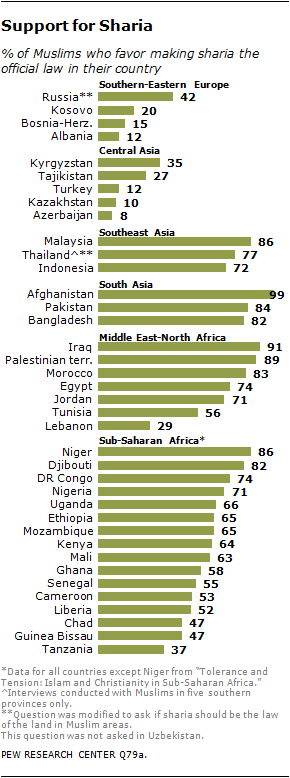
Now, the survey suggests caveats aplenty. Muslims in former Communist
countries are not so supportive, and Muslims in some secularized
countries like Turkey are less likely to support sharia. There are
differences of opinion on whether sharia should be applied to criminal
cases, or just to family and property disputes. And some significant
countries like Syrian and Somalia were not surveyed.
CLICK TO READ MORE
CLICK TO READ MORE


 Posts
Posts


No comments:
Post a Comment