|
|
Follow the Middle East Forum
|
|
|
Insult after
Injury: Egypt's Muslim-Christian 'Reconciliation Meetings'
|
|
|
Share:  
|
  Be the first of your friends to like this. Be the first of your friends to like this.
Originally published under the title "Insult after Injury:
Understanding Egypt's 'Reconciliation Meetings'."
|
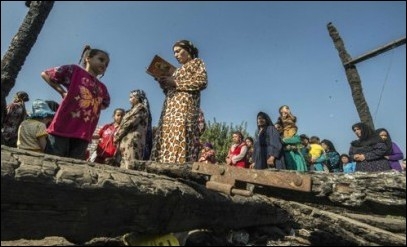
Egyptian
Christians in the village of Ismailia attend mass last month in the ruins
of a makeshift chapel burned down earlier this year.
|
We often hear about Egypt's Christians being attacked by Muslim mobs.
What we rarely hear about is what happens afterwards. Are the culprits
imprisoned? Are the victims compensated? Do authorities take measures to
help prevent such attacks from happening again?
While the acquainted reader may correctly assume no, the anatomy of what
always takes place is of interest.
First, the attack itself is often based on the accusation that some
Christian dared overstep his bounds, that is, he broke Islam's
supremacist dhimma contract.
Christians trying
to build a church, romantically
involved with Muslim girls, or insulting
Muhammad—all banned according to Islam—are typical violations that
prompt large, armed Muslim mobs to attack all the Christians in that
village (and their church if one exists) as a form of collective
punishment, which is also Islamic.
Security forces take their time
getting to the scene of anti-Christian mob attacks.
|
While the attack is in progress, the besieged Christians do the only
thing they can: frantically call the local police and/or state security.
Based on private conversations with those involved, formal complaints
from the Coptic Orthodox Church of Egypt, and objective media reporting,
here's what happens practically every single time:
Police and state security take their time to get to the scene, allowing
the mob ample time to riot with impunity. It is not uncommon for
authorities to arrive two or three hours after a mob attack commences—even
when they are closely stationed.
For example, after 3,000 Muslims rose in violence against the Christians
of a village near Alexandria in 2012, it took the army an hour to
arrive—even though it was stationed a mere mile away: "This happens
every time," said a Christian eyewitness. "They wait outside the
village until the Muslims have had enough violence, then they appear"
(Crucified
Again, p. 175).
After the uprising has fizzled out, authorities arrive. Instead of
looking for and arresting the culprits or mob ringleaders—or, as often is
the case, the local imam who incites the Muslim mob against the
"uppity infidels" who need to be reminded of "their
place"—authorities gather the leaders of the Christian and Muslim
communities together in what are termed "reconciliation
meetings." During these meetings, Christians are asked to make further
concessions to angry Muslims.
Authorities tell Christian leaders things like, "Yes, we understand
the situation and your innocence, but the only way to create calm in the
village is for X [the offending Christian and extended family, all of whom
may have been beaten] to leave the village—just for now, until things calm
down." Or, "Yes, we understand you need a church, but as you can
see, the situation is volatile right now, so, for the time being, maybe you
can walk to the church in the next town six miles away—you know, until
things die down."
Christian victims are regularly
placed into a room with their persecutors for a 'reconciliation meeting.'
|
Needless to say, things never "die down" or "return to
normal." Christians who agree to banishment are seldom allowed reentry
and churches rarely resume being built, for the mob will rise up again.
To be sure, when the authorities arrive to the scene of the crime,
beaten and robbed Christians regularly reject the idea of being placed into
a room with their persecutors in a mock reconciliation meeting that has
proven time and again only to add insult to injury.
But when they rebuff the authorities' offer and demand their rights as
citizens against the culprits, the authorities smile and say
"okay." Then they go through the village making arrests—except
that most of those whom they arrest are Christian youths. Then they tell
the Christian leaders, "Well, we've made the arrests. But, just as you
say so-and-so [Muslim] was involved, there are even more witnesses
[Muslims] who insist your own [Christian] youths were the ones who began
the violence. So, we can either arrest and prosecute them, or you can
rethink our offer about having a reconciliation meeting."
Under the circumstances, dejected Christians generally agree to the
further mockery. What alternative do they have? They know if they don't
their youth will certainly go to prison and be tortured. In one recent
incident, wounded Christians who dared fight against Muslim attackers were
arrested and, despite serious injuries, held
for seven hours and prevented from receiving medical attention.
This issue of reconciliation meetings is so prevalent and prevents Copts
from receiving any justice that a 2009 book, titled (in translation) Traditional
Reconciliation Sessions and Copts: Where the Culprit Emerges Triumphant and
the Victim is Crushed, is entirely devoted to it. According to a review
of the book,
In some 100 pages the book reviews how
the security apparatus in Egypt chooses to 'reconcile' the culprits and the
victims in crimes where churches are burned; Coptic property and homes
plundered, and Copts themselves assaulted, beaten and sometimes murdered;
and when even monks are not spared. Even though it stands to reason that
such cases should be seen in courts of law where the culprits would be
handed fair sentences, this is almost never allowed to take place. And even
in the few cases which managed to find their way into the courts, the
culprits were never handed fair sentences since the police invariably fell
short of providing any incriminating evidence against them.
The farcical scenario of reconciliation
sessions has thus without fail dominated the scene where attacks against
Copts are concerned, even though these sessions proved to be nothing but a
severe retreat of civil rights.
Politically speaking, the authorities
aim—through the reconciliation sessions—to secure a rosy façade of the
'time-honoured['] amicable relationships between Muslims and Copts',
implying that they live happily ever after. The heartbreaking outcome,
however, is that the only winners in these sessions are the trouble mongers
and fanatics who induce the attacks in the first place and who more often
than not escape punishment and emerge victorious. The Coptic victims are
left to lick their wounds.
Worse, not only are the victims denied any justice, but the aggressors
are further emboldened to attack again. As Coptic Bishop Makarious of Minya
recently put it in the context of discussing how Coptic
Christians are now being attacked at the rate of every two or three days:
As long as the attackers are never
punished, and the armed forces are portrayed as doing their duty, this will
just encourage others to continue the attacks, since, even if they are
arrested, they will be quickly released.
Raymond Ibrahim is a Judith
Friedman Rosen fellow at the Middle East Forum and a Shillman fellow at the
David Horowitz Freedom Center.
|
|
|
|





 Posts
Posts


No comments:
Post a Comment