|
|
Follow the Middle East Forum
|
|
|
Turkey's
Democracy Deficit
|
|
|
Share:  
|
  Be the first of
your friends to like this. Be the first of
your friends to like this.
Originally published under the title "Turkey, Europe's
Little Problem."
|
German
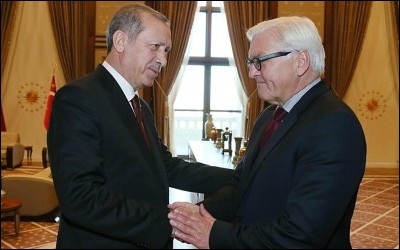
Foreign Minister Frank-Walter Steinmaier (right) said there is
virtually "no basis" for talks between his government and
that of Turkish President Recep Tayyip Erdogan (left).
|
Nations do not have the luxury, as people often do, of choosing their
neighbors. Turkey, under the 14-year rule of Recep Tayyip Erdogan's
Islamist governments, and neighboring both Europe and the Middle East,
was once praised as a "bridge" between Western and Islamic
civilizations. Its accession into the European Union (EU) was encouraged
by most EU and American leaders.
Nearly three decades after its official bid to join the European club,
Turkey is not yet European but has become one of Europe's problems.
Europe's "Turkish problem" is not only about the fact that
within the span of a single fortnight a bomb attack wrecked a terminal of
the country's biggest airport and a coup attempt killed nearly 250
people; nor is it about who rules the country. It is about the undeniable
democratic deficit both in governance and popular culture.
In only the past couple of weeks, Turkey was in the headlines with
jaw-dropping news. In Istanbul, a secretary at a daily newspaper was attacked by a group of people who accused her of
"wearing revealing clothes and supporting the July 15 failed
coup." She was six months pregnant.
Also in Istanbul, a Syrian gay refugee was murdered: he had been beheaded
and mutilated. One social worker helping LGBT groups said: "Police
are doing nothing because he is Syrian and because he is gay."
Turkey is dangerous not only for gays and refugees. A French tourist was left bloodied and beaten by
Turkish nationalists after he refused to hold a Turkish flag. Grisly
footage shows the gang, encouraged by Erdogan to patrol the streets on
"democracy watch," telling the man "You will be punched if
you don't hold the flag." The tourist is alone and does not appear
to speak Turkish.
Europe shows signs of waking up
from its Turkey-as-'bridge' dream.
|
Meanwhile Europe is giving signals, albeit slowly, that it may be
waking up from its Turkey-the-"bridge" dream. Germany's Foreign
Minister Frank-Walter Steinmaier said that his country's
relations with Turkey have grown so bad the two countries have virtually
"no basis" for talks. He said that Germany has serious concerns
about mass arrests carried out by Turkish officials. According to
Steinmaier, Turkey and Germany are like "emissaries from two
different planets." Steinmaier is right. He is also not the only
European statesman who sees Turkey as alien.
Erdogan recently threatened Italy that its bilateral relations with
Turkey could deteriorate if Italian prosecutors investigating Erdogan's
son, Bilal, for money laundering, proceeded with their probe. "Italy
should be attending to the mafia, not my son," Erdogan said.
Typically, he does not understand the existence of independent judiciary
in a European country. He thinks, as in an Arab sheikdom, prosecutors are
liable to drop charges on orders from the prime minister.
Italy's prime minister, Matteo Renzi, answered Erdogan in language Erdogan will probably
will not understand: "Italy has an independent legal system and
judges answer to the Italian constitution and not the Turkish
president."
In unusual European realism, Austrian Chancellor Christian Kern said that he would start a discussion
among European heads of government to end EU membership talks with
Turkey. He rightly called the accession talks "diplomatic
fiction." Kern said: "We know that the democratic standards are
clearly not sufficient to justify [Turkey's] accession."
Even Turkish Cypriots on the divided island fear that Erdogan's
Islamization campaign may target their tiny statelet. On August 3, about
1,500 people from 80 groups spanning the political spectrum took to
the streets in Nicosia to protest against "Turkey's attempt to
mold their secular culture into one that's more in tune with Islamic
norms."
All of that inevitably makes Turkey an alien candidate waiting at
Europe's gates to join the club. According to a European survey, Turkey is the least-wanted potential
EU member -- even less wanted than Russia. Opposition to Turkish
membership ranges from 54% (Norway) to 81% (Germany).
Celal Yaliniz, a little-known Turkish philosopher, likened
Turks in the 1950s to "members of a ship's crew who are running
toward the west as their ship travelled east." The Turks were not
alone. Erdogan's "liberal" Western supporters have been no
different.
Burak Bekdil is an Ankara-based
columnist for the Turkish newspaper Hürriyet Daily News and a fellow at the
Middle East Forum.
|
|
|
|
|





 Posts
Posts


No comments:
Post a Comment