 |
   |
|
In this mailing:
BDS Movement: Barbarians Inside the Gates - Part II
by Denis MacEoin
May 8, 2014 at 5:00 am
  Be the first of your
friends to like this. Be the first of your
friends to like this.
These politically correct activists are all supposed to be
anti-racists and multiculturalists. Yet when artists are banned just because
they happened to be born in Israel, it tears apart the very basis of both
anti-racism and multiculturalism.
As you doubtless know, many in Europe loathe the United States. Their
invective down the years has been an assault on reason and emotional
stability, whether directed against the Vietnam war, the response to 9/11 or
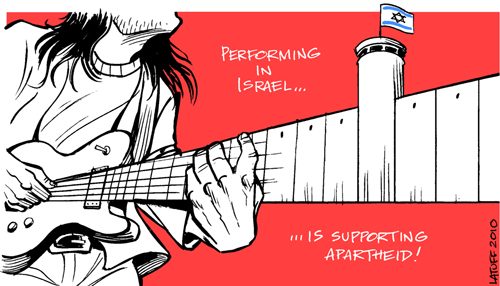
to the Iraq war. Yet there is no boycott of the United States.So, despite a hatred for America -- and a perverse love of Iran, Hezbollah, and the PLO -- we come back to the Israeli exception, to the singling out of just one country. However charitable we may try to be, it is hard not to detect the reek of anti-Semitism. Am I being unfair? To people who marched through the streets of European cities chanting, "Hamas, Hamas, Jews to the gas," (and here and here at Dutch football matches) was that just simple folly -- or proof of intention? The international Boycott, Divestment and Sanctions movement [BDS] against Israel is so determined to hurt Israel abroad, that the boycotters also put pressure on performers who even consider holding concerts in Israel.
Carlos Santana caved in to pressure from the BDS crowd, as did Elvis Costello, Gil Scott-Heron, Annie Lennox, Stevie Wonder, and writers such as Iain Banks and Alice Walker, a crusader against racism who flies the flag of anti-Semitism as though Jews are suitable victims. Five hundred artists from Montreal, Canada have joined the campaign. Actors such as Vanessa Paradis and her husband Johnny Depp stayed at home in 2011 -- under the threat that, if they turned up in Israel, they would face a boycott, too. Roger Waters, former lead singer and lyricist for the rock band Pink Floyd, is a hardline anti-Israel activist who demands a boycott until Israel ends "the occupation" (presumably on Palestinian terms). He also demands that Israel grants full equality to Israel's Arabs -- notwithstanding that Israel's Arabs already have full equality both in law and in practice. Waters would also give all Palestinians the "right of return" -- a condition that guarantees the end of Israel should millions of Muslim non-refugees overrun it. What Waters and his supporters fail to appreciate is that the exodus of Arabs in 1948 came about in the course of a defensive war: the Arab Higher Committee and the Arab Liberation Army ordered Arabs to leave the land to make it easier to kill the Jews. The Arabs who stayed now make up 20% of Israel's population; they have their own political parties, their own Members of Knesset, their own Supreme Court judgeships, professorships in universities, and so on. Those Arabs who did choose to leave what is now Israel made their beds -- or had them made for them -- and should now lie in them. This bit of history does not even include the large number of Jews -- estimated at about 800,000, the same number as Arabs who left Israel -- who were forced to leave all their homes and property behind while fleeing onslaughts in Arab countries. But while Israel took all the Jews in, built housing for them, educated them, and made them citizens, the Arab countries effectively kept their Arab brethren out, often packing them in rancid warrens known as "refugee camps." By way of comparison, does the Republic of Ireland claim that it must displace all of England, and then allow the English to remain as subordinated citizens if they pay "protection"? Does the United States plan to return Florida to the Seminole or California to Mexico? But not all the news is bad. Far from it. Many performers have chosen to play in Israel and have done so in great numbers. Artists who have voiced opposition to the BDS campaign include the outstanding Italian writer Umberto Eco, the film makers Joel and Ethan Coen, and musicians such as Elton John, Leonard Cohen, Lady Gaga, Rihanna, Justin Bieber, Madonna, and Sir Paul McCartney. And one of the world's oldest and biggest bands, the Rolling Stones, plans to play in Tel Aviv this summer. Not everyone is meek in the face of BDS pressure. The British musician John Lydon (the notorious Johnny Rotten of the Sex Pistols, an anti-establishment figure who actually might have been expected to join in the boycott), responded to criticism by saying: "If Elvis-f#*&ing-Costello wants to pull out of a gig in Israel because he's suddenly got this compassion for Palestinians, then good on him. But I have absolutely one rule, right? Until I see an Arab country, a Muslim country, with a democracy, I won't understand how anyone can have a problem with how they are treated." These are the ironies of the whole BDS business. These politically correct activists are all supposed to be, as if it were the law of the jungle, anti-racists and multiculturalists. But when artists such as Riff Cohen and Ester Rada are banned just because they happened to be born in Israel, it tears apart the very basis of both anti-racism and multiculturalism. Ban a black singer anywhere else, and you will be denounced as a racist. Ban a Jewish singer whose parents come from North Africa, and you will have made a mockery of the multicultural dream. Banned because you do not like the singer's government? Iran has a deeply dangerous government, but would you ban the extraordinary voice of Mohammed Reza Shajarian? Portugal once had a dictator named António de Oliveira Salazar; no one thought for a moment to ban the country's extraordinary singer, Amália Rodrigues. Who would want to boycott a woman who was understood to be the embodiment of the soul of the Portuguese people, on whose death the state declared three days of public mourning? But perhaps, after all, matters are changing. A friend just sent a long list of thirty-two items, part of which follows below. People are starting to boycott the boycotters -- probably the most fun you could have with your clothes on. BDS Scorecard for 3rd Quarter 2013
Related
Topics: Denis MacEoin
How the European Union Tries to Duplicate the United States, but Fails
by Malcolm Lowe
May 8, 2014 at 4:00 am
Be the first of your
friends to like this.
Many European politicians would like to create a federal Europe
on the lines of the United States of America. But it is in the area of the
political system that the failures of the EU are most evident. Besides the
absence of a European defense policy and the incoherent attempts to conduct a
common foreign policy, there are serious failures even in areas where at
first things seemed to be going well.
But there are also other obstacles to a United States of Europe.
Some of these obstacles are evident, some are known but underestimated, while
others are unnoticed.
The history of the EU has registered both remarkable achievements and
embarrassing failures. The earlier phase of that history focused on the
creation of a common market through the elimination of trade barriers and the
harmonization of business and financial law. The EU's greatest achievements
lie in those areas, despite the irritations sometimes caused by seemingly
petty directives.The immediate aim in the earlier phase was to increase shared economic prosperity, but many of the protagonists had a higher and nobler aim: to make future European wars impossible. More recently, therefore, the EU has focused on creating pan-European political institutions. These cover all three areas of a constitution: legislative, executive and judicial. Here too, there have been achievements, despite the debacle of the so-called "European Constitution" of 2004. Also the Euro project, which embodies both aims, may succeed. The verdict on the costs and benefits for the so-called PIIGS group of countries is not yet in. Certainly, it is convenient for those who, say, spend a few hours driving from northern France across Belgium and the Netherlands to northern Germany that they no longer need to carry four kinds of loose change in their pockets. In short, many European politicians would like to create a federal Europe on the lines of the United States of America. But it is in the area of the political system that the failures of the EU are most evident. Besides the absence of a European defense policy and the incoherent attempts to conduct a common foreign policy, there are serious failures even in areas where at first things seemed to be going well. The Façade of Pan-European PartiesOne central feature of the US system, of course, is that there are just two political parties that operate at all levels of government, one leaning more to the Right and the other more to the Left. For some decades, Europe seemed to be going in the same direction. Power alternated between the CDU and the SPD in Germany, the PP and the PSOE in Spain, New Democracy and PASOK in Greece, the CDA and the PvdA in the Netherlands, etc. Not to mention the UK's Conservative and Labour Parties. Even in Italy, most of the multitude of political parties combined into a Center-Right alliance and a Center-Left alliance. The latter coalesced around the chief heir of the former Partito Comunista Italiano; this post-communist alliance has paid the US the ultimate compliment by renaming itself the Democratic Party (since 2007).Emboldened by the apparent end to European history, the respective parties in the various countries banded together into pan-European Center-Right and Center-Left parties: the European People's Party and the Party of European Socialists. These are the labels under which they operate in the European Parliament. They hoped to enjoy the same cozy alternation of power, at both national and European levels, as the US Republicans and Democrats, whereby whichever party you belong to, your turn in government will come around. Alas, not long after these flimsy constructions were stitched together, they started to lose support among their various electorates -- and for very natural reasons.
Add to this the phenomenon of local nationalisms in various countries. The UK, Spain, Belgium and Italy are only the most prominent examples (see Addendum 1). Even in Germany the CSU replaces the CDU in Bavaria. It may be only the admiration commanded by certain CDU leaders, from Adenauer to Merkel, which has hindered the reemergence of nationalist rivals to the CDU on both local and federal levels in Germany. The Left, of course, always had an internationalist orientation, but above all its aims were utopian. Participation in a united Europe, however, makes it harder to realize Utopia in one country. This explains how in Greece the Euro-skeptic SYRIZA has almost blotted out PASOK on the left, but also how the Dutch Socialist Party currently threatens to do the same to the PvdA. Both SYRIZA and the Dutch SP are ragbags of Trotskyites, Maoists and other militant utopians. In Germany, the SPD now has two serious rivals on the Left: the Greens and the ex-communist Die Linke. In the elections of February 2013, Italy's brief two-party system was shattered by the sudden appearance of the Movimento Cinque Stelle, which appeals to Trotskyite and chauvinist Euro-skeptics alike. In the upcoming elections for the European Parliament (May 22-25), an even bigger surprise may be caused by a new Greek leftist party, "The River" (To Potami). It was formed only weeks ago (February 26), but rivaled New Democracy and SYRIZA in a recent poll (all three c. 13%). Other polls put The River well behind both of them, but leading the rest of the pack. The biggest surprise of all, however, is that an opinion poll in the UK has put UKIP ahead of both Labour and the Conservatives. This, although UKIP has never held a seat in the House of Commons, members of it have committed embarrassing gaffes in recent weeks, and it is a Euro-skeptic party competing in elections to the European Parliament. Among further absurdities of maintaining a façade of transnational parties, George Papandreou was reelected President of the Socialist International in August 2012, although PASOK, his once mighty party, had been reduced to some 12% in the elections of that year. Today PASOK barely reaches 5% in Greek opinion polls. One consequence of all this is the emergence of national governments in which former main parties on the right and the left, which used to alternate in power, are now united in a last stand against their new enemies all over the political spectrum. So New Democracy is in coalition with PASOK in implementing the unpopular reforms in Greece, just as old rivals are jointly ruling in Germany and Austria. The current Dutch government is a coalition between the largest parliamentary faction on the Right and the largest one on the Left (see Addendum 2). Also in Italy, the Center-Left and Center-Right ruled in coalition between April 2013 and February 2014. Similar scenarios are now imaginable in France (because of the National Front) and in Spain (as more and more regional nationalists enter the central parliament). As if none of this were happening, those pan-European concoctions, the European People's Party and the Party of European Socialists, are campaigning all over for their respective candidates for President of the European Commission: Jean-Claude Juncker of Luxembourg and Martin Schulz of Germany. They assume that, as in previous years, one of them will have it in the bag. But they, too, may be forced to unite behind a single candidate if the upcoming European elections produce a vast spaghetti of miscellaneous parties. And if not this time, then sometime soon. Other Obstacles on the Path to a "USE"So the vision of European counterparts to the US's Republicans and Democrats may be an illusion. As a sign of that, Democrats 66 -- which was founded in 1966 with the aim of creating a US-style political system in the Netherlands -- now seeks to emulate Germany. But there are also other obstacles to a "United States of Europe." Some of these obstacles are evident, some are known but underestimated, while others are unnoticed.Consider the absence of a common language. English is now used as a second language everywhere, but there are more native speakers of German and almost as many of French and even of Italian. EU institutions have complex rules for the use of the continent's mass of official and semi-official languages. In the US, by contrast, Spanish is an official language only in Puerto Rico, although the total number of Spanish speakers has doubled since 1990 to nearly 40 million. One consequence of polyglossia is that most Europeans have little idea of what is happening in other EU countries than their own. For example, the Greek crisis has long disappeared from European headlines everywhere except in Greece, where it is in the headlines every day. Nor is it surprising, since this is the first Greek government in history to have seriously tackled the institutional problems that have plagued the modern Greek state ever since its inception in 1832. Another factor is the great difference between the electoral system for the European Parliament and the many systems used in individual countries. Indeed, the short-lived appearance of two-party systems in Greece and Italy was based on manipulation of the electoral system. In Italy the largest party, however small, is given an automatic majority of seats in the lower house. The same happens with the representation of each region in the Italian Senate. (This electoral law was declared unconstitutional in December 2013, but without retroactive effect.) In Greece, the largest party gets a bonus of fifty seats. In earlier years, when New Democracy and PASOK accounted for some 80% of voters, the bonus ensured that one of them would have a comfortable majority in parliament; now it gives an absurd boost to some party that gets less than 30% (June 2012) or even less than 20% (May 2012) of the votes. Even the arrival of large Muslim populations has been handled differently in the two continents. Whereas Muslim ghettos and no-go areas have sprung up in Europe, the US has been more successful in integrating Muslims, despite recent worrying signs. As an example of unnoticed factors, consider the phenomenon of party discipline, which is severe in Europe but hardly exists in the US. In the Greek parliament, whoever votes against the party line is immediately expelled from the party faction. An instructive recent case was Dora Bakoyannis (see Addendum 3). British political parties are not so savage toward those who cross party lines. But unless you are Winston Churchill (who switched parties twice during his early career), if you ignore party discipline you severely dent your prospects of ever becoming a government minister. It may be that the absence of party discipline is the secret of how the US has maintained a two-party system ever since the Republicans obliterated the Whigs in the 1850s. That flexibility facilitates the emergence of political consensus without disrupting party structures. But we do not expect to see it soon in Europe. AddendaAddendum 1. Since 1997, the UK's House of Commons has had at most one Conservative member from Scotland in four elections. Currently, the Scottish Nationalist Party has an absolute majority in the Scottish Parliament and has organized a referendum on independence for Scotland, to be held on September 18, 2014. Nationalist parties also have a majority in the Catalan Parliament, but the Constitutional Court of Spain will not let them to hold a referendum. So on September 11, 2014 the Catalans manifested their wish for independence by organizing a human chain from one end of their country to the other (half a million people along 400 kilometers of roads). In Belgium separatism is so advanced that there are distinct Flemish-speaking and French-speaking parties in the Flemish and Walloon areas respectively; if you live in the one area, you cannot vote for a party in the other (Brussels and its surroundings are the only exception). The Italian Northern League suffered severe setbacks after a financial scandal in 2012, but support for separatism remains high and nostalgia for the Venetian Republic (726-1797) is particularly strong. In the US, by contrast, even Puerto Rico's separatist movement polled barely 5% in the 2012 referendum; a near majority voted to increase the territory's integration into the US by becoming a state.Addendum 2. In August 2012, as an earlier article noted, the Dutch Socialist Party was poised to become the largest party in parliament. A poor performance by its leader in the television debates led to a last-minute switch back to the PvdA by leftist voters, who were desperate to defeat the VVD (a party that has displaced the CDA on the right). To the fury of those same voters, the VVD and the PvdA thereupon entered into coalition. Today the PvdA is again behind the SP in the polls, but highest is another left-wing party, Democrats 66, which trounced the PvdA in the recent local elections. Nothing like this happens in the US, of course. Addendum 3. Dora Bakoyannis, as a leading member of New Democracy, served as Foreign Minister during 2006-2009. In 2010, PASOK's George Papandreou, the last Greek prime minister to command an absolute majority in the Greek Parliament, negotiated the original rescue plan for Greece with the Europeans. New Democracy decided to vote against it, thinking that it could profit from popular fury against the plan and thereby win the next national election. But Bakoyannis decided to make a principled vote in favor, for which she was thrown out of the party. By 2012, however, the Greek Right was badly splintered and the voters furious with PASOK had gone over to SYRIZA. The elections of May 2012 produced a parliament so fragmented that no government could be formed. Then New Democracy belatedly formed an electoral alliance with the new party founded by Bakoyannis, giving it a slight edge over SYRIZA in the repeat election of June 2012. Had SYRIZA polled a mere 3% more and grabbed the 50-seat bonus, the Greek reform program would have finally collapsed. Such a scenario is inconceivable in the US Congress.
Related
Topics: Malcolm Lowe
|
||||||||||
|
To subscribe to the this mailing list, go to http://www.gatestoneinstitute.org/list_subscribe.php |




 Posts
Posts


No comments:
Post a Comment