 |
   |
|
In this mailing:
Germany: Islamists Infiltrating Schools in Hamburg
by Soeren Kern
May 13, 2014 at 5:00 am
  Be the first of your
friends to like this. Be the first of your
friends to like this.
The document warns that
increasing numbers of students in Hamburg are being influenced by Islamist
propaganda and are embracing radical Islam and idolizing jihadist fighters in
Syria.
The problems in Hamburg are
drawing renewed attention to the alarming growth of Salafism in Germany.
Salafists openly state that they want to replace democracy in Germany (and
the rest of the world) with a Sunni Islamic government based on sharia law.
Muslim radicals are imposing Islamic norms and values in primary and
secondary public schools in Hamburg, the second-largest city in Germany, say
school officials, who are asking for stepped-up monitoring of the Salafist
groups thought to be behind the Islamization efforts.At least 25 schools across Hamburg are believed to have been infiltrated by Salafists and other fundamentalist Muslim groups, according to German media reports. But local politicians from the ruling Social Democratic Party (SPD)—a party committed to enforcing multiculturalism in Hamburg—have refused to disclose precisely which schools are affected. Now, for the first time, a confidential report leaked to the German newspaper Bild identifies seven of the problem schools by name. The schools where Islamist fanatics are "waging a religious war" against non-Muslim teachers and classmates are located in districts across the city, the document says, but the situation in Mümmelmannsberg in eastern Hamburg is "particularly appalling" and "the focus of an organized strategy" by Islamists to recruit new followers. Teachers and school administrators say that efforts by Muslim fundamentalists to run the schools "according to their own rules" have increased in recent months, and speculation is rife that the document was leaked by someone seeking to force city officials into taking more forceful action. School principals are being pressured, among other demands, into setting up special prayer rooms for Muslim children, who are increasingly gathering for prayers and shouting Islamist slogans on school playgrounds. Girls are requesting exemptions from gym classes and swimming lessons, and are being harassed if they fail to dress according to Islamic norms. Teachers at the Öjendorf District School and the An der Glinder Au primary school say that some Muslim parents are being asked by other Muslims to ensure their daughters are dressing according to Islamic standards. The pressure to conform to Islamic norms has been "especially great" at the Mümmelmannsberg District School, where teachers have observed gender discrimination, coercion on clothing issues and cases of religiously motivated violence.
The latest allegations mirror those contained in a separate document—entitled "Religiously Colored Conflict Situations in Hamburg Schools" [Religiös gefärbte Konfliktlagen an Hamburger Schulen] and dated December 2013—that was leaked to a German newspaper in February 2014. The document was produced by the Landesinstituts für Lehrerbildung, an official training institute for teachers. Although Hamburg officials are refusing to make the document available to the general public, excerpts of it were published by the Hamburger Morgenpost on February 17. The document warns that increasing numbers of students in Hamburg are being influenced by Islamist propaganda and are embracing radical Islam and idolizing jihadist fighters in Syria. The report—which is said to paint a frightening picture of what is taking place in schools across the city—says that school principals are alarmed and confused and are seeking help from state authorities. According to the Hamburger Morgenpost, Islamists are pressuring female students to wear headscarves and skip swimming lessons. Teachers are being subjected to religiously motivated threats of violence and constant trouble over "eating, physical education and prayer opportunities in schools," as well as the content of religious education. Girls are "not allowed to dance or play" and are "prohibited from going on school trips." Teachers have found the notebooks of some students to be filled with "particularly radical Salafist propaganda." The report describes the case of an Alevi [a sect within Shia Islam] student who was bullied so much by Sunni classmates that his parents took him out of school. Radicalized parents are "demanding prayer opportunities in classrooms," and youth are "organizing spontaneous group prayers at central locations within schools with the express intention of provoking confrontation." Efforts to halt such prayers are fruitless because Muslim students say they have a "constitutional right to religious freedom." The document says that children from disadvantaged backgrounds are particularly vulnerable to radicalization, and that the war in Syria is fueling religious fervor in schools to such an extent that jihadists are being idolized. One school says the "tension and concern is palpable," and has asked German authorities for help. An article published by another Hamburg newspaper, the Hamburger Abendblatt, provides an in-depth look at the pressure tactics used by Islamists in Hamburg schools. The article says there are many indications that the problem is much bigger than currently known, partly because many teachers and school administrators are afraid to report incidents of intimidation, harassment, threats and abuse. At one school, a teacher wanted to organize a parent-teacher conference after he was threatened by radical Muslim students. But two colleagues who were also threatened backed out of the event at the last minute because they were afraid of the students. As a result, disciplinary actions were abandoned. The teacher was also told that the school board's Violence Prevention Unit was unable to help him. "The threat potential is large, the system is helpless," he said. "There must be clear rules and safeguards." At another school located on the other side of Hamburg, a veteran teacher says that lately he has observed that many of the female students have adopted an Islamic dress code. "Their behavior has also changed" he says, "and they look similar to 'black widows' [female suicide bombers in the Caucasus]." Hamburg authorities—who concluded a "historic treaty" with the city's 200,000-strong Muslim community in November 2012—have downplayed the problems, describing them as "isolated incidents." Hamburg Senator Ties Rabe, who is responsible for the city's schools, issued a statement on February 21 saying that Salafism is not welcome in the classroom and problem students could be expelled from school. But he also put the responsibility on teachers to "ensure a peaceful coexistence on the school grounds." The problems in Hamburg are drawing renewed attention to the alarming growth of Salafism in Germany. Salafists, who trace their roots to Saudi Arabia, openly state that they want to replace democracy in Germany (and the rest of the world) with a Sunni Islamic government based on Sharia law. According to German intelligence, the number of committed Salafists in Germany now exceeds 5,500, up from 4,500 in 2012 and 3,800 in 2011. Around 70% are Germans and 30% are non-Germans, coming from a variety of nations including Turkey, Morocco and Bosnia. About a quarter of the Salafists in Germany are Muslim converts. Although Salafists make up only a fraction of the estimated 4.3 million Muslims in Germany, authorities are concerned that most of those attracted to Salafi ideology are impressionable young Muslims who are especially susceptible to committing suicide attacks in the name of Islam. Germany has banned several Salafist Muslim groups—"DawaFFM," "Islamische Audios," "An-Nusrah," "Millatu Ibrahim," "Hizb ut-Tahrir"—that it says wants to "overturn democracy and install a system based on Islamic Sharia law." "Salafism ... is incompatible with our free democratic order," former German Interior Minister Hans-Peter Friedrich said in March 2013. "The groups aim to change our society in an aggressive, belligerent way so that democracy would be replaced by a Salafist system, and the rule of law replaced by Sharia law." Hans-Georg Maaßen, the head of Germany's domestic intelligence agency, the Bundesamt für Verfassungsschutz (BfV), says the Salafist threat to Germany is rising and warns that unless the government "takes decisive action against violent Islamists," the Salafist groups "will continue to grow and the threat of violence will increase." A recent exposé by the Hamburger Abendblatt shows that Salafism is alive and well in Germany. The number of its adherents is swelling in all parts of the country, due in part to young Muslims who are becoming radicalized by the war in Syria. German Salafists are also raising considerable amounts of money for the more than 300 German jihadists currently fighting the Syrian government. Soeren Kern is a Senior Fellow at the New York-based Gatestone Institute. He is also Senior Fellow for European Politics at the Madrid-based Grupo de Estudios Estratégicos / Strategic Studies Group. Follow him on Facebook and on Twitter.
Related
Topics: Germany
| Soeren
Kern
Have Kerry and Indyk Pushed Abbas into the Arms of Hamas?
by Harold Rhode
and Joseph
Raskas
May 13, 2014 at 4:30 am
Be the first of your
friends to like this.
Abbas correctly calculated that
so long as he continued to negotiate with Israel, the U.S. and the Europeans
would continue to prop him up with political backing and financial support in
the mistaken belief that a peace deal could be reached.
Thus Kerry and Indyk have been
pushing Abbas into a corner by trying to tempt him to commit suicide in the
name of permanently solving the Arab-Israeli dispute.
While Israeli leaders seek peace,
Palestinian leaders seek an endless peace process.
Palestinians say that for Muslims, Palestinian land reaches "from the
[Jordan] river to the [Mediterranean] sea" -- that is, over all of what
is now Israel. In their view, Tel Aviv is illegally occupied territory just
as much as any of the settlements in the West Bank. This view is based on the
Muslim doctrine, deeply rooted in Islamic jurisprudence, called "waqf"
(religious endowment). Any territory once under the control of Muslims, must
forever be controlled by Muslims.[1]
According to Islamic law, "If a person makes something waqf, it
ceases to be his property and neither he nor anybody else can gift or sell it
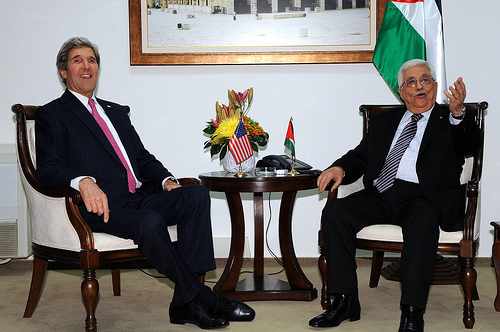
to any other person.[2]Unfortunately, the premises on which American negotiations -- led by U.S. Secretary of State John Kerry and U.S. Special Envoy for Israeli-Palestinian Negotiations, Martin Indyk[3] -- are based are completely at odds with the premises on which Middle Eastern negotiations are based. Americans seem to believe that all problems are solvable; if there is no solution, it simply means one has not tried hard enough. Americans generally are prepared to compromise on particular points to attain other points that are more important to them. When both sides reach an agreement, Americans usually are prepared to put past disagreements to bed. By making concessions, neither side has compromised its personal honor. Americans focus on the goal, which is to attain an agreement both sides can live with. We negotiate, arrive at an agreement and let bygones be bygones. Not so in the Middle East. The mere concept is inconceivable in the winner-take-all culture of that part of the world. Middle Easterners live with problems they know are unsolvable. For most, their immediate problems are never solved. Furthermore, any compromise is regarded solely as a backsliding that reduces personal honor and results only in indelible public shame. Far preferable is to paint a beautiful, if fictitious, patina over festering problems that cannot be solved, rather than to endure shame, dishonor and public humiliation. For many in the Middle East, perceived wrongdoings are never in the past and the past is never over. Wrongs – such as the Christian conquest of Muslim Spain, regardless of when they occurred -- must be righted.[4] Given the choice between war and shame, Middle Easterners will often choose war, even if that choice will result in both war and shame. Because Muslims ruled Spain from 712-1492 C.E., today, over five hundred year later, Muslim organizations there are still preparing to reconquer it in the name of Islam. Osama Bin Laden also repeatedly spoke about righting a perceived wrong he felt the West had imposed on the Muslim world more than 80 years ago: Turkey's then-leader, Mustafa Kemal Ataturk, expelled the entire family of the Ottoman Sultan, the Caliph, leader of the world's Sunni Muslims. So too with much of the area the Romans conquered in 6 A.D. The Emperor Hadrian renamed it Palestina in 135 A.D, but the area was then taken from the Eastern Roman Empire by the Muslims in 637 A.D. Today, any Palestinian Muslim leader who would sign a final peace agreement recognizing as Jewish any part of what had once been part of the Muslim World would be violating a core tenet of Islam.[5] And any Palestinian leader who agreed to surrender land held in trust by the Muslim waqf would not only be humiliated, but very likely assassinated. Abbas's predecessor, Yasser Arafat, faced this dilemma at Camp David in 2000, when Israel's Prime Minister, Ehud Barak, offered Arafat all of the West Bank and East Jerusalem, with the exception of what was under the Temple Mount. Arafat, knowing that he could never accept such an agreement, rejected Barak's offer. He then asserted that, "There never was a Jewish Temple there,"[6] and is reputed to have said, "Do you want see me up there having tea with Sadat?"[7] -- a reference to the assassination by Islamists of Egypt's President Anwar Sadat, who had signed a peace treaty with Israel. Kerry, Indyk and their staff, even with the best intentions, seem unaware that Muslims cannot ever, under any conditions, cede territory regarded as rightfully belonging to Muslims -- or, more aptly, to Allah -- to non-Muslims. So even with Kerry's and Indyk's -- or anyone's -- best efforts, any attempt to coax Abbas into signing a permanent agreement that would undermine this Muslim requirement is futile. Abbas undoubtedly understood the nature of his engagement with Kerry and Indyk from the outset.[8] He correctly calculated that so long as he continued to negotiate with Israel, the Americans and Europeans would continue to prop him up with political backing and financial support in the mistaken assumption that a solution can be reached. Looking at the public record of these negotiations, it seems apparent that the more the President and Secretary of State pressured Abbas to accept a final peace agreement with Israel, the more fearful he became that if he were to sign such an agreement, he too would find himself "having tea with Sadat." Given that Islam cannot accept a Jewish state, the Palestinians win peace talks by "not losing." While Israeli leaders seek peace, Palestinian leaders seek an endless peace process. Abbas simply needs to find a way to draw out the negotiations as long as possible, without ever coming to a final agreement.[9] Abbas, in all likelihood, knows he cannot rely on the Jordanians or Saudis to back him. Leaders of both nations have publicly said that they would agree to any agreement the Palestinians accepted with Israel -- the equivalent of firing blanks. The announcement was an excellent tactical move on their part: any Muslim leader who would permanently hand over Muslim territory to non-Muslims -- especially to Jews -- would be subject to public humiliation and almost certain assassination. Far better to let Abbas suffer the consequences rather than they, and meanwhile absolve themselves from any shame or blame in the process. Abbas's other out seems to have been embracing his mortal Palestinian enemy, Hamas. Abbas was doubtlessly aware that Hamas would also never consent to the conditions previously imposed on it by the Middle East Quartet: rejecting violence, recognizing Israel and accepting previous accords. Hamas could be counted on never to accept any treaty with Israel, as evidenced by the Hamas charter, which repeatedly calls not only for the destruction of Israel, but also of the Jews. This rapprochement with Hamas, however, not only enables Abbas to continue receiving funds from the U.S. and Europe, but later to be able to blame Hamas for any subsequent failure of the talks. Abbas now does not have to choose between either possible death or certain dishonor in the eyes of his fellow Palestinians. Hamas therefore provides the perfect cover Abbas needs not to sign any permanent peace agreement that Kerry & Co. still seem so determined to deliver. Thus, Kerry and Indyk have been pushing Abbas into a corner by trying to convince him to commit suicide in the name of permanently solving the Arab-Israeli dispute. Their inability or unwillingness to structure their framework accordingly has, in fact, enabled Abbas to entrench his negotiating positions even further.
Any agreement, such as a hudna ["truce"], is understood to be only temporary, until adequate forces can be built up with which to launch yet another attack. Abbas, cloaking his apparent rapprochement with Hamas as an attempt to unify the Palestinian people, is meanwhile also bolstering his declining status among his West Bank constituents. Although the Palestinian Authority is popular internationally -- in 2012, it achieved upgraded status as a non-member state in the United Nations -- it is weak domestically, with Abbas in the ninth year of his four year term in office. Conversely, Hamas is relatively weak internationally – designated a terrorist organization by Israel, the US, Egypt, the EU, Canada, Japan, and Australia -- but strong domestically. In 2007, Hamas expelled most Fatah members in a bloody coup and consolidated its control over Gaza. From Abbas's position, the unity bid probably represented a win-win, permitting him to dodge Kerry diplomatically while appealing to his constituents domestically. If anything, Kerry and Indyk should blame themselves for undermining their own well-intentioned efforts to achieve peace. [2] For more on the concept of waqf, see https://www.princeton.edu/~achaney/tmve/wiki100k/docs/Waqf.html [3] "What did Indyk contribute to peace talks?" Reuters, Newsletter 11.05.2014 [4] Notes of a Century, Bernard Lewis, p. 247-8. [5] For more on this principle and how it is understood today, see Knowing the Enemy: Jihadist Ideology and the War on Terror, By Mary R. Habeck, p. 115, and Basic Principles of Islam, Principle #6. [6] Camp David: An Exchange - The New York Review of Books, September 20, 2001 [7] "Do you want me to be up there having tea with Sadat?" [8] "Israel to U.S. and EU: Palestinians Deceived Kerry", Haaretz, May 7, 2014. [9] "Inside the talks' failure: US officials open up", YNet News, May 2, 2014.
Related
Topics: Harold Rhode
| Joseph
Raskas
India: Hindu Nationalists Reshaping Politics
by Vijeta Unyal
May 13, 2014 at 4:00 am
Be the first of your
friends to like this.
In the same spirit, the leading
London-based news magazine, The Economist, issued a fatwa of
its own. Why do supposedly liberal media, such as The Economist and
the Frankfurter Rundschau, smear people with whom they disagree
instead of presenting their readers with well-reasoned arguments?
And why do supposedly liberal
media support a religiously extreme, authoritarian movement rather than
individual freedoms?
Indian politics is a seemingly complicated affair. Indian elections have
mostly been fought and won on regional and local issues, with votes along
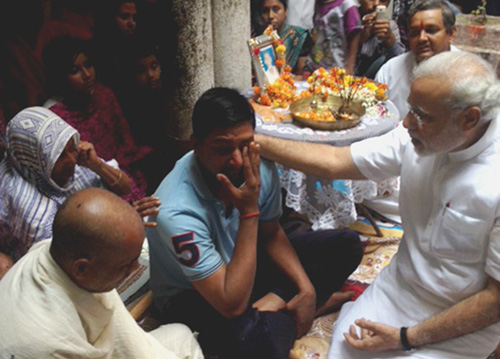
caste and clan-based lines.Since the 1990s, when the virtual single-party rule of the Congress Party came to an end, the key to power in New Delhi has been held by more than two dozen small regional parties. In this election cycle, all that has changed. For the first time in Indian history, voters have been presented with two distinct choices. This time, hundreds of millions of voters across India have found real reasons to cast their ballots. The last ten years of the Congress Party's rule have been marred by corruption scandals, slowed growth, declining foreign investment, lawlessness, rising inflation and foreign-policy missteps. Almost all opinion polls seem to show widespread dissatisfaction with the government. After a decade, the Congress Party cannot sell itself as a credible agent of change to discontented voters. The Congress Party had hoped to win these parliamentary elections on the strength of its welfare programs, but even the politics of freebies failed to avert a jarring defeat in state-level elections, held in December 2013. Sensing the general mood, the Congress Party is not even trying to run the campaign on its record of governance. Rather, it is putting its faith in Rahul Gandhi (age 43), the fourth generation heir-apparent of the Nehru-Gandhi Dynasty. He is pitted against Narendra Modi (age 63), the rival Hindu nationalist Bharatiya Janata Party [BJP] candidate. Narendra Modi has an impressive track record. He has run the western Indian state of Gujarat, but in the power circles of New Delhi, is considered an outsider. Modi has, however, run a successful grass-roots campaign -- upsetting existing political equations. Modi, however, has an "Achilles heel." He is unacceptable to Indian Muslims, who constitute over 15% of the electorate. His opponents charge him with complicity in a 2002 Hindu-Muslim riot in Gujarat. The charges have never been proven in the courts, including the Supreme Court of India, but Indian Muslims hold him accountable, nonetheless. The strategy of Rahul Gandhi's Congress Party has been to go after India's Muslim voting bloc, and has presented itself as the only political force capable of stopping Modi from coming to power. It mainly hopes to form the next government first by getting the Muslim votes, then cobbling together an alliance with smaller regional and caste-based parties. The most senior Imam of Delhi in his Friday sermon issued a "fatwa" [religious opinion] calling upon faithful Muslims to vote en bloc in favor of the Congress Party. In the same spirit, the leading London-based news magazine, The Economist, issued a fatwa of its own. In an editorial entitled, "Can anyone stop Narendra Modi?" The Economist called Modi a "divisive man" and accused him of "clinging to the anti-Muslim vote."
Why do supposedly liberal media, such as The Economist and the Frankfurter Rundschau smear people with whom they disagree, instead of presenting readers with well-reasoned arguments? And why do supposedly liberal media support a religiously extreme, authoritarian movement instead of individual freedoms? Outside his political party, Modi is largely a political pariah also in India. Shunned by the mainstream media and liberal intelligentsia, Modi has found a new medium to bring home his message: social media. His foot soldiers are disparagingly called the "Internet Hindus" -- young (age 18-25), tech-savvy Indians, who passionately defend their candidate, keep the heat on his rivals and, in "real time," counter every opposing argument with social media content. Modi's BJP is not averse to the idea of promising freebies to secure votes, but BJP's promise of delivering high economic growth by cutting government regulations and ending "tax terrorism" after a decade-long policy paralysis has found takers in the business community and the middle class. A series of opinion polls have predicted Modi's victory in these elections, but the final result on May 16th is anyone's guess. Regardless of the election results, Hindu nationalists have managed to establish themselves as the single largest political force in India. India's fragmented politics seems to be giving way to two competing camps: the determined Hindu nationalists versus everyone else. The cobbled-together alliance opposing Modi does not seem have any constructive agenda, only tactical electoral tie-ups to try to keep him out of power. Regardless of the results, however, for the first time Hindu nationalists have a nationwide appeal. Vijeta Uniyal is an Indian-born analyst based in Germany.
Related
Topics: India
|
|||||||||||||||
|
To subscribe to the this mailing list, go to http://www.gatestoneinstitute.org/list_subscribe.php |





 Posts
Posts


No comments:
Post a Comment