|
|
Follow the Middle East Forum
|
|
|
|
Related Articles
Turkey
and Israel: A Loveless Date
|
|
|
Share:  
|
  Be the first of
your friends to like this. Be the first of
your friends to like this.

There is official evidence and credible speculation that Turkey and
Israel may be on the brink of a historic handshake. Some say that it may
be a matter of weeks, some speak of a couple of months before old
friends, new foes, Turkey and Israel, will befriend each other once
again. Probably until they become foes once again.
Ankara and Jerusalem look like two teenagers being forced into an
unwilling date by their classmates, friends, foes and schoolteachers, and
also because they feel alone and threatened; not because they feel even
halfheartedly warm toward one another. They are nervously, grudgingly
going on their date.
After nearly six years, staggering diplomacy and pragmatism will
probably win over emotions and deep mistrust. Since Turkey and Israel
downgraded their diplomatic ties in 2010, Turkey's Islamist leaders have
been careful about distinguishing between the "Israeli people"
and "Israeli government." Deviating from that rhetoric for the
first time, Omer Celik, spokesman for the ruling Justice and Development
Party, said that "the Israeli state and people are
friends of Turkey." That was a powerful confidence-building effort
on Turkey's part.
Celik's statement found an echo in Israel. On January 23, Israel's
Prime Minister Benjamin Netanyahu said that he was hopeful about normalization of ties
with Turkey, and that normalization would be good for both countries.
|
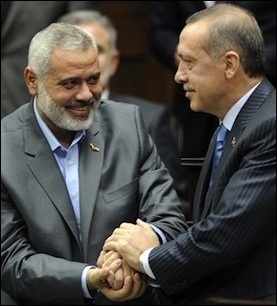
Erdogan
with Hamas leader Ismail Haniyeh in 2012.
|
But, as peace looked to be blossoming, reality showed its face.
Speaking in Athens, Israeli Defense Minister Moshe Ya'alon bluntly told the world where he sees Turkey in the global
fight against Islamic terror. The Turkish government has to decide, he
said, "Whether they want to be part of any kind of cooperation in
fighting terrorism, [and] this is not the case so far." More
disturbingly, Ya'alon said that the Islamic State of Iraq and Syria
(ISIS) "enjoyed Turkish money for oil for a very, very long period
of time," that Turkey allowed jihadists to move from Europe to Syria
and back home, and that Turkey still hosts Hamas's "external
terrorist brokers in Istanbul."
All that, under different circumstances, would have triggered a prompt
and strong backlash from Ankara. Surprisingly -- or not -- Ankara
remained unusually mute and mature. The denial of Ya'alon's allegations
came from Ankara, but not from the Turkish government. The U.S.
Ambassador to Turkey, John Bass, rejected the Israeli minister's claims
and insisted that there is no evidence to support the allegations. Bass said: "In fact, ISIS oil smuggling has
decreased over time, due to the efforts of Turks and other counter-ISIS
coalition members to target oil extraction and transportation
infrastructure. Turkey continues to take steps to improve the security of
its border with Syria, working with the United States and other international
partners."
Why were the Turks -- always childishly angry at any accusation from
Israel -- silent, and why did the U.S. ambassador jump in like a referee
in a boxing ring? It is vital for U.S. interests that the country's two
Middle Eastern allies stop their feud and shake hands. And the American
ambassador wanted to diffuse a potentially explosive dispute before it
seriously began.
Yet the ground is, and will probably remain, shaky in the
Turkish-Israeli dating scene. Recent research
found that nearly 60% of Turks view Israel as a security threat to their
country. Worse, anti-Semitism in Turkey, fueled in recent years by the
same Islamist government that now shyly wants to make peace with Israel,
does not allow the Turks to be aware that it is time to be a bit more
mature and a lot more pragmatic.
Turkey's ruling Islamists have
systematically nurtured and exploited anti-Semitic sentiments.
|
Turkish vandals spray-painted graffiti on a synagogue in Istanbul,
just days after a one-time prayer service was held -- the first in 65
years. They wrote on the external walls of the building, "Terrorist
Israel, there is Allah," in white paint.
"Writing anti-Israel speech on the wall of a synagogue is an act
of anti-Semitism," said Ivo Molinas, editor-in-chief of Salom,
a weekly newspaper of Istanbul's Jewish community, in an interview with
the Turkish newspaper, Today's Zaman.
That will be the problem after any possible Turkish-Israeli handshake.
Diplomacy is about ups and downs. But stereotypes and public perceptions
of who is the foe or friend are often sticky. Turkey's ruling Islamists
have systematically nurtured and exploited anti-Semitic sentiments. Now
that the nearest election is four years away and there is no longer an
emerging Turkish empire on the Arab Street, government-sponsored
anti-Semitism in Turkey is suddenly supposed to be a thing of the past.
By a simple twist of fate, the architects of Turkish anti-Semitism will
now have to use the same propaganda machine they used to fuel
anti-Semitism to diffuse it if they want a sustainable courtship with their
old Jewish friends.
Burak Bekdil is an Ankara-based
columnist for the Turkish newspaper Hürriyet Daily News and a fellow at the
Middle East Forum.
|
|
|
|
|





 Posts
Posts


No comments:
Post a Comment