|
Related Articles
Shifting
Eastern Mediterranean Alliances
by Emmanuel Karagiannis
Middle East Quarterly
Spring 2016 (view PDF)
|
|
|
Share:  
|
  Be the first of
your friends to like this. Be the first of
your friends to like this.
|
The
exploitation of energy resources in the Eastern Mediterranean has drawn
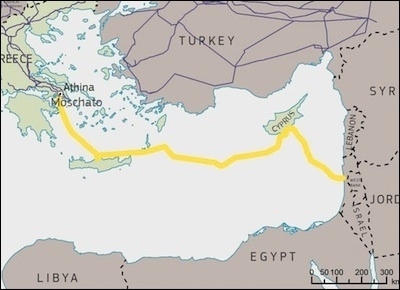
together hitherto estranged states. In August 2013, Cyprus, Greece, and
Israel signed onto the "EuroAsia Interconnector" project,
which would install a 2000-megawatt underwater electric cable
(illustrated above) to connect their power grids and to be a means by
which "three nations ... [can] enhance their growth and
prosperity" and build a "bridge of friendship between our
nations."
|
The Eastern Mediterranean is changing fast with its estimated 122
trillion cubic feet (tcf) of natural gas reserves (the equivalent of 21
billion barrels of oil) already having an impact on regional patterns of
amity and enmity.[1]
With Israel and Cyprus well underway to becoming gas exporters, the
problematic Israeli-Lebanese and Cypriot-Turkish relationships have been
further strained. At the same time, energy cooperation has been the
driving force behind the nascent Greek-Cypriot-Israeli partnership,
manifested in rapidly growing defense and economic cooperation. Clearly,
the development of energy resources and their transportation will have
far-reaching geopolitical implications for the Eastern Mediterranean and
its nations.
The Strategic
Significance of the Gas Reserves
Natural gas is the fastest growing source of energy in the world,
currently accounting for 22 percent of total global energy consumption.[2] It is both affordable and more
environmentally friendly than other commercially feasible options,
resulting in an increasing demand even in an era of dropping oil prices.
That demand seems likely to be met in large part by the newly discovered
gas reserves of the Eastern Mediterranean.
|
Israel
has the potential to become an important regional producer of liquefied
natural gas. Its Tamar field, with estimated reserves of 9.7 trillion
cubic feet (tcf), came online in 2013 while its Leviathan gas field
(above), with a potential of 16 tcf, is slated to be ready for
production in 2017.
|
Israel, for one, has the potential to become an important regional
producer.[3] Its
Tamar field was confirmed to have estimated reserves of 9.7 tcf[4] while its Leviathan gas field
has the potential of producing up to 16 tcf.[5] Meanwhile, in November 2011,
U.S.-based Noble Energy announced a major gas discovery south of Cyprus:
The Aphrodite field was estimated to contain 7 tcf.[6] In February 2013, a seismic
survey south of Crete indicated that rich hydrocarbon resources may soon
be found in Greek waters.[7]
Most recently, the Italian company Eni announced the discovery of a huge
gas field off the coast of Egypt.[8]
For reasons of geographical proximity, these Mediterranean energy
resources concern first and foremost the European Union—the world's third
largest energy consumer behind China and the United States.[9] While oil is still the dominant
fuel, accounting for 33.8 percent of total EU energy consumption, natural
gas comes in second at 23.4 percent.[10] The Eastern Mediterranean gas
reserves have three distinct advantages for European governments (and
companies) and are thus viewed by them as a strategic priority. First,
due to their smaller sizes and populations, the needs of Israel and
Cyprus are relatively low and most of their gas could be exported.
Second, Eastern Mediterranean gas could partly cover Europe's energy
needs and thereby decrease its dependence on an increasingly volatile
Russia. Finally, since both Israel and Cyprus lack the capital and the
offshore drilling technology to develop gas reserves on their own,
foreign energy companies have identified them as investment opportunities
that could generate significant financial returns.
As the Middle East implodes, security of energy supply has become an
important policy objective for the EU. Indeed, there is a consensus among
European governments that new initiatives are needed to address energy
challenges. The EU is already directly involved to some extent in Eastern
Mediterranean energy affairs because Greece and Cyprus are member states
while Turkey is a candidate for membership and has a customs union with
the EU. Although the governments of the EU and Israel are often at odds
politically, economic relations between Jerusalem and Brussels are close
and multifaceted.
The development of Israeli and Cypriot gas fields could help
strengthen Europe's energy security. Currently, European countries import
liquefied natural gas (LNG) from politically unstable countries such as
Nigeria and Algeria. But the Eastern Mediterranean could serve as a third
gas "corridor" for Europe, alongside Russian gas and the
southeast European pipelines for Azeri gas. The Italian Eni company, the
British Premier Oil, and the Dutch Oranje-Nassau Energie have clearly
shown interest by bidding in the second round of licensing for natural
gas exploration in the Cypriot exclusive economic zone (EEZ),[11] a sea zone prescribed by the
United
Nations over which a state has special rights.
The U.S. administration views
Eastern Mediterranean gas as an alternative source for its European
allies who depend heavily on Russian supplies.
|
Given the prominence of the Middle East for U.S. energy policy, it is
hardly surprising that the gas finds in Israel and Cyprus have drawn
Washington's attention as well. Although the U.S. is likely to become the
largest gas producer in the world as a result of increased use of shale
gas, the administration views Eastern Mediterranean gas as an alternative
source for its European allies who depend heavily on Russian supplies.[12] Within the private sector, the
American company, Noble Energy, has played a leading role in the
exploration process; it has a 40 percent stake in the Leviathan fields, a
36 percent stake in Tamar, and a 70 percent stake in Aphrodite.
Not surprisingly, these discoveries have attracted Moscow's interest
as well due to a potential, adverse impact on its gas exports to European
markets. Russian energy companies, which often act as the Kremlin's
long-arm, are particularly active in the region. In February 2013, for
example, Gazprom signed a 20-year deal with the Israeli Levant LNG
Marketing Corporation to purchase liquefied natural gas exclusively from
the Tamar field.[13]
Then in December 2013, the Russian company SoyuzNefteGas signed an
agreement with the Assad regime to explore part of Syria's exclusive
economic zone. One month later Putin signed an investment agreement with
Palestinian leader Mahmoud Abbas to develop gas fields off the Gaza
Strip.[14]
Warming
Israeli-Greek Relations
|
Despite
past support for the Palestinians, newly-elected Greek prime minister
Alexis Tsipras (left) of the left-wing SYRIZA party, here with Israeli
prime minister Binyamin Netanyahu, has sought to strengthen ties with
the Jewish state. Greece's location makes it a natural bridge between
the energy-rich Eastern Mediterranean and energy-consuming Europe while
Israel is now poised to become a major natural gas producer. Thus,
Greece and Israel share significant energy interests.
|
Energy considerations have a long history of influencing the course of
relations between states, and the new gas discoveries are no exception to
this rule, affecting Israel's relations with both Greece and Cyprus.
Greek-Israeli relations have been frosty for decades. The postwar
Greek governments typically followed a pro-Arab foreign policy in order
to protect the large Greek community in Egypt, secure Arab support on the
Cyprus dispute in the United Nations, and maintain access to cheap Arab
oil.[15]
While there was de facto recognition of the Jewish State in 1949, legal
recognition needed to wait until 1990 under the right-wing Mitsotakis
government. But the formation of a Turkish-Israeli strategic partnership
in the mid-1990s provoked a strong backlash with Athens reverting to its
pro-Arab policy.[16]
This policy, too, has changed with the rise of Recep Tayyip Erdoğan
and his Islamist Justice and Development Party (Adalet ve Kalkınma
Partisi, AKP) in Turkey since the early 2000s. With Athens alarmed by
Ankara's growing regional assertiveness, and Jerusalem disturbed by the
new regime's fiercely anti-Israel approach, Greek-Israeli relations
improved rapidly with the two countries signing a string of agreements in
the fields of security, energy, trade, and tourism, and exchanging
official visits at the ministerial, presidential, and prime-ministerial
levels.[17] In
March 2012, the air-naval exercise Noble Dina, involving U.S., Israeli,
and Greek forces, was conducted in the Aegean Sea while, a month later, a
joint Greek-Israeli air exercise was held in central Greece. Most
recently, Minister of Defense Panos Kammenos stated that "[Greek]
defense planning should take into account friends and allies who seek
defense cooperation in the region. And I clearly mean eastward toward
Israel."[18]
Athens's new Israel policy has been largely unaffected by the frequent
change of governments in recent years. The last three prime ministers
before the current one—George Papandreou (2009-11), Loukas Papadimos
(2011-12), and Antonis Samaras (2012-15)—all met with Israeli officials
and concluded agreements, all the more striking given the political and
ideological differences among them: Papandreou is a moderate,
left-of-center politician; Papadimos is known as a liberal technocrat,
and Samaras, a right-wing politician.
In the wake of the economic crisis that has roiled domestic Greek
politics and the austerity measures that the EU has sought to impose on
Athens, Greeks took to the polls in January 2015 and brought to power the
left-wing SYRIZA (Greek acronym of the Coalition of the Radical Left)
party, in coalition with the small, right-wing party, the Independent Greeks.
This caused considerable alarm in Jerusalem as many senior SYRIZA
officials have strong pro-Palestinian sympathies: European Member of
Parliament Sofia Sakorafa, for one, is a self-proclaimed friend of Hamas
while Prime Minister Alexis Tsipras has participated in pro-Palestinian
rallies. In late December 2015, the Greek parliament passed a non-binding
resolution recommending recognition of "Palestine" as a state.
And yet, the SYRIZA-led government has not distanced itself from
Jerusalem. Foreign Minister Nikos Kotzias identified Turkey as a source
of threats[19]
while Minister of Defense Kammenos, leader of the Independent Greeks,
harbors strong pro-U.S. and pro-Israeli views.[20] In late November 2015, Tsipras
visited Israel and, yet again, on January 27, 2016, together with six
members of his cabinet when they held a joint meeting with the Israeli
government.[21]
So it seems likely that the Greek-Israeli partnership will continue.
Athens is seeking bids for an
Eastern Mediterranean pipeline to carry Israeli and Cypriot gas to
Europe.
|
Beyond common concerns about Turkey's intentions, Athens and Jerusalem
share significant energy interests. Both countries want to implement the
1982 U.N. Convention of the Law of the Sea (UNCLOS) to facilitate the
exploration and exploitation of the seabed;[22] and both maintain that the
Eastern Mediterranean could be unilaterally developed through its division
into exclusive economic zones of 200 nautical miles. In contrast, Ankara
has not signed on to UNCLOS and favors a settlement in the Aegean and the
Eastern Mediterranean that would take perceived Turkish interests into
greater account.
Moreover, Greece's location makes it a natural bridge between the
energy-rich Eastern Mediterranean, including Israeli fields, and
energy-consuming Europe, and Greeks see the country as a hub for bringing
Eastern Mediterranean gas to European markets. In March 2014, Athens announced
an international tender for a feasibility study of the Eastern
Mediterranean pipeline to carry Israeli and Cypriot gas to Europe via
Crete and the mainland.[23]
While the proposed pipeline would be rather expensive and pass through
disputed waters, Russian intervention in the Crimea and eastern Ukraine
has given new momentum to the project as the EU looks for alternative
sources of natural gas.[24]
The European Commission has included the proposed pipeline in its list of
"Projects of Common Interests" that could receive financial
support.[25]
If Jerusalem and Nicosia decide to opt for liquefaction of their gas
resources, then Greek-owned shipping could also play an important role in
transporting liquid gas to the international market. During his visit to
Israel in November 2015, Tsipras stated,
One of the main issues in our
discussions today was [sic] the opportunities arising in the
fields of energy in the Eastern Mediterranean ... We are examining ways
to cooperate in research, drilling, and the transportation of gas from
Israel to Europe.[26]
While energy is not the sole factor contributing to the improvement of
bilateral relations, it has certainly played a crucial role in the
convergence of Greek and Israeli interests in the Eastern Mediterranean.
Jerusalem and
Nicosia
The development and exploitation of Eastern Mediterranean energy
resources have also given a boost to Israeli-Cypriot relations. Despite
geographical proximity, the two countries have largely ignored each other
for years. For most Israelis, Cyprus is either the site where Holocaust
survivors were forcibly interned by the British (1946-49) as they sought
refuge in mandatory Palestine or the closest place where couples unable
or unwilling to contract a religious marriage in Israel are able to enter
into a civil marriage.
For its part, Nicosia traditionally took a pro-Arab line in diplomatic
settings that differed little from neighboring Greece; and just like in
Greece, the AKP-induced chill in Turkish-Israeli relations had a warming
effect on Cypriot-Israeli relations. In March 2011, Israeli president
Shimon Peres hosted his Cypriot counterpart, President Demetris
Christofias, who reciprocated this hospitality in November. Both sides
came to view each other as potential counterbalances to Turkey's presence
in the Eastern Mediterranean. Cypriot defense minister Dimitris Iliadis
signed an agreement on the "Mutual Protection of Confidential
Information" in January 2012 with his Israeli counterpart, Ehud
Barak,[27]
and a month later, Netanyahu paid a visit to Nicosia, the first ever by
an Israeli prime minister, to discuss energy and defense cooperation.
According to press reports, the Cypriot navy is planning to buy two
Israeli-manufactured hi-tech offshore patrol vessels in order to patrol
its exclusive economic zone.[28]
The energy dimension of the nascent Israeli-Cypriot relationship is
particularly strong. Nicosia has announced plans to build a liquefied
natural gas plant in its Vassilikos industrial area to process its gas.
Since the current gas finds are not large enough to make this
multi-billion dollar project economically viable, Nicosia has suggested
to Jerusalem that the two countries pool their gas reserves to form a
single producing unit. In 2013, Minister of Energy Yiorgos Lakkotrypis
declared:
[W]e feel that through a close
collaboration with Israel, we will be able to be a major player in the
world energy market, something that might be too hard for each country to
achieve individually.[29]
The future of the Israeli-Cypriot partnership will also depend on the
export route of the Israeli gas. Jerusalem has examined a number of
options for the optimum utilization of its gas fields but probably
prefers to export gas westward in order to improve its relations with
European countries.[30]
From the Israeli perspective, energy cooperation with Greece and Cyprus
could build a new web of alliances with the EU that would help Jerusalem
to break out of its increasing geopolitical isolation. The Netanyahu
government even lobbied on behalf of Greece in Europe and the United
States for an economy recovery plan.[31] In late March 2012, during an
energy conference in Athens, then Israeli minister of energy Uzi Landau
spoke of "an axis of Greece, Cyprus, and Israel and possibly more
countries, which will offer an anchor of stability."[32] In August 2013, the three
countries signed an agreement to install a 2000-megawatt underwater
electric cable to connect their power grids—the first of its kind to
connect Europe and Asia.[33]
Most recently, in December 2015, a series of trilateral consultations
was held in Jerusalem in which a set of issues were taken up and
discussed, with energy development topping the list. The parties agreed
to further promote trilateral consultations and to meet on a regular
basis, beginning with a meeting of their heads of state in Nicosia on
January 28, 2016.[34]
Lebanon,
Cyprus, and Israel
While revenues from the sale of oil and gas can bring wealth and
prosperity to societies, they also have the potential to upset regional
balances of power. In the Eastern Mediterranean, where countries have
been locked in conflicts over territory for decades, gas discoveries seem
likely to increase the stakes. Contested ownership of gas resources has,
in fact, destabilized already strained relations between Israel and
Lebanon as well as between Turkey and Cyprus.
Although a delimitation agreement between Lebanon and Cyprus was
signed in January 2007, the Lebanese parliament has refused to ratify it
to date, and Hezbollah declared the agreement
null and void because the Lebanese side
that signed it had its official capacity revoked ... The sea, like land, is
a one hundred percent legitimate Lebanese right, and we shall defend it
with all our strength.[35]
When in December 2010, Nicosia signed an agreement with Jerusalem
demarcating their maritime borders, Beirut accused both states of
violating its maritime rights.[36]
The following year, in a televised speech marking the fifth anniversary
of Hezbollah's 2006 war with Israel, the group's secretary general,
Hassan Nasrallah, threatened Israel with a strike against its energy
infrastructure:
We warn Israel against extending its
hands to this area and steal[ing] Lebanon's resources from Lebanese
waters ... Whoever harms our future oil facilities in Lebanese
territorial waters, its own facilities will be targeted.[37]
These are not hollow threats. Hezbollah has the military capacity to
attack Israel's offshore gas platforms should it choose to do so. The
2006 war revealed that its vast arsenal of missiles and rockets includes
Chinese-manufactured C-802 anti-ship missiles (range 75 miles) and
Zelzal-2 rockets (range 125-250 miles).[38] For its part, the Israeli navy
is acquiring at least two 1,200-ton patrol-class vessels, along with
additional unmanned aerial vehicles and missile-armed, remote-control
gunboats.[39]
In this way, Jerusalem seeks to deter possible raids from Lebanon. The
protection and exploitation of gas reserves is thus seen by the Israeli
leadership as a matter of national security.
Turkey,
Cyprus, and Israel
The relationship between Turkey and Cyprus is yet another example of a
long-standing conflict with few prospects of imminent resolution, and the
AKP's rise to power has only exacerbated the situation.
|
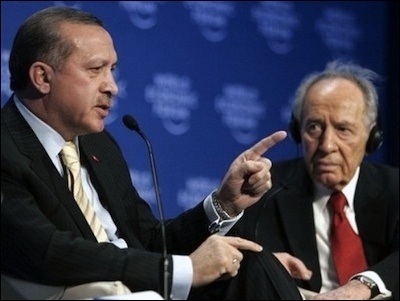
Turkey's
strongman, Islamist Recep Tayyip Erdoğan (left), seen here at the World
Economic Forum, Davos, in 2009, publicly berating Israel's
then-president Shimon Peres for alleged Israeli misconduct, has managed
to alienate—and alarm—Eastern Mediterranean neighbors with frequent
outbursts and occasional saberrattling. This has led Cyprus, Israel,
and Greece, the area's potential energy producers and transporters, to
seek closer ties that would have been inconceivable a decade ago.
|
In Erdoğan's increasingly paranoid worldview, the possible economic
and diplomatic revival of Cyprus as a result of gas development poses a
clear and present danger to Turkish national security. In September 2011,
Ankara signed a continental shelf delimitation agreement with the "Turkish
Republic of Northern Cyprus," and shortly afterward, the Turkish
state oil company (TPAO) started its first drilling near the occupied
Cypriot city of Famagusta.
While Ankara has invited foreign companies to explore its
Mediterranean coast for energy resources, only the Royal Dutch/Shell has
thus far expressed interest.[40]
In late October 2014, a Turkish research vessel entered the Cypriot EEZ
to collect seismic data. Nicosia viewed this as a violation of its
sovereign rights, since it had already licensed parts of its EEZ to
foreign energy companies.[41]
Israeli and Turkish officials have
recently concluded secret talks about bilateral reconciliation.
|
The energy factor has also internationalized the "Cyprus
Problem," creating a new point of friction between Ankara and
Jerusalem. The Turkish government did not anticipate the rapid
improvement of Israeli-Cypriot relations and fears that the bilateral
cooperation will not be limited to the energy sector. Even before this
development, Erdoğan had threatened Jerusalem over its gas exploration
initiatives, warning that while "Israel has begun to declare that it
has the right to act in exclusive economic areas in the
Mediterranean...[it] will not be owner of this right."[42] For its part Jerusalem has not
remained passive, requesting Cypriot permission for the use of the Paphos
air base by Israeli fighter jets.[43]
In early November 2015, the two countries conducted the second
Onisilos-Gideon military exercise in the western part of the island.
The internationalization of the "Cyprus Problem" extends
well beyond the region. Chinese companies have already bid for gas
exploration and liquefaction projects in the Eastern Mediterranean and
are negotiating an agreement with the Cypriot government to purchase LNG
by 2020. Consequently, Beijing has closely followed the Cyprus peace
negotiations.[44]
An
Engine for Conflict Resolution?
The Eastern Mediterranean energy boom has helped warm traditionally
chilly bilateral relationships between some countries while aggravating
already strained relations with others. Can it also become an engine for
promoting regional cooperation?
While the last few years have seen a great deal of saberrattling out
of Ankara, the likelihood of a military confrontation between Cyprus and
Turkey, or Israel and Turkey, seems small. The construction and operation
of energy infrastructure (e.g., pipelines, refineries, natural gas
plants) is a costly business requiring political stability, and Ankara
may not wish to undermine its role as an energy transit state. Indeed,
Israeli and Turkish officials have recently concluded secret talks about
bilateral reconciliation that covered, among other items, the laying of a
natural gas pipeline between the two countries. This would allow Turkey
to reduce its energy dependence on Russia (relations with which have
worsened following the downing of a Russian fighter jet in November 2015)
as well as to open up a new market for Israel's natural gas projects off
its coast.[45]
In addition, Ankara has offered to build a "peace pipeline"
to transport Cypriot gas to European markets via Turkish territory.[46] Nicosia has not rejected this
plan provided there is a resolution to the "Cyprus problem,"
including the reunification of the island and the withdrawal of Turkish
troops from the northern section. This bolsters the argument, advanced by
the U.S. State Department among others, that gas profits could contribute
to the island's unification as both Greek and Turkish Cypriots would have
major additional incentives to accept a peace deal.[47] It is no coincidence that the
special representative for regional energy cooperation for the
newly-established State Department's Bureau of Energy Resources is based
in the U.S. embassy in Nicosia.[48]
This optimism is rooted in the long-held, liberal view of
international relations positing that economic benefits resulting from
energy transportation can help resolve political conflicts. Yet if
history offers any guide, an economic boom attending hydrocarbons exports
can just as often lead to ethnocentrism and economic nationalism as to
goodwill and shared prosperity. The production of large quantities of oil
and natural gas in the North Sea, for example, has strengthened Scottish
nationalism and may eventually lead to Scotland's secession from the
United Kingdom. Likewise, the Clinton administration's promotion of a
"peace pipeline" to carry Azerbaijani oil through the contested
area of Nagorno-Karabakh and Armenia to the Turkish market failed because
Armenia did not wish to make the necessary territorial concessions to
Azerbaijan.[49]
Then again, in 2004, Georgian leader Mikheil Saakashvili floated the
construction of a Russian-Georgian oil pipeline through the breakaway
republic of Abkhazia to facilitate a solution to the Georgian-Abkhazian
conflict, only to be rebuffed by both Russia and Abkhazia.[50] The proposed
Iran-Pakistan-India gas pipeline had the same fate in 2009 when the Indian
government announced its decision not to participate in the project for
security reasons.[51]
Evidently, such pipelines have failed to materialize because states
were neither willing to surrender territory nor comfortable depending on
hostile neighbors in return for possible economic benefits. Those who
envisage the prospect of a "peace pipeline" positively
affecting the current negotiations between Greek and Turkish Cypriots for
the resolution of the "Cyprus Problem" may find themselves
seriously disappointed.
Conclusion
The new substantial gas discoveries in the Eastern Mediterranean are
rapidly transforming regional orientations. Energy interests have brought
Israel closer than ever diplomatically to Cyprus and Greece and have
played an important role in the apparent thaw in Israeli-Turkish
relations. At the same time, energy has generated new tensions between
producing countries and countries that feel excluded from the regional
natural gas development opportunities. Relations between Turkey and
Cyprus as well as between Israel and Lebanon, poor at best, have come
under further strain.
U.S. and European interests will
be well served by the emergence of the Eastern Mediterranean as a
gas-exporting region.
|
Undoubtedly, U.S. and European interests will be well served by the
emergence of the Eastern Mediterranean as a gas-exporting region.
However, this will only be possible if there is a resolution to the
ownership issue that can accelerate the pace of private investment in the
regional gas industry.[52]
Without a region-wide legal agreement, energy companies may not be
able to secure the necessary funding to develop and implement gas
projects. Washington, which enjoys good relations with all Eastern
Mediterranean countries, could act as a broker in hosting multilateral
regional talks to defuse tensions and promote mutual understanding
between countries in the region.
Emmanuel Karagiannis is senior
lecturer at the department of defense studies, King's College, London,
and author of Political
Islam in Central Asia (Routledge, 2010) and Energy and Security
in the Caucasus (Routledge, 2002).
[1]
"Natural
Gas Potential Assessed in Eastern Mediterranean," U.S.
Geological Survey, Office of Communication, Reston, Va., Aug. 4, 2010.
[2]
"International Energy Outlook 2013," Office of Communications,
U.S. Energy Information Administration, Washington, D.C., July 25, 2013.
[3]
Brenda Shaffer, "Israel—New
Natural Gas Producer in the Mediterranean," Energy Policy,
Sept. 2011, pp. 5379-87.
[4] Haaretz
(Tel Aviv), Aug.
13, 2009.
[5]
"Israel and its natural resources: What a gas!" The
Economist, Nov. 11, 2010.
[6] Cyprus
Mail (Nicosia), Oct.
4, 2013.
[7] Kathimerini
(Neo Faliro, Gr.), Feb.
27, 2013.
[8] BBC
News, Aug.
20, 2015.
[9]
"Total
Energy Consumption, 2014," Global Energy Statistical Yearbook
2015, Enerdata,
Grenoble, accessed Jan. 15, 2016.
[10] EU
Energy Market in 2014 (Luxemburg: Publication House of the European
Union, The European Commission, 2014), p. 6.
[11]
"Second
Licensing Round—Hydrocarbons Exploration," Ministry of Energy,
Commerce, Industry and Tourism, Republic of Cyprus, Nicosia, accessed
Dec. 29, 2015.
[12] Middle
East Online (London), Aug. 6, 2013.
[13] RIA
Novosti (Moscow), Feb.
26, 2013.
[14] Ed
Blanche, "Enter
the Bear," The Middle East, Mar. 2014, pp. 29-30.
[15]
John Sakkas, "Greece, Arab World and Israel: A Troubled Triangle in
the Eastern Mediterranean," Defensor Pacis (Athens), Mar.
2007, pp. 95-104.
[16]
Amikam Nachmani, Turkey-Israel Strategic Partnership (Raman Gan:
The BESA Center for Strategic Studies, 1999), pp. 1-10.
[17] The
Washington Post, Oct. 21, 2010.
[18] The
Times of Israel (Jerusalem), Feb. 11, 2015.
[19] Sigma
Live (Nicosia), Nov.
30, 2015.
[20] The
Jerusalem Post, July 19, 2015.
[21]
Israel Ministry of Foreign Affairs, "Israel and Greece hold
Government-to-Government Consultation," Jan.
27, 2016.
[22]
"Israel's
Candidature for IMO Council 2014-2015," Ministry of Foreign
Affairs, Sept. 9, 2013.
[23]
Reuters, Aug. 10, 2014.
[24] New
Europe (Brussels), Mar. 11, 2014.
[25] "Projects
of Common Interests," The European Commission, Brussels, Oct. 14,
2013.
[26] Kathimerini,
Nov. 25, 2015.
[27] Today's
Zaman (Istanbul), July 3, 2012.
[28] Cyprus
Mail, Dec. 18, 2013.
[29] Hürriyet
(Istanbul), May 9, 2013.
[30]
Simon Henderson, "Natural
Gas Export Options for Israel and Cyprus," German Marshall Fund
of the United States, Washington, D.C., Sept. 10, 2013.
[31] The
Jerusalem Post, Mar.
6, 2011.
[32] Kathimerini,
Mar.
28, 2012.
[33] Cyprus
Mail, Aug.
9, 2013.
[34]
Joint Statement: Second Political Consultations at the level of
Secretaries General of Israel, Greece and Cyprus MFA's—17/12/2015,
Ministry of Foreign Affairs, Nicosia.
[35] Al-Akhbar
(Beirut), Oct. 27, 2012.
[36] YNet
News (Tel Aviv), July 10,
2011.
[37] The
Daily Star (Beirut), July 27, 2011.
[38] BBC
News, Aug. 3, 2006.
[39] United
Press International, May 23, 2013.
[40] Hürriyet,
Nov.
23, 2011.
[41] The
Guardian (London), Nov.
10, 2014.
[42]
Simon Henderson, "Turkey's
Threat to Israel's New Gas Riches," Policywatch, no.
1844, The Washington Institute for Near East Policy, Washington, D.C.,
Sept. 13, 2011.
[43] The
Jerusalem Post, July
2, 2012.
[44] Li
Guofu, "China: An Emerging Power in the Mediterranean," in
Daniela Huber, et al., eds., The Mediterranean Region in a Multipolar
World: Evolving Relations with Russia, China, India, Brazil,
(Washington, D.C.: The German Marshall Fund of the United States, 2013),
pp. 11-9; "Will Cyprus
Become a New Investment Heaven for China?" China Radio
International (Beijing), Oct. 31, 2013; Chinese ambassador Liu Xinsheng,
interview, Cyprus Mail, Jan. 5, 2015.
[45] The
Wall Street Journal, Dec. 18, 2015.
[46] Hürriyet,
May
27, 2013.
[47] Sigma
Live, July 24, 2015; Ethnos (Athens), Mar. 29, 2012.
[48] Cyprus
Mail, Feb. 9, 2012.
[49]
John J. Maresca, "A Peace Pipeline to End the Nagorno-Karabakh
Conflict," Caspian Crossroads, Winter 1995, pp. 17-8.
[50]
George Anjaparidze and Cory Welt, "A
Georgian-Russian Pipeline: For Peace or Profit?" Eurasianet
(New York), Mar. 8, 2004.
[51] The
Hindu (Chennai, Madras), Nov.
25, 2013.
[52]
James Stocker, "No EEZ Solution: The Politics of Oil and Gas in the
Eastern Mediterranean," Middle East Journal, Autumn 2012, pp.
579-97.
|







 Posts
Posts


No comments:
Post a Comment