|
ADVERTISEMENT
Turkey's Erdoğan Gambles and Loses
|
|
|
|
Share:  
|
  Be the first of
your friends to like this. Be the first of
your friends to like this.
N.B.: Australian title is
"Erdoğan's despotic slide in Turkey is bad news for Europe"
The Republic of Turkey, long a democratizing Muslim country solidly in
the Western camp, now finds itself internally racked and at the center of
two external crises, the civil war in next-door Syria and the illegal
immigration that is changing European politics. The prospects for Turkey
and its neighbors are worrisome, if not ominous.
The key development was the coming to power of Recep Tayyip Erdoğan in
2002, when a fluke
election outcome gave him total control of the government, which he
then brilliantly parlayed into a personal dominion. After years of
restraint and modesty, his real personality – grandiloquent, Islamist,
and aggressive – came out. Now, he seeks to rule as a despot, an ambition
that causes his country incessant, avoidable problems.
Initially, Erdoğan's disciplined approach to finance permitted the
Turkish economy to achieve China-like economic growth and won him
increasing electoral support while making Ankara a new player in regional
affairs. But then conspiracy theories, corruption, short-sightedness, and
incompetence cut into the growth, making Turkey economically vulnerable.
Initially, Erdoğan took unprecedented steps to resolve his country's
Kurdish problem, acknowledging that this ethnic minority making up
roughly 20 percent of the country's population has its own culture and
allowing it to express itself in its own language. But then, for
electoral reasons, he abruptly reversed himself last year, resulting in a
more-than-ever determined and violent Kurdish insurgency, to the point
that civil war has become a real prospect.
Initially, Erdoğan accepted the traditional autonomy of the major
institutions in Turkish life – law courts, the military, the press,
banks, schools. No longer; now he seeks to control everything. Take the
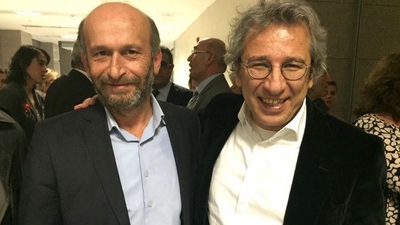
case of two prominent journalists, Can
Dündar and Erdem Gül: because their newspaper, Cumhuriyet,
exposed the Turkish government's clandestine support for the Islamic
State (ISIS), Erdoğan had them imprisoned on the surreal charges of
espionage and terrorism. Worse, when the Constitutional Court (Turkey's
highest) reversed this sentence, Erdoğan accused the court of ruling
"against the country and its people" and indicated he would
ignore its decision.
|
Erdem Gül (left) and
Can Dündar on their release from prison.
|
Initially, Erdoğan maintained cautious and correct relations with
Moscow, benefiting economically and using
Russia as a balance against the United States. But since the reckless
Turkish shoot-down of a Russian warplane last November, followed by a
defiant lack of apology, the little bully (Erdoğan) has more than met his
match with the big bully (Russia's Vladimir Putin) and Turkey is paying
the price. French
President François Hollande has publicly warned of "a risk of
war" between Turkey and Russia.
Initially, Erdoğan's accommodating policies translated into a calming
of domestic politics; now, his bellicosity has led to a string of minor
and major acts of violence. To make matters worse, many of them are murky
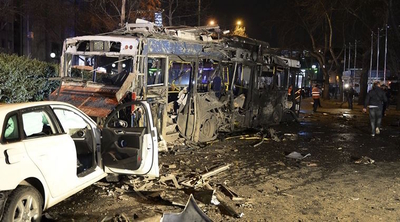
in origin and purpose, building paranoia. For example, before the Kurdish
group TAK claimed responsibility for the bombing on Mar. 13 that killed
37 near the prime minister's office in Ankara, the attack was variously
blamed on Kurds, ISIS, and the Turkish government; . It was interpreted
as intending to justify
a more forceful campaign against domestic Kurds or punish
the government for attacking the Kurds; to encourage a Turkish military invasion of Syria or to
frame Erdoğan's political archenemy, the Gülen
movement.
|
The scene in Ankara
on Mar. 13.
|
Initially, Turkey became a plausible candidate for membership in the
European Union thanks to Erdoğan's muted behavior. Now, his slide toward
despotism and Islamism means the Europeans go merely through the motions
of pretending to negotiate with Ankara, while counting on the Republic of
Cyprus to blackball its application; as Turkish journalist Burak
Bekdil notes, "modern Turkey has never been this galactically
distant from the core values enshrined by the European civilization and
its institutions."
In the early months of the Syrian uprising, Erdoğan offered sage
advice to the dictator in Damascus, Bashar al-Assad, about relaxing his
grip and allowing political participation. Things have gone so awry that
– as Dündar and Gül reported – Erdoğan now supports
ISIS, the most fanatical and Islamist organization of today, and
perhaps ever. That support has taken many forms: permitting foreigners to
cross Turkey to reach Syria, allowing recruitment in Turkey, providing
medical care, and provisioning money and arms. Despite this, ISIS,
fearful of betrayal by Ankara, threatens and attacks Turks.
Erdoğan's error of backing ISIS and other Sunni Islamist organizations
in Syria has hurt him in another way, leading to a massive influx of
Syrian refugees to Turkey, where, increasingly unwelcomed by the
indigenous population, they cause new social and economic strains.
Which brings us to Erdoğan's latest gambit. The many Syrian refugees
wanting to go on to northwestern Europe provide him with a handy
mechanism to blackmail the European Union: pay me huge amounts of money
(€6 billion at latest count) and permit 80 million Turks to travel visa-free
to your countries, or I will dump more unwelcome Syrians, Iraqis,
Afghans, Somalis, et al. on you.
So far, the ploy has worked. Led by Germany's Chancellor Angela
Merkel, the Europeans are succumbing to Erdoğan's demands. But this may
well be a Pyrrhic victory, hurting Erdoğan's long-term interests. In the
first place, forcing Europeans to pretend they are not being blackmailed
and to welcome Turkey with clenched teeth, creates a foul mood, further
reducing, if not killing off, Turkish chances for membership.
|
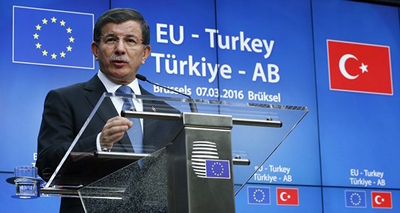
Turkey's Prime
Minister Ahmet Davutoğlu speaks at a conference on immigration.
|
Second, Erdoğan's game has prompted a profound and probably lasting
shift in mood in Europe against accepting more immigrants from the Middle
East – including Turks – as demonstrated by the poor showing of Merkel's
party in elections
earlier this month.
This is just the start. In combination, these errors by Erdoğan point
to more crises ahead. Gökhan
Bacik, a professor at Ipek University in Ankara, notes that "Turkey
is facing a multifaceted catastrophe," the scale of which "is
beyond Turkey's capacity for digestion." If Iran is today the Middle
East's greatest danger, Turkey is tomorrow's.
Mr. Pipes (DanielPipes.org, @DanielPipes) is president of the
Middle East Forum. © 2016 by Daniel Pipes. All rights reserved.
This
text may be reposted or forwarded so long as it is presented as an
integral whole with complete and accurate information provided about its
author, date, place of publication, and original URL.
|






 Posts
Posts


No comments:
Post a Comment