Can Egypt and Ethiopia Share the Nile?
|
|
|
|
Share:  
|
  Be the first of
your friends to like this. Be the first of
your friends to like this.
Oil is the Middle East's glamor product, sought after by the entire
world and bringing the region wealth
beyond the dream of avarice. But water is the mundane resource that
matters even more to locals for, without it, they face the horrible
choice of leaving their homes or perishing within them.
That choice may sound hyperbolic, but the
threat is real. Egypt stands out as having the largest population at
risk and being the country, other than Iraq
and Yemen,
with the most existential hydrologic problem.
|
The Washington Times
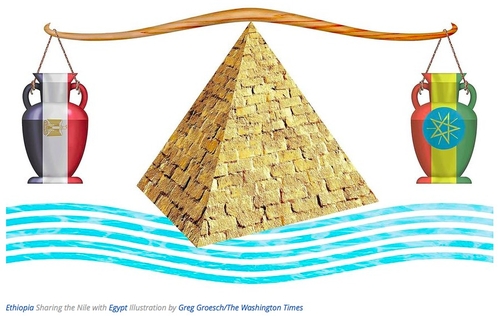
graphic for this article.
|
As every schoolchild learns, Egypt is the gift of the Nile and the
Nile is by far the globe's longest river. Less well known is that most of
the Nile's volume, 90 percent, comes from the highlands of Ethiopia and
that the river passes through 11 countries. For uncounted eons, its water
flowed to Egypt in uncounted quantities.
In 1929, the British government, representing Egypt, signed an
agreement with the independent government of Ethiopia guaranteeing an
annual flow of 55.5 billion cubic meters (bcm) of water to Egypt.
Counting a minimum of 1,000 cubic meters per capita per annum (the
average worldwide is 7,230 cubic meters), that amount more than sufficed
for the 15 million Egyptians of the day.
The succeeding 87 years saw Egypt's population increase six times
until today it numbers 90 million. Adding to the river's 55.5 bcm, Egypt
gets about 5 bcm from non-renewable underground sources and 1.3 bcm from
rain, leaving it with about 62 bcm a year, or one-third less than the
country's minimal needs. In addition, Egyptians recycle about 10 bcm of
agricultural runoff water, whose highly polluted nature (fertilizer and
insecticide residues) eventually kill the land by salinizing it.
Exacerbating this shortage, Egypt's high temperatures leads to higher
rates of evapotranspiration, requiring more water for agriculture than in
places with cooler climates.
This water shortfall translates into a need to import food and, at
present, Egypt must borrow funds to import an alarming 32 percent of its
sugar needs, 60 percent of yellow feed corn, 70 percent of wheat, 70
percent of beans, 97 percent of food oil, and 100 percent of lentils. The
need to import will get worse with time; estimating Egypt's population at
135 million in 2050, it will need 135 bcm annually and, based on present
assumptions, the water deficit will more than double to 75 bcm.
Making matters worse, Ethiopians recently woke up to the fact that
vast quantities of water leave their territories without any benefit to
themselves. Accordingly, they initiated a network of dams, culminating
with the pompously named Grand Ethiopian Renaissance Dam (GERD).
|
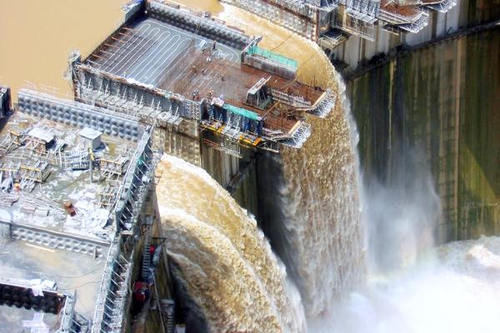
The Grand Ethiopia
Renaissance Dam (GERD), under construction, but almost completed, has
caused much consternation in Egypt.
|
As presently planned, the lake behind this dam would hold 74.5 bcm,
plus 5 bcm would be lost through seepage and 5 bcm lost to evaporation.
Four auxiliary upstream dams to reduce silting will retain another 200
bcm. Noting that 86 percent of Egypt's water originates in Ethiopia,
Egyptian specialists not unreasonably conclude that the allotted 55.5 bcm
would not be forthcoming. Nader
Noureddin, professor of soil and water sciences at Cairo University,
sees the dams placing "the lives of 90 million Egyptians at
risk." (Most statistics in this analysis derive from Noureddin's
work.)
Ethiopians
reply: Not to worry, all will be fine, the guaranteed allotment and
more will reach Egypt. When Cairo protests nonetheless, Addis Ababa
agrees to one study after another, even as it furiously builds the GERD,
which is scheduled to begin operations in 2016, storing an initial 14
bcm.
The potential for disruption is enormous; in 2013, during the Mohamed
Morsi era, Egyptian
politicians inadvertently bruited in public their military plans
about special forces, jet fighters, and rebel groups to deal with the
GERD (shades of the opera Aïda).
Morsi now sits in jail but such ideas offer insight into Egyptian
desperation.
|
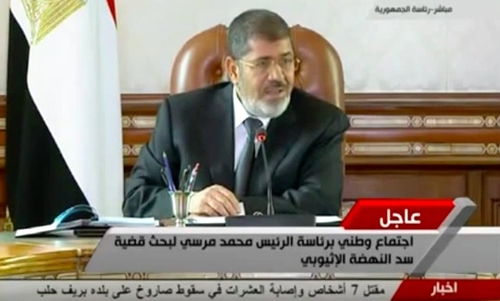
Pres. Morsi presides
over a televised meeting in June 2013 in which Egyptian politicians
discuss aggressive means to stop Ethiopia's dams.
|
At base, the Nile River confrontation lies in variant understandings
of water possession. Downstream states like Egypt point to the immemorial
nature of rivers flowing across borders. Upstream states like Ethiopia
point to the water belonging to them in the same way that oil belongs to
the Arabs. There is no right or wrong here; resolution requires creative
compromise (for example, by lowering the height of GERD saddle dams),
allowing the Ethiopians to benefit from their waters without Egyptians
facing cataclysm.
Short term, statesmen are needed to prevent disaster. Long term,
Egyptians need to learn
how to manage water more resourcefully.
Mr. Pipes (DanielPipes.org, @DanielPipes) president of the Middle East
Forum, depended on Nile water for three years while living in Cairo. ©
2016 by Daniel Pipes. All rights reserved.
This
text may be reposted or forwarded so long as it is presented as an
integral whole with complete and accurate information provided about its
author, date, place of publication, and original URL.
|




 Posts
Posts


No comments:
Post a Comment