|
|
Follow the Middle East Forum
|
|
|
Republicans:
Put Syria Back on the Table
by Gary C. Gambill
The Hill
February 17, 2016
|
|
|
Share:  
|
  Be the first of
your friends to like this. Be the first of
your friends to like this.
|
Republican
candidates have largely ignored the Obama administration's failures in
Syria.
|
Given Syria's transformation in just a few years from one of the Arab
world's most politically stable countries into a cauldron of mass
ethno-sectarian bloodletting that ISIS calls home, you'd think it would
take center stage in the Republican race for the White House.
Although plenty of places have taken a turn for the worse during
President Obama's tenure as leader of the free world, nowhere has the
deterioration been as stark – or as damaging to American interests – as
in Syria. And this despite his administration's ostensible determination
from the outset to bring an end to the bloodletting, his relatively close
contact with the foreign governments fuelling the violence, and the fact
that other Western governments have largely deferred to Washington. If anyone
should be called to account for the international community's mishandling
of Syria, it is President Obama.
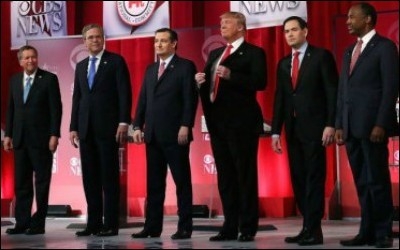
And yet Republican candidates have barely mentioned the country (just
six times in the last two debates), and then only incidentally in boilerplate
pledges to go after ISIS and do something about refugees. The resounding
failure of administration efforts to stop Syria's disintegration has been
virtually ignored.
Part of the reason Obama's Syria policy is off the table is that
Republicans can't agree on what's wrong with it. Mainstreamers like Sen.
Marco Rubio (R-Fla.) say he hasn't intervened enough to help Sunni Arab
rebels oust the Iranian-backed Alawite-led regime of Bashar Assad, while
a vocal minority of libertarians and tea-partiers, notably Sens. Rand
Paul (R-Ky.) and Ted Cruz (R-Texas), say he has intervened too much on
their behalf. The RNC and conservative media aren't particularly eager to
draw attention to a problem for which the Republican Party has no clear
answer.
Whatever the merits of full-on
intervention vs. non-intervention, Obama's middling path is worse than
either.
|
But it's not just lack of consensus that accounts for this silence.
Proponents of both positions tend to assume a linear relationship between
American intervention and payoffs, which makes the Obama administration's
policy second best for each (i.e. if a lot of intervention is best, then
a little is better than none at all; if no intervention is best, then a
little is better than a lot).
But this is a fallacy. Whatever the merits of full-fledged
intervention vs. strict non-intervention, the Obama administration's
middling path may well be much worse than either.
In a nutshell, the argument for intervention is that it would bring
the central axis of the conflict – that between Assad and Sunni rebels –
to a close sooner, sap jihadist strength by offering the Sunni population
credible "moderate" alternatives, and cultivate pro-American
goodwill in Syria.
Anti-interventionists have argued that heavy American involvement in
the Syrian civil war would provoke greater involvement by Russia and
Iran, discourage regional Sunni governments from stepping up to the plate
in the fight against Iranian influence, and saddle the United States with
responsibility for what comes next in Syria.
Obama's middle road – gradually increasing modest levels of aid in
fits and starts, while talking tough and drawing illusory red lines – is
producing none of the benefits and most of the drawbacks of full-on
American support for the rebels. U.S. material support has been far too
miniscule to impact the situation on the ground, draw recruits away from
ISIS, or win the loyalty of combatants.
Obama's middle road is producing
none of the benefits and most of the drawbacks of full-on American
support for the rebels.
|
At the same time, the administration's steadily (if slowly) increasing
aid and vocal endorsement of rebel aims over the past three years have
given the Arab states and Turkey false hope that we'll eventually do the
job for them, leading to free-riding and other sorts of underhandedness
(e.g. funding and arming militias with an eye toward gaining influence
within the insurgency rather than toppling Assad).
So if this middle path is so bad, why has the Obama administration
taken it? Superpowers aren't known for low-balling material aid to
proxies they vocally support.
Ostensibly, this unusual approach is rooted in the belief that
stalemate is more conducive to brokering a diplomatic settlement than
facilitating major rebel advances. The supposed aim has been to provide
just enough rebel aid that Assad and his sponsors would appreciate the
necessity of a negotiated solution, but without enabling the rebels to
achieve their aims without talking. Belated American airstrikes against
ISIS targets in Syria have been calibrated not to tip the broader balance
of forces there.
But it's doubtful anyone in the administration ever really believed
this approach would bring peace to Syria, certainly not in the wake of
Russia's military intervention last fall.
The real reason for the middle path is the Obama administration's
effort over the past three years to square the circle between its pursuit
of Israeli-Palestinian peace (for which it needed the goodwill of Sunni
Arab governments and Turkey) and its pursuit of a negotiated solution to
the Iranian nuclear threat (which might have been jeopardized by full-on
support for the rebels).
That both exhaustive efforts failed spectacularly is bad enough. That
nearly 300,000 Syrians have paid the ultimate price for Obama's pursuit
of pie-in-the-sky "legacy" achievements is shameful.
Republicans should start saying so.
Gary C. Gambill is a research
fellow at the Middle East Forum
|
|
|
|
|





 Posts
Posts


No comments:
Post a Comment