|
|
Follow the Middle East Forum
|
|
|
|
Related Articles
Lessons
From Al Capone On Countering Islamist Violence
|
|
|
Share:  
|
  Be the first of
your friends to like this. Be the first of
your friends to like this.
|
What
if Italian Americans fought investigation of the mob the way some U.S.
Muslim groups object to counter-terrorism probes?
|
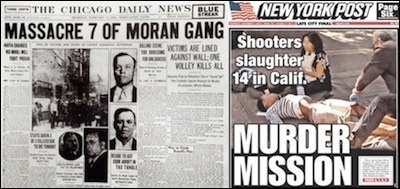
Eighty-seven years ago yesterday, Al Capone's South Side gang lured
leading members of Bugs Moran's North Side Irish gang into a Chicago
garage and gunned them down execution style in what became known as the
St. Valentine's Day Massacre. Amid public uproar, local and federal
authorities began for the first time to seriously crack down on Capone,
who was listed as "public enemy" number one by the Chicago
Crime Commission within a year.
Imagine if Italian-American organizations had responded to all this by
claiming that the Italian community was caught in the "middle"
of organized crime by Irish and other gangs, that the mafia violence was
the result of upheaval in Sicily and discrimination in America, and that
there would have to be a comprehensive approach by government, community
organizations, law enforcement, and citizens to address all gang violence
and discrimination, because an approach targeting only the Italian mafia
is "not going to handle it."
Would anyone who heard that response have believed the organizations
offering it were trying to help law enforcement, the American public, or
even their own community? Or would they have believed these groups were
in the pocket of the Italian mafia and using any and every excuse
possible to do nothing to oppose it?
Fast-forward to earlier this month, when the U.S. Council of Muslim
Organizations (USCMO) held
a conference
of Muslim organizations in the U.S. and other Western nations.
Afterwards, USCMO Secretary General Oussama Jammal made a brief statement, then
took questions. Asked what his coalition would do "to combat the
rising tide of extremism in Europe and the flow of the recruitment of
ISIS of European citizens and ... young people from the West,"
Jammal replied,
We do acknowledge the rise of extremism
on both sides and therefore it is a threat to the society at large, not
just the Muslim communities from let's say right-wing extremism but also
from the violent extremism that comes from the Middle East as a result of
the chaotic political upheaval and situation in that area and the Muslim
communities in the West have been caught right in the middle trying to
fight both extremism. And therefore it will take more than just the
Muslim community to face these challenges but it's going to be an
integral part of the government, community organizations, and law
enforcement and citizens to really face this. We believe there has to be
a comprehensive approach to dealing with violent extremism in any side
and therefore one single approach to it we believe is not going to handle
it.
Let's dissect that "answer." In what has become a trope,
Jammal introduces the irrelevant topic of "right-wing
extremism" and uses it, first, to imply Islamist extremism is simply
one aspect of a more general problem, thereby minimizing the connection
between Islamism and jihadi violence.
|
Oussama
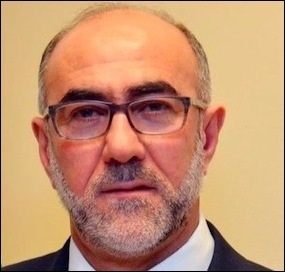
Jammal, secretary general of the U.S. Council of Muslim Organizations.
|
Then, Jammal asserts that Islamist violence is "a result of the
chaotic political upheaval and situation" in the Middle East. In
other words, Islamist violence is a political problem, resulting from
violence in the Middle East. Implicitly, Jammal denies any link between
Islamism and Islam or its ideologies, notably the Muslim Brotherhood. One
almost expects Jammal to add the claim that Islamist violence is the
product of the US invasion of Iraq, as though it did not exist before.
Next, Jammal opines that Muslim communities in the West "have
been caught right in the middle trying to fight both extremism."
Exactly what are Muslim communities in the middle of? Jammal seems to be
claiming that Muslims are the victims here, of both
"right-wing" and Islamist extremists. He does not offer any
details of how or in what way Muslim communities are the victims of
Islamist extremists.
Groups like USCMO and the Council
on American-Islamic Relations are not serious about fighting Islamist
violence.
|
Unsuspecting Muslim parents are certainly victimized when ISIS lures
their minor children to Syria. Unfortunately, Jammal offers no response
at all about whether the new coordinating body has a plan to combat the
flight of young Muslims to join ISIS.
Instead, Jammal laments that "it will take more than just the Muslim
community to face these challenges," while insisting that there
"has to be a comprehensive approach to dealing with violent
extremism in any side" and "therefore one single
approach to it we believe is not going to handle it." Therefore
what, exactly? The implicit gist here is that, according to Jammal,
neither Muslim community members nor Muslim organizations can or should
do a thing to counter the lure of ISIS or prevent Islamist massacres so
long as law enforcement specifically targets
Islamist violence and jihadi organizations.
Can one read Jammal's statement, or the many others
like it by USCMO, the Council on American-Islamic Relations (CAIR), and
its other member organizations, and believe that these organizations are
serious about opposing Islamist violence?
Johanna Markind is associate
counselor at the Middle East Forum
|
|
|
|
|





 Posts
Posts


No comments:
Post a Comment