|
In this mailing:
by Richard Kemp and Jasper
Reid • February 16, 2016 at 5:30 am
- The UN's
assertion that the Saudi-led coalition has committed war crimes in
Yemen is unlikely to be true. UN experts have not been to Yemen,
depending instead on hearsay evidence and analysis of photographs.
- The UN has a
pattern of unsubstantiated allegations of war crimes against the
armed forces of sovereign states. Without any military expertise,
and never having visited Gaza, a UN commission convicted the Israel
Defense Force of deliberately targeting Palestinian civilians in the
2014 conflict. It was an assessment roundly rejected by America's
most senior military officer, General Martin Dempsey, and an
independent commission.
- The Houthis
have learned many lessons from Hamas and Islamic Jihad in Gaza,
groups also supported by Iran. Those lessons include the
falsification of civilian casualty figures and their causes. The UN
swallowed the fake Gaza figures hook, line and sinker, and are now
making the same error in Yemen.
- The Houthis
exploit gullible or compliant reporters and human rights groups to
facilitate their propaganda, including false testimony and
fabrication of imagery.
- Forensic
analysis shows that rather than deliberately targeting civilians,
the Saudis and their allies have taken remarkable steps to minimize
civilian casualties.
The United Nations, Amnesty International and other groups have
accused the Saudi-led coalition of war crimes in Yemen. A leaked UN
report claims the bombing campaign against Iranian-supported Houthi
insurgents seeking violently to topple the legitimate government of Yemen
has conducted deliberate, widespread and systematic attacks on civilian
targets.
If the UN's assertion is true, and the coalition is deliberately and
disproportionately killing thousands of innocent civilians, it is a war
crime. But it is unlikely to be true. The UN has produced no actual
evidence of war crimes. None of their allegations is based on
investigation on the ground. Their experts have not been to Yemen,
depending instead on hearsay evidence and analysis of photographs.
by Burak Bekdil
• February 16, 2016 at 4:00 am
- Washington
should think more than twice about allowing Turkey and Saudi Arabia,
its Sunni allies, militarily to engage their Shiite enemies in
Syria. Allowing Sunni supremacists into a deeper sectarian war is
not a rational way to block Russian expansion in the eastern
Mediterranean. And it certainly will not serve America's interests.
- Turkey and
Saudi Arabia are too weak militarily to damage Russia's interests.
It is a Russian trap -- and precisely what the Russians are hoping
their enemies will fall into.
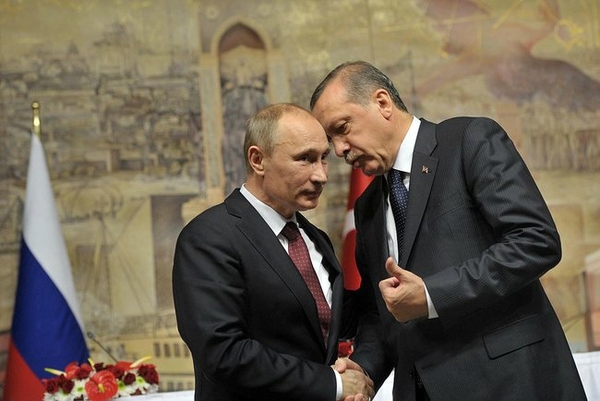
Will direct military involvement in Syria by Turkey
and Saudi Arabia spark a NATO-Russia confrontation? Pictured: Russian
President Vladimir Putin with Turkish President Recep Tayyip Erdogan
(then prime minister), meeting in Istanbul on December 3, 2012. (Image
source:kremlin.ru)
After Russia's increasingly bold military engagement in war-torn
Syria in favor of President Bashar al-Assad and the Shiite bloc, the
regional Sunni powers -- Turkey and its ally, Saudi Arabia -- have felt
nervous and incapable of influencing the civil war in favor of the many
Islamist groups fighting Assad's forces.
Most recently, the Turks and Saudis, after weeks of negotiations,
decided to flex their muscles and join forces to engage a
higher-intensity war in the Syrian theater. This is dangerous for the
West. It risks provoking further Russian and Iranian involvement in
Syria, and sparking a NATO-Russia confrontation.
|







 Posts
Posts


No comments:
Post a Comment