|
|
Follow the Middle East Forum
|
|
|
|
Related Articles
The
Obama Administration's Soft Boycott of Israel
|
|
|
Share:  
|
  Be the first of
your friends to like this. Be the first of
your friends to like this.
Originally published under the title "How the United
States Mislabels Israel."
|
The
U.S. Customs and Border Protection agency now advocates sanctioning
products from Israeli settlements that bear the "made in
Israel" label.
|
In a move uncharacteristic of U.S. policy as it has been carried out
for decades, the Obama administration recently endorsed Europe's version
of a soft Boycott, Sanctions and Divestment (BDS) campaign targeting
Israeli merchandise.
In late January, the U.S.
Customs and Border Protection agency changed its policy on imports
from the West Bank, imposing, in effect, a sanction on such goods.
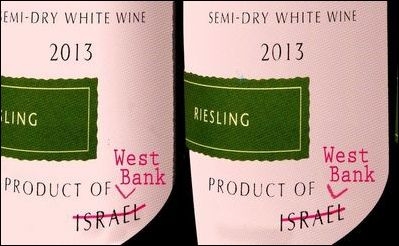
The penalty states that products must no longer be labeled "Made
in Israel," because the United States views the West Bank as
territory illegitimately controlled by Israel.
Europe adopted such a labeling policy in November. Since then, the
United States has chartered a zigzag course through the product
demarcation debate. When asked in November if labeling constitutes a
boycott, Mark
C. Toner, U.S. State Department deputy spokesman, said: "It's
a—it could be—it could be perceived as a step on the way."
Just last month, however, Toner's boss, spokesman John
Kirby, announced: "We do not view labeling the origin of
products as being from the settlements a boycott of Israel. We also do
not believe that labeling the origin of products is equivalent to a
boycott." The United States, like the European Union, goes to great
lengths to insist that demarcating Israeli products from the settlements
is not a boycott.
In an increasingly anti-Israel
Europe, labeling could lead to sweeping damage to Israel's economy.
|
Yet, in an increasingly anti-Israel Europe, labeling could lead to
sweeping damage to Israel's economy. This slippery slope helps to explain
why a bipartisan group of thirty-six senators protested the EU decision.
Sens. Kirsten Gillibrand (D-NY) and Ted Cruz (R-TX) took the lead in
sending a letter of objection to the EU in November.
"As allies, elected representatives of the American people, and
strong supporters of Israel, we urge you not to implement this labeling
policy, which appears intended to discourage Europeans from purchasing
these products and promote a de facto boycott of Israel. . . ," wrote
the senators.
To blunt European economic warfare targeting Israel, South Carolina
Gov. Nikki Haley in 2015 approved legislation that outlaws public
organizations from conducting business with companies that discriminate
against the Jewish state.
Illinois and Indiana have passed similar anti-BDS legislation. In late
January, Florida
legislators announced they intend to pass a bill opposing companies
involved in BDS.
California seeks to replicate similar pro-Israel legislation.
Congressman Brendan Boyle of Pennsylvania introduced HR
2645, legislation that seeks to prohibit the federal pension system
from investing in companies that boycott Israel.
The combination of the U.S. State Department endorsing the EU labeling
of settlement products along with intensified criticism of Israeli peace
process policies gives a tailwind to the boycott supporters. The stated
aims of BDS are nothing short of the dissolution of Israel and its
replacement with a binational, majority Palestinian entity. Put simply,
the BDS movement's goal is the opposite of peace.
From the beginning of Obama's
tenure, his administration has demanded that Israel halt settlement
activity.
|
These diplomatic maneuvers coming out of President Obama, Secretary of
State John Kerry and the State Department at large are making Israel a
partisan issue in the United States.
From the beginning of Obama's time in office his administration
demanded that Israel halt settlement activity. Obama's posture has been
motivated by two assumptions: The key to solving the Middle East's
problems rests with the Israeli-Palestinian problem, and the be-all and
end-all of obstacles to a final peace agreement in the region is
remedying the problem of Israel's control over the disputed territories
of the West Bank, East Jerusalem and Golan Heights.
This faulty "linkage theory" contributes to a growing rift
between the Israeli and Palestinian positions. Both parties are aware
that the settlement issue will only be solved when the final borders of
Israel and a future Palestine are created, which is why Palestinian
leaders Mahmoud Abbas and the late Yasser Arafat both previously entered
into negotiations without a freeze on settlement construction. For that
matter, if a construction freeze was so important for restarting
negotiations with Israel, the PA could have initiated direct discussions
during 2010's ten-month settlement moratorium rather than waiting to
start talks during the month that the freeze was due to expire.
Yet the White House's attitude is that it can twist Israel's arm
diplomatically in exchange for security guarantees, and the slippery
slope to boycotts can be used as a legitimate pressure point.
The EU mirrors the U.S. escalation pressure-point strategy by seeking
to compel Israel to make unilateral concessions to the Palestinians in
the context of the stalled peace process.
Europe insists it merely wants to inform consumers about the origin of
Israeli goods. But the policy legitimizes boycott. In November, the
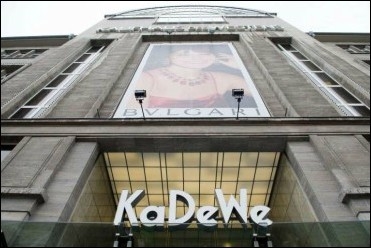
high-end Berlin department store KaDeWe removed Israeli wines from its
shelves. After it was reported by the Jerusalem
Post that the Nazis had stolen the store from its Jewish owners in
the 1930s, KaDeWe put the wines back on its shelves.
|
The
Berlin department store KaDeWe pulled Israeli wines from its shelves in
November, then reversed the decision after the Jerusalem Post
reported that the Nazis had seized the store from its Jewish owners in
the 1930s.
|
Anti-Israel animus in Europe has fostered conditions that legitimate a
path to a form of anti-Semitism that one recalls from the turbulent
1930s. The Nazi party launched a "Don't Buy from Jews!" movement
in Germany. Substitute "Don't Buy from Israel," and one grasps
the moral perils of economic warfare.
The European BDS movement has some unsavory optics attached to it. In
2012, the neo-Nazi National Democratic Party of Germany (NPD) submitted a
legislative initiative in the state parliament of Mecklenburg-Western
Pomerania to mark Israeli products. The NPD in the state of Thuringia
praised the Social Democratic Party mayor of Jena, Albrecht Schröter, for
signing a petition seeking mandatory labeling of Israeli products.
In 2013, Germany's powerful Green Party introduced an initiative in
the Bundestag that largely mirrored the neo-Nazi-sponsored legislation
from 2012. Green Party MPs belabor the talking point that labeling is
intended to raise "consumer awareness." By way of background,
in 1983, the Greens put out a "Green Calendar" with the
headline "Israel, the gang of murderers" and called for a
"boycott of goods from Israel."
The EU naively believes that the root cause of the Israeli-Palestinian
conflict lies in the "occupation," and the way to a solution is
economic pressure targeting Israel. After all, the EU has singled out
Israel while finding no need, for example, to label Turkish products from
the illicitly occupied North Cyprus. The EU also refuses to penalize
Morocco for its illegal seizure of Western Sahara.
In an interesting twist, the most left-wing government in Greece's
history announced its opposition to implementing the EU's Israel-product
label policy. Hungary joined Greece in opposing the labeling measure. The
Czech parliament also rejected it.
Anti-Israel boycotts deflect
attention from the real obstacles to peace, and from real opportunities
to achieve it.
|
Boycotts don't bring peace any closer, especially not in the Middle
East. Instead, they deflect attention from the real obstacles to peace
and the real opportunities that exist, many of which are provided
precisely by the academia that the anti-Israel crowd targets. The
labeling measure, unfortunately, provides a shot in the arm for academic
boycotts. British and Italian academics have recently called for a
boycott of Israeli scholarly institutions.
A new Human
Rights Watch report has called for a boycott of Israeli companies in
the disputed territories, which employ nearly 21,000 Palestinians. HRW infamously sought
to raise funds in Saudi Arabia to bash Israel. Its obsessive focus on
targeting Israel with economic warfare instead of on the non-free
countries in the Middle East is well documentated.
In one example of how economic pressure backfires, the Israeli company
SodaStream was forced to close its West Bank operation because of BDS.
The closure entailed the loss of nearly one thousand well-paying jobs for
Palestinians. SodaStream—one of the first companies to be targeted by the
boycott movement—offered Syrian refugees jobs.
This year, Congress passed Trade Promotion Authority (TPA) legislation
requiring the United States to "discourage Europe from enacting any
politically motivated policies that would boycott, divest from, or
sanction Israel when negotiating the Transatlantic Trade and Investment Partnership."
What can be done to stymie the BDS movement?
Given the growing European hostility toward Israel, it is long overdue
that an ironclad anti-BDS provision be made part of the free trade deal.
Secondary sanctions and other financial penalties hitting recalcitrant
pro-BDS EU companies and countries would quickly influence a change in
European behavior.
Asaf Romirowsky is the executive
director of Scholars for Peace in the Middle East (SPME) and a fellow at
the Middle East Forum. Benjamin Weinthal is a Berlin-based fellow at the
Foundation for Defense of Democracies.
|
|
|
|
|





 Posts
Posts


No comments:
Post a Comment