The
Saudi/Iranian Tug-of-War
A briefing by Joshua
Teitelbaum
February 16, 2016
|
|
|
Share:  
|
  Be the first of
your friends to like this. Be the first of
your friends to like this.
Multimedia for this item
Audio Recording
|
Joshua Teitelbaum, senior research
associate at the Begin-Sadat Center for Strategic Studies (BESA), and
professor of Middle East studies at Bar-Ilan University, briefed the
Middle East Forum on a conference call on Feb. 4, 2016.
Saudi Arabia's recent execution of 47 Shiite prisoners, including the
prominent Shiite cleric Nimr al-Nimr, sparked a sharp crisis between the
desert kingdom and its Iranian neighbor that can be best understood in
the context of the historic Sunni-Shiite rivalry.
Saudi Shiites constitute a small, beleaguered minority (10-15 percent
of the total population) in a theocratic Sunni kingdom that derives its
legitimacy from a Wahhabi doctrine that considers Shiites polytheists and
heretics, leading to long-standing discrimination and oppression. The
position of Shiites substantially worsened following the creation of the
Islamic Republic of Iran in 1979 and its aggressive pursuit of worldwide
Shiite leadership, ebbing still further during the 2011-12 upheavals due
to their support of the struggle of their Shiite brethren in neighboring
Bahrain for political and socioeconomic reforms.
Responding with iron-fist repressive measures, the Saudi authorities
played the sectarian card by launching a press campaign and delivering
anti-Shiite mosque speeches to stoke Sunni opposition. For his part, Nimr
catapulted himself to the forefront of the demonstrations, openly calling
for Shiite martyrdom and the toppling of the Saudi royal family. A video
clip of his inevitable arrest went viral, dangerously fomenting already
inflamed Sunni-Shiite passions.
Last year's change of Saudi leadership to King Salman Abdul Aziz,
aided by his young and energetic son, Minister of Defense and Deputy
Crown Prince Muhammad bin Salman, resulted in a muscular and assertive foreign
and defense policy. Feeling betrayed by the Iran nuclear deal and
Washington's attendant empowerment of Tehran as the regional power
broker, the Saudis see President Obama as essentially pro-Shiite.
|
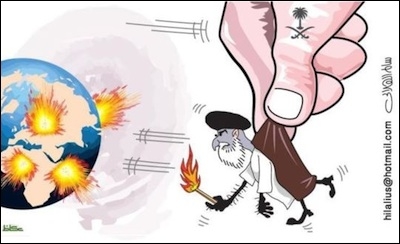
A
cartoon from the Saudi daily Okaz depicts Saudi Arabia as
restraining Iran from igniting fires across the region.
|
Geopolitics abhors a vacuum so, given the American retrenchment,
Iran's resurgent hegemonic ambitions, Iraq's post-Saddam transformation
into a de facto Shiite state, and the threat of Tehran's Houthi protégé
in Yemen, the execution of Sheikh Nimr sought to send a clear message to
Iran and its Shiite proxies of Riyadh's determination to not tolerate
dissent and to protect itself against whatever forms of Shiite aggression
lie ahead.
The vector of Saudi policy arches towards a more assertive regional
posture in Yemen, Syria, Iraq, and towards Iran. Increased cooperation
with China, and maybe even Russia — even though it now supports the Assad
regime — is in the cards. These possible security partners may play a
role in Saudi plans to expand its armed forces to create the possibility
for Riyadh's regional projection of force — not unlike the capabilities
possessed by Israel.
But this may still be dependent on a greater question: what will be
the direction of American foreign policy? Is the Obama policy of American
retrenchment a sea change, a lasting legacy that will guide future US
leaders? Or will the next president return US policy to one of actively
protecting allies instead of creating a balance of forces? The answer to
that question must await the first Tuesday in November.
Summary account by Marilyn Stern,
Middle East Forum Board of Governors
Related
Topics: Iran, Saudi Arabia
| Joshua Teitelbaum This
text may be reposted or forwarded so long as it is presented as an
integral whole with complete and accurate information provided about its
author, date, place of publication, and original URL.
|





 Posts
Posts


No comments:
Post a Comment