|
|
|
|
Steven Emerson,
Executive Director
|
March 18, 2016
|
Islamist
Activist Asks Obama to Support Libyan AQ Group
by John Rossomando
IPT News
March 18, 2016
|
|
|
|
|
Share:  
|
  Be the
first of your friends to like this. Be the
first of your friends to like this.
 The revelation of
his praise for Palestinians who chose "the jihad way" to
liberation forced northern Virginia surgeon Esam Omeish to resign from a statewide immigration commission in
2007. But it hasn't stopped him from enjoying red carpet treatment from
Obama administration officials. The revelation of
his praise for Palestinians who chose "the jihad way" to
liberation forced northern Virginia surgeon Esam Omeish to resign from a statewide immigration commission in
2007. But it hasn't stopped him from enjoying red carpet treatment from
Obama administration officials.
Omeish briefly drew national attention in 2007 when he was forced to
resign from the Virginia immigration panel. The move resulted from
Investigative Project on Terrorism (IPT) video showing him praising for Palestinians who chose
the "jihad way" during a rally in 2000.
This was no slip of the tongue. At a different event two months earlier,
Omeish congratulated Palestinians who gave "up their
lives for the sake of Allah and for the sake of Al-Aqsa. They have
spearheaded the effort to bring victory upon the believers in Filastin,
insha'allah [God willing]. They are spearing the effort to free the land of
Filastin, all of Palestine, for the Muslims and for all the believing
people in Allah."
Nonetheless, high-ranking Obama administration officials engaged with
him despite this and his praise for Hamas founder Sheikh Ahmed Yassin. They
consulted with him on Libya and included him in other events aimed at engagement with the Muslim community and countering violent
extremism.
Now, Omeish is hoping those contacts will help him persuade U.S.
officials to change gears in Libya, shifting support from a secular
political figure to one with links to al-Qaida. He spelled out those
ambitions in a Feb. 29 letter addressed to President Obama posted on Omeish's
Facebook page.
It is co-signed by Emadeddin Z. Muntasser, secretary general of the Libyan American Public
Affairs Council (LAPAC). Omeish is identified as the LAPAC president.
Before he was affiliated with the LAPAC, Muntasser was convicted in 2008 of failing to disclose connections
between a charity he worked with and jihadist fundraising when he sought
tax-exempt status for the charity.
Muntasser ran the Boston branch of the Al-Kifah Refugee Center, which is
considered a precursor to al-Qaida, federal prosecutors have said. It was founded by Osama bin Laden's mentor
Abdullah Azzam. Under Muntasser's leadership, Al-Kifah's Boston office
published a pro-jihad newsletter called Al-Hussam and distributed
flyers indicating its support for jihadists fighting on the front lines in
places such as Chechnya, Bosnia, Afghanistan and Algeria.
Muntasser's charity, Care International, was "an outgrowth of and
successor" to Al-Kifah, prosecutors say.
Omeish and Muntasser note in their letter that the U.S. has backed the
"Libyan National Army," led by Khalifa Hifter, a former general
under dictator Muammar Gaddafi. That's a bad idea, Omeish and Muntasser
wrote, because "many in Libya believe [Hifter] has dictatorial aspirations
..."
"He sounds like the Ahmed Chalabi of Libya," said former
Pentagon spokesman J.D. Gordon, a fellow at the Center for a Secure Free
Society. "He wants America to fight his battles for him in order to
gain the upper hand over his countrymen."
However, the letter makes no mention of ties between the group Omeish
endorses, the Revolutionary Council of Derna, and al-Qaida. Instead, he and
Muntasser casts the group as an effective counter to ISIS because the
council has "stripped [ISIS] from its social support. [ISIS]'s foreign
presence and violent ways made them an evil that local Libyans themselves
rejected and defeated" in Derna.
The council's leaders included two men – Nasir Atiyah al-Akar and Salim
Derbi – known to have had ties to al-Qaida.
After ISIS killed al-Akar, the Derna council eulogized him last June for his close ties to Abu Qatada, al-Qaida operative currently in Jordan.
Defense Intelligence Agency (DIA) reports from 2012 connect Akar to
Abdulbasit Azzouz, who was al-Qaida leader Ayman al-Zawahiri's man in Libya
at the time. Azzouz allegedly was involved with the attack on the U.S. consulate and CIA
annex in Benghazi that left U.S. Ambassador Stevens and three other
Americans dead.
Derbi, also killed fighting ISIS, previously belonged to the al-Qaida linked Libyan
Islamic Fighting Group (LIFG) and commanded the Abu Salim Martyrs Brigade,
which also has al-Qaida ties.
Egypt's Al-Alam Al-Youm refers to the Revolutionary
Shura Council as "a branch of al-Qaida."
Despite his ongoing connections to key White House decision-makers,
Omeish appears headed for disappointment this time.
His letter is not likely to be read by the president's national security
team, a White House source told the Investigative Project on Terrorism
(IPT). The U.S. is prepared to support a "Government of National
Accord" that is being developed, the White House said in a statement.
However, the Obama administration repeatedly has involved Omeish in
policy deliberations about Libya.
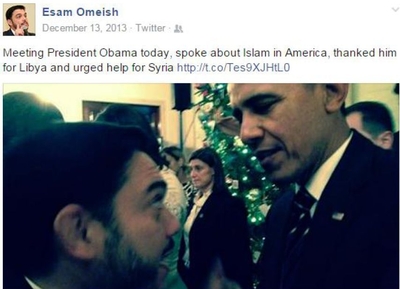
White House logs show that Omeish visited nine times since 2011,
including a Dec. 13, 2013 visit in which he was photographed with
President Obama.
Omeish's encounter with the president came during the White House's
annual Christmas party, a White House spokesperson said. President Obama
never conducts policy discussions at such public meetings, the source said.
 Two photos appear on
Omeish's Facebook page showing him with U.N. Ambassador Samantha Power,
widely considered an architect of the president's Libya policy, where she
advocated for military intervention. She notably helped draft
PSD-11, a secret presidential directive that led to the U.S. supporting the
Muslim Brotherhood in Libya among other places. Two photos appear on
Omeish's Facebook page showing him with U.N. Ambassador Samantha Power,
widely considered an architect of the president's Libya policy, where she
advocated for military intervention. She notably helped draft
PSD-11, a secret presidential directive that led to the U.S. supporting the
Muslim Brotherhood in Libya among other places.
One photo shows Omeish meeting with Power in February 2012, when
she worked as special assistant to the president and senior
director for Multilateral Affairs and Human Rights at the National Security
Council. The other photo
posted the day Obama announced Power's nomination as U.S. ambassador to
the U.N. shows her standing next to Omeish.
White House officials thought enough of Omeish that they invited him to attend an April 2011 speech
on Libya by President Obama at the White House. Omeish also attended the installation of
Christopher Stevens, the late U.S. ambassador to Libya killed in the Sept.
11, 2012 Benghazi attack, and that of his successor, Deborah Jones, in 2013.
Omeish told The Washington Times following the Benghazi
attack that he briefed Stevens before the ambassador began his duties in
Tripoli.
Omeish and the Muslim Brotherhood
In addition to his comments about Palestinians and jihad, Omeish admits to prior personal involvement in the Muslim
Brotherhood in the U.S. and served as president of the Muslim American
Society, which has been described as the "overt arm" of the Brotherhood in
America. His association with the Brotherhood likely dates back to his
involvement in the Muslim Students Association (MSA) in the 1990s when he
became the national
organization's president, which was founded by Brotherhood members in 1963.
Omeish endorsed Libya's Muslim Brotherhood in a 2012 IRIN News article,
stating that although it came in a distant second in Libya's 2012
elections, it "may be able to provide a better platform and a more
coherent agenda of national action."
Libya's Muslim Brotherhood subsequently failed to implement a coherent agenda and
became deadlocked with its liberal rival, the National Forces Alliance,
over establishing a working constitution.
Brotherhood members opposed building a strong Libyan military that could
have helped rein in the militias that have since created havoc. Numerous
militias tied to the Brotherhood have contributed to Libya's instability.
U.S. State Department officials contracted with the Brotherhood-linked February 17 Martyrs Brigade – a
group that also had Al-Qaida ties – to provide security for the
ill-fated U.S. consulate in Benghazi. A BBC report described the brigade as
the best armed militia in eastern Libya. It additionally
held al-Qaida sympathies, according to posts on its Facebook page. A State
Department report called reliance on the February 17 militia in
the case of an attack such as happened on Sept. 11, 2012
"misplaced."
LAPAC is but one of an alphabet soup of groups that Omeish helped found
as a result of the Arab Spring, aimed at affecting U.S. policy toward
Libya.
This includes Libyan
Emergency Task Force,(LETF),Libyan Americans for Human Rights, Libyan Council of North
America (LCNA), Libyan American Organization, American Libyan Council,
American Libyan Chamber of
Commerce and Industry (ALCCI), Center
for Libyan American Strategic Studies. Former Libyan Ambassador to the
U.S. Ali Aujali appointed
Omeish the official representative of the Libyan-American community,
according to ALCCI's old website.
LETF lobbied
for the U.S. and the international community to establish a no-fly zone to
keep Gaddafi from bombing rebellious cities in early 2011. Omeish's LCNA
worked to facilitate meetings between U.S. officials and
Libyan rebels, including a meeting
with John Kerry while he still was a U.S. senator. ALCCI works with the Libyan
embassy in Washington to "certify and support trade relations between
Libya and the United States."
It remains to be seen whether the advice from Omeish and Muntasser will
be ignored. But their gambit, publicly posting their letter urging the
president to support Islamists, indicates a confidence generated by years
of access and consultation. That raises a host of troubling questions.
|
The IPT accepts no funding from
outside the United States, or from any governmental agency or political or
religious institutions. Your support of The Investigative Project on
Terrorism is critical in winning a battle we cannot afford to lose. All
donations are tax-deductible. Click here to donate online. The
Investigative Project on Terrorism Foundation is a recognized 501(c)3
organization.
202-363-8602
- main
202-966-5191
- fax
|
|

 Print
Print Send
Send Comment
 RSS
RSS


 Posts
Posts


No comments:
Post a Comment