 | Middle East Forum | |
| MEF Home Research & Writings Middle East Quarterly | ||
Related Will Untapped Ottoman Archives Reshape the Armenian | ||
 Send
Send RSS
RSS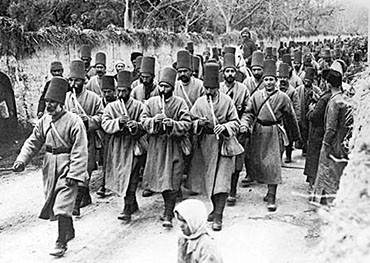 Ottoman soldiers march |
In 1989, the Başbakanlık Osmanlı Arşivleri (the Ottoman
Archives division of the Prime Minister's Office) in Istanbul fully opened
its doors to scholars regardless of their nationality or subject of
research. The Ottoman Empire's central state archives originally consisted
of two groups of documents: the records of the Imperial Council and of the
Grand Vizier's office. From time to time, the state added other
collections, for example, the records of the finance departments and the
Cadastral Survey Office. The government registers include copies of the
texts of imperial orders and decrees sent to provincial officials and
judges and replies to reports from across the empire. They relate to
questions of law and order, state revenues, military arrangements, foreign
relations, administrative assignments, and other matters submitted for the
sultan's consideration. Survey registers of rural and urban populations
and their production convey figures and other information collected for
administrative purposes. Likewise, there are specific registers dealing
with the non-Muslim peoples of the Ottoman Empire, such as church
registers and registers concerning other non-Muslim communities
(millets). These run through World War I and contain valuable
information on the question of Turkish-Armenian relations.[4]
There are approximately 150 million documents that span
every period and region of the Ottoman realm in the stacks and vaults of
the Ottoman Archives. Each day, new collections in these Ottoman archives
are opened to researchers. All these extensive records are well preserved
and organized.
The first published catalog of Ottoman archival holdings
appeared in 1955 and consisted of ninety pages of archival inventory and
commentary.[5] Archivist Attila Çetin
followed in 1979 with a more extensive catalog, which is also available in
Italian.[6] As the classifying and
organizing of the archives continued, the catalog grew. The 1992 edition
is 634 pages long. The expanded 1995 compilation provides access to even
more documents. Revised editions are to be forthcoming from time to time,
as more detailed descriptions become available for the various
fonds or individual record groups.[7]
Ottoman archival documentation constitutes an unequaled
trove of information about how people lived from the fifteenth through the
early twentieth centuries in a territory now comprised of twenty-two
nations. İlber Ortaylı, director of the Topkapı Palace Museum at Istanbul,
argues that the history of the Ottoman Empire should not be written
without Ottoman sources.[8] He is not
alone in this. His position is buttressed by a number of specialists in
the study of the Ottoman state and society. Albert Hourani, for example,
the late British scholar of Middle Eastern affairs, argued that his best
advice to history students considering Middle East specialization would be
to "learn Ottoman Turkish well and learn also how to use Ottoman
documents, since the exploitation of Ottoman archives, located in Istanbul
and in smaller cities and towns, is perhaps the most important task of the
next generation."[9]
The Archives and the Armenians
There are few comprehensive sources about Armenian life in
Anatolia outside of Ottoman archival sources. Diplomatic records, such as
those cited by Armenian historian Vahakn Dadrian, as the basis for
discussions among genocide scholars are spotty and intertwined with
wartime politics.[10] The Ottoman
Ministry of the Interior (Dahiliye Nezareti) was the government department
directing and supervising the relocation and resettlement of the Armenian
population. The collection of the ministry documents covers the period
from 1866 to 1922 and consists of 4,598 registers or notebooks. It is
classified according to twenty-one subcollections, according to office of
origin. Among the available documents in the Ottoman archives are several
dozen registers containing the records of the deliberations and actions of
the Council of Ministers, which set policies, received reports, and
discussed problems that arose regarding the relocations and other wartime
events. The minutes of its meetings, deliberations, resolutions, and
decisions are bound in 224 volumes covering the years 1885 through 1922.
These registers include each and every decree pertaining to the decision
to relocate the Ottoman Armenians away from the war zones during World War
I. The Records Office of the Sublime Porte (Babıali Evrak Odası) also
contains substantial documentation, including the correspondence between
the grand vizier and the ministries, as well as the central government and
the provinces that can illuminate the events of 1915.[11]
It is ironic, therefore, as politicians seek to deliberate
on questions of history, that few historians investigating Armenian issues
have actually consulted the Ottoman archives. As Australian historian
Jeremy Salt has explained,
The Ottoman archives remain largely unconsulted. When so
much is missing from the fundamental source material, no historical
narrative can be called complete and no conclusions can be balanced. If
the Ottoman sources are properly utilized, the way in which the Armenian
question is understood is bound to change.[12]
There is little explanation as to why more historians do not
consult the Ottoman archives. They are open to all scholars. Bernard
Lewis, Cleveland Dodge Professor Emeritus of Near Eastern Studies at
Princeton University, who has worked extensively in the Ottoman archives
since 1949, has argued that "the Ottoman archives are in the care of a
competent and devoted staff who are always willing to place their time and
knowledge at the disposal of the visiting scholar, with a personal
helpfulness and courtesy that will surprise those with purely Western
experience. [These records] are open to all who can read them."[13] The late Stanford Shaw, Professor
Emeritus of Turkish and Judeo-Turkish History at the University of
California, Los Angeles, also spoke highly of the helpfulness of the
archivists.[14] He argued that the
sheer amount of new material available removed any excuse for any scholar
investigating various nationalist revolts not to spend time examining the
new sources.[15]
Even Taner Akçam of University of Minnesota, one of the most
vocal proponents of Armenian genocide claims, noted the improvement in the
working conditions of the archives. In a recent article, he thanked the
staff and especially the deputy director-general of state archives for
their help and openness during his last visit.[16] The archivists are now helpful to all researchers,
not only those pursuing research which supports the Turkish government's
line.
Turkish Military Archives
The archives of the Turkish General Staff Military History
and Strategic Studies Directorate in Ankara (Türkiye Cumhuriyeti
Genelkurmay Askeri Tarih ve Stratejik Etüt Başkanlığı Arşivleri) provide a
military perspective. Indeed, more than the Ottoman Archives in the Prime
Minister's Office, this repository provides a rich trove of information
about internal conditions in the empire, operations of the Ottoman army,
and the Special Organization (Teşkilat-ı Mahsusa), somewhat equivalent to
the Ottoman special forces, for the period 1914-22.[17]
The World War I and War of Independence archives alone
number over five and a half million documents spread among Turkish General
Staff Division reports and War Ministry files. Division 1 (Operations)
contains military operations plans and orders, operations and situation
reports, maps and overlays, general staff orders, mobilization
instructions and orders, organizational orders, training and exercise
instructions, spot combat reports. Division 2 (Intelligence) contains
intelligence estimates and reports and orders of battle. Divisions 3 and 4
(Logistics) contain files concerning procurement, animals, munitions,
transportation, rations, and accounting. The Ministry of War files contain
the General Command's ciphered cables to military units as well as the
papers of the infantry, fortress artillery, and other divisions. Vehip
Pasha's Third Army (Erzurum), Jemal Pasha's Fourth Army (Damascus), and
Ali İhsan Pasha's Sixth Army (Baghdad) are included among the staff files.
These also include the Lightning Armies and Caucasian Armies groups.[18]
The cataloging and microfilming of the military archives
repository up to the end of 1922 is complete. Once-secret documents should
provide new information on the Armenian issue.[19] In addition to the microfilmed documents, the
Turkish General Staff Military History and Strategic Studies Directorate
publishes volumes of documents from its collection, including Latin
alphabet transliteration of all documents.[20]
Justin McCarthy, professor of Middle Eastern history and
demographer at the University of Louisville/Kentucky, one of the few
Western scholars to have done systematic research in the Ottoman archives,
has written that the "reports of Ottoman soldiers and officials were not
political documents or public relations exercises. They were secret
internal reports in which responsible men relayed to their governments
what they believed to be true."[21]
Indeed, the military records have already called into question
conventional wisdom about the Special Organization, namely, the
organization's involvement in the Armenian relocations. [22]
Other Ankara Resources
The Turkish Historical Society (Türk Tarih Kurumu) at Ankara
is also open to the public. The society houses private collections
relating to strategy and political matters in the twentieth century, which
include the papers of World War I-era war minister Enver Pasha together
with those of his chief aide-de-camp and brother-in-law, Kazım Orbay. The
Enver Pasha collection, donated in 1972 by his daughter Mahpeyker Enver,
consists of 789 single, disparate items of handwritten notes, memoranda,
reports, military records, cards and invitations, dispatches, letters of
appreciation of colleagues and opponents, photographic albums, topographic
maps, charts, private correspondence, diaries, and miscellany for the
period 1914-22. There are no restrictions on access to these.[23] Because in the early decades of the
twentieth century it was customary for officials to keep their papers upon
their departure, these remain a relatively rare resource. Orbay's papers
add additional insight because they enable historians to gauge which
issues most occupied the Ottoman Empire's highest ranking military
official of the time. Few scholars have used this last collection perhaps
because they remain unaware of it.[24]
The National Library (Milli Kütüphane) at Ankara houses
thousands of Muslim court records, most of which were transferred from
local museums and offices scattered around Turkey. These records contain a
vast array of information concerning imperial administration, city
government, the affairs of townspeople and villagers and deal with almost
every aspect of the lives of the subjects be it personal status, taxes,
loans, sales, price regulations, complaints, flight, or theft. Any matter
requiring official resolution, registration, verification, or adjudication
was potentially the domain of the Muslim judge (kadı) even when the
matters applied to non-Muslims, such as Armenian Christians.[25] Many Turkish historians have
employed Muslim court records extensively for Anatolian regional studies,
but they remain relatively untapped by Armenian historians.[26]
Armenian Archives
Sole reference to Ottoman archives will not and should not
satisfy historians; a full study of the Armenians during World War I
should consider material from all sides in a conflict. The Armenian
community maintains a number of archives. The archives in Watertown,
Massachusetts, contain repositories from the Dashnak Party (Dashnaksutiun,
the Armenian Revolutionary Federation) and the First Republic of Armenia.
Both of the above together with the archives of the Armenian patriarchate
in Jerusalem and the Catholicosate, the seat of the supreme religious
leader of the Armenian people, in Echmiadzin, Armenia, remain closed to
non-Armenian researchers. Tatul Sonentz-Papazian, Dashnakist archivist,
for example, denied İnönü University scholar Göknur Akçadağ access to the
Watertown archives in a June 20, 2008 letter. Dashnaksutiun archives are
also not available to those Armenians who do not tow the party line.
Historian Ara Sarafian, director of the Gomidas Institute in London,
complained that "some Armenian archives in the diaspora are not open to
researchers for a variety of reasons. The most important ones are the
Jerusalem Patriarchate archives. I have tried to access them twice and
[been] turned away. The other archives are the Zoryan Institute archives,
composed of the private papers of Armenian survivors, whose families
deposited their records with the Zoryan Institute in the 1980s. As far as
I know, these materials are still not cataloged and accessible to
scholars."[27] Beyond the closure of
Armenian archives to non-Armenian and even to some Armenian scholars, few
of these allow the public to access catalogs detailing their holdings.
Many scholars writing on the Armenian question utilize
Britain's National Archives (formerly the Public Record Office) in Kew
Gardens. While the British government has made available many of their
diplomats' reports for study, much material from the British occupation of
Istanbul (1919-22) and elsewhere in Anatolia following World War I remains
closed to researchers under the Official Secrets Act and are only
partially available in the archives of the government of India in Delhi.
British authorities say they remain sealed for national security reasons.
Their release should be important to historians as they will include
evidence regarding returning Armenian refugees and other related matters.
Files of the British Eastern Mediterranean Special Intelligence Bureau
also remain closed, perhaps because the British government does not wish
to expose those who may have committed espionage on behalf of Britain.
These are important because they should enable historians to research
British espionage and sabotage, demoralizing propaganda, and attempts to
provoke treason and desertion from Ottoman ranks during and immediately
after 1914-18. The documents of the Secret Office of War Propaganda, which
under the direction of Lord James Bryce and Arnold Toynbee developed
propaganda used against the Central Powers during World War I, also remain
sealed. Their opening will allow historians to assess whether British
officials in the heat of war created or exaggerated accounts of deliberate
atrocities.
An International Historians' Commission
History cannot be decided by politicians weighing either
constituent concerns or emotions more than evidence. Nor should the debate
on history be closed while the existing narrative utilizes only a small
portion of the source material. The same holds true not only for Armenian
historians but also for their Turkish counterparts and others.
Rather, historians should work together to consider all
source material, both in Armenian and Turkish archives. Each should be
open fully. Cherry-picking documents to "prove" preconceived ideas and to
ignore documents that undercut theses is poor history and, in a
politicized atmosphere, can do far more harm than good.
On April 10, 2005, Turkish prime minister Recep Tayyip
Erdoğan extended an invitation to Armenian president Robert Kocharian to
establish a joint commission consisting of historians and other experts to
study the developments and events of 1915, not only in the archives of
Turkey and Armenia but also in those of relevant third countries such as
Russia, Britain, France, Germany, Austria-Hungary, and the United States,
and to share their findings with the public.[28] Ninety-seven members of the Council of Europe's
Parliamentary Assembly at Strasbourg signed a declaration calling on
Armenia to accept the Turkish proposal.[29] In his annual commemoration message to the
Armenian-American community in 2005, President George W. Bush expressed
support for Turkey's proposal, declaring, "We look to a future of freedom,
peace, and prosperity in Armenia and Turkey and hope that Prime Minister
Erdoğan's recent proposal for a joint Turkish-Armenian commission can help
advance these processes."[30]
Secretary of State Condoleezza Rice reiterated the point two years later,
telling Congress,
I think that these historical circumstances require a very
detailed and sober look from historians. And what we've encouraged the
Turks and the Armenians to do is to have joint historical commissions
that can look at this, to have efforts to examine their past, and in
examining their past to get over their past.[31]
It is unfortunate that the Armenian government has failed to
accept the joint commission, for without joint consideration of all
evidence, the wounds of the past will not heal and, indeed, when an
incomplete narrative enters the political realm, the consequences can be
grave.
Yücel Güçlü is first counselor at the Turkish
Embassy in Washington, D.C. The views expressed in this article are the
author's own and do not necessarily reflect those of the Ministry of
Foreign Affairs of the Republic of Turkey.
[1] See, for example, Vahakn N. Dadrian, The History of
the Armenian Genocide (Providence: Berghahn Books, 1995), p.
xviii.
[2] Bernard Lewis, professor
of Near Eastern Studies at Princeton University, to Shaike Weinberg,
director of the Holocaust Memorial Museum, Princeton, N.J., Oct. 11, 1991,
United States Holocaust Memorial Museum Archives, Director of the Museum:
Subject Files of Jeshajahu 'Shaike' Weinberg, 1979-1995, Box: 7; Bernard
Lewis, Semites and Anti-Semites: An Inquiry into Conflict and
Prejudice (New York and London: W.W. Norton and Co., 1986), p. 21;
Bernard Lewis, The Middle East: A Brief History of the Last 2,000
Years (New York: Scribner, 1995), pp. 339-40; Guenter Lewy, The
Armenian Massacres in Ottoman Turkey: A Disputed Genocide ( Salt Lake
City: The University of Utah Press, 2005), pp. ix, xii; Guenter Lewy, "The
First Genocide of the 20th Century?" Commentary, Dec.
2005, p. 51; Guenter Lewy, "Revisiting
the Armenian Genocide," Middle East Quarterly, Fall 2005, pp.
3-12.
[3] BBC News, Jan. 18,
2001.
[4] Yusuf Sarınay, "Türk
Arşivleri ve Ermeni Meselesi," Belleten, Apr. 2006, pp. 291-310;
Metin Coşgel, "Ottoman Tax Registers (Tahrir Defterleri)," Historical
Methods, Spring 2004, pp. 87-100.
[5] Murat Sertoğlu, Muhteva Bakımından Başvekalet
Arşivi (Ankara: Ankara Üniversitesi Dil ve Tarih-Coğrafya Fakültesi
Yayınları, 1955).
[6] Attila Çetin,
Başbakanlık Arşivi Kılavuzu (Istanbul: Enderun Kitabevi,
1979).
[7] Yusuf Ihsan Genç et al.,
Başbakanlık Osmanlı Arşivi Rehberi (Ankara: Başbakanlık Basımevi,
1992); Mustafa Küçük et al., Başbakanlık Osmanlı Arşivi Katalogları
Rehberi (Ankara: Başbakanlık Basımevi, 1995); Ilber Ortaylı,
"Başbakanlık Arşivinin 1995 Yılı Yayınları Üzerine: Verimli Bir Yılın
Değerlendirilmesi," Türkiye Günlüğü, Jan.-Feb. 1996, pp.
217-21.
[8] Ilber Ortaylı,
Osmanlı Barışı (Istanbul: Timaş Yayınları, 2007), pp. 217-29; idem,
Osmanlıyı Yeniden Keşfetmek (Istanbul: Timaş Yayınları,
2006), p. 124.
[9] Nancy
Gallagher, ed., Approaches to the History of the Middle East:
Interviews with Leading Middle East Historians (Reading: Ithaca Press,
1994), p. 43.
[10] Lewy, "Revisiting
the Armenian Genocide."
[11]
Genç, Başbakanlık Osmanlı Arşivi Rehberi, pp. 384, 352.
[12] Jeremy Salt, "The Narrative Gap in
Ottoman Armenian History," Middle Eastern Studies, Jan. 2003, p.
35.
[13] Bernard Lewis, "The
Ottoman Archives as a Source for the History of the Arab Lands,"
Journal of the Royal Asiatic Society, Oct. 1951, pp. 139-55; idem,
From Babel to Dragomans: Interpreting the Middle East (Oxford and
New York: Oxford University Press, 2004), pp. 418-9.
[14] Stanford Shaw, Studies in
Ottoman and Turkish History (Istanbul: The Isis Press, 2000), p.
600.
[15] Stanford Shaw, "New
Research Opportunities in the Ottoman Archives of Istanbul,"
Belleten, Aug. 1994, p. 465.
[16] Taner Akçam, "Deportation and Massacres in the Cipher
Telegrams of the Interior Ministry in the Prime Ministerial Archive
(Başbakanlık Arşivi)," Genocide Studies and Prevention, Dec. 2006,
pp. 320-1, ftnt. 6.
[17] Türkiye
Cumhuriyeti Genelkurmay Askeri Tarih ve Stratejik Etüt Başkanlığı
Arşivleri (ATESE), Genelkurmay Başkanlığı Harp Tarihi Dairesi Tarihçesi
(HTDT), 1961, folder: 1, file: 1, no. 1-14.
[18] Author interview, Colonel Ahmet Tetik, chief of the
archives division of the Turkish General Staff Military History and
Strategic Studies Directorate, July 11, 2008; ATESE, HTDT, 1961, folder:
1, file: 7, no. 1-15; on the importance of the Ottoman military archival
sources, see Edward Erickson, "The Turkish Official Military Histories of
the First World War: A Bibliographic Essay," Middle Eastern
Studies, July 2003, pp. 190-8.
[19] Türkiye Cumhuriyeti Genelkurmay ATESE ve Denetleme
Başkanlığı Yayın Kataloğu (Ankara: Genelkurmay Basımevi, 2005).
[20] See, among others, Arşiv
Belgeleriyle Ermeni Faaliyetleri, 1914-1918, vols. 1-8 (Ankara:
Genelkurmay Basımevi, 2005-2008).
[21] Justin McCarthy, Conference on the Reality of the
Armenian Question (Ankara: Türkiye Büyük Millet Meclisi Basımevi,
2005), p. 57.
[22] Edward
Erickson, "Armenian Massacres: New Records Undercut Old Blame," Middle
East Quarterly, Summer 2006, pp. 67-75; Tuncay Öğün, Kafkas
Cephesinin Birinci Dünya Savaşındaki Lojistik Desteği (Ankara: Atatürk
Araştırma Merkezi, 1999).
[23]
"1972 Yılı Çalışma Raporu," Belleten, July 1973, p. 425.
[24] Uluğ Iğdemir, Cumhuriyetin 50.
Yılında Türk Tarih Kurumu (Ankara: Türk Tarih Kurumu Basımevi, 1973),
p. 51; Fahri Çoker, Türk Tarih Kurumu: Kuruluş Amacı ve Çalışmaları
(Ankara: Türk Tarih Kurumu Basımevi, 1983), p. 143.
[25] Mahmut Şakiroğlu, "La bibliothèque
nationale d'Ankara," Turcica, 20 (1988): 243-6. The best
descriptions of the contents of Turkish Muslim court records series and
its various uses for historiography thus far to appear have been Ahmet
Akgündüz's Şer'iye Sicilleri: Mahiyeti, Toplu Kataloğu ve Seçme
Hükümler, 3 vols. (Istanbul: Türk Dünyası Araştırmaları Vakfı
Yayınları, 1988); Amy Singer, "Tapu Tahrir Defterleri ve Kadı Sicilleri: A
Happy Marriage of Sources," Tarih, 1(1990): 95-125.
[26] For insightful discussions on the
importance of Muslim court records see Halil Inalcık, "Ottoman Archival
Materials on Millets," in Benjamin Braude and Bernard Lewis, eds.,
Christians and Jews in the Ottoman Empire: The Functioning of a Plural
Society, vol. 1 (New York and London: Holmes and Meier, 1982), pp.
437-49; Cahid Baltacı, "Şer'iye Sicillerinin Tarihsel ve Kültürel Önemi,"
Osmanlı Arşivleri ve Osmanlı Araştırmaları Sempozyumu 17 Mayıs 1985
(Istanbul: Türk-Arap Ilişkileri Incelemeleri Vakfı, 1985), pp. 127-32; Jon
Mandaville, "The Jerusalem Shari'a Court Records: A Supplement and
Complement to the Central Ottoman Archives," in Moshe Maoz, ed.,
Studies on Palestine during the Ottoman Period (Jerusalem: The
Magnes Press, the Hebrew University, and Yad Izhak Ben-Zvi, 1975), pp.
517-24; Amy Singer, Palestinian Peasants and Ottoman Officials Rural
Administration around Sixteenth-Century Jerusalem (Cambridge and New
York: Cambridge University Press, 1994), pp. 20-1.
[27] Ara Sarafian, "Génocide arménien et la Turquie,"
Nouvelles d'Arménie, Sept. 2008, p. 1.
[28] Anatolian News Agency, Apr. 11, 2005.
[29] For an appraisal on the subject,
see "Turkey and Armenia: When History Hurts," The Economist, Aug.
6-12, 2005, p. 26.
[30]
"President's Statement on Armenian Remembrance Day," The White House,
Office of the Press Secretary, Apr. 24, 2005.
[31] Congressional transcripts, United States House of
Representatives, Appropriations Subcommittee on State-Foreign Operations,
Mar. 21, 2007; Associated Press, Mar. 21, 2007; United Press
International, Mar. 21, 2007.
Related Topics: History, Turkey Spring 2009
MEQ
To receive the full, printed version of the Middle
East Quarterly, please see details about an affordable subscription.
To
subscribe to the MEF mailing lists, go to http://www.meforum.org/list_subscribe.php
You
may post or forward this text, but on condition that you send it as an
integral whole, along with complete information about its author, date,
publication, and original URL.


 Posts
Posts


No comments:
Post a Comment