IPT
EXCLUSIVE: DHS Hires CAIR to Train French Officials
by Steven Emerson
IPT News
December 14, 2016
|
|
|
|
Share:  
|
  Be the
first of your friends to like this. Be the
first of your friends to like this.
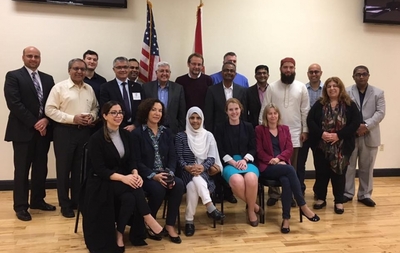 The Florida chapter
of the Council on American-Islamic Relations (CAIR) facilitated a training session last week for a French
police delegation, in conjunction with the State Department and the
Department of Homeland Security (DHS)'s Community Engagement Office in
Tampa, the Investigative Project on Terrorism has confirmed with DHS
officials and other agencies. The Florida chapter
of the Council on American-Islamic Relations (CAIR) facilitated a training session last week for a French
police delegation, in conjunction with the State Department and the
Department of Homeland Security (DHS)'s Community Engagement Office in
Tampa, the Investigative Project on Terrorism has confirmed with DHS
officials and other agencies.
This session stands in contrast with the FBI's 2009 policy not to engage with CAIR outside of
criminal investigations due to questions about the Hamas ties of its top
executives. An FBI official wrote that "until we can resolve whether
there continues to be a connection between CAIR or its executives and
HAMAS, the FBI does not view CAIR as an appropriate liaison partner."
That FBI policy toward CAIR remains in effect, and was publicly reaffirmed in 2013.
CAIR-Florida issued a press release Dec. 8 giving details of the event, and posted numerous photos
of the French delegation on its Facebook page. The training session was
devoted to showing the French officials "how to effectively challenge
violent extremist individuals of all backgrounds and prevent hate crimes,
while protecting civil rights and challenging profiling and
discrimination," the release said.
Several French counter-terror
officials received this training, including a representative of
France's Ministry of the Interior and many police chiefs.
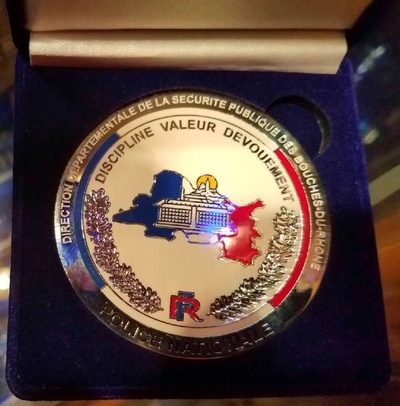
They presented Nezar Hamze, CAIR-Florida's regional
operations director, with a medallion bearing the French national colors
and inscribed: "Public Safety Departmental Directorate at
Bouches-du-Rhone / Discipline - Valor – Devotion."
"We appreciated the opportunity to communicate how restricting
liberty encourages hate crimes and violence and that preserving liberty and
civil rights is key to preserving peace and security," CAIR-Florida
Executive Director Hassan Shibly said in the release.
This indicates that the thrust of this training was devoted to
discouraging counter-terror activities within Muslim communities, which
CAIR often has falsely represented as infringing upon the civil
liberties of Muslims. CAIR officials repeatedly urge Muslim Americans not to cooperate with the FBI.
DHS and the State
Department participated in this CAIR training of French officials
despite the well-documented record of CAIR's ties to terrorists.
Internal Muslim Brotherhood records obtained by the FBI place CAIR and its
founders at the core of a Brotherhood-created Hamas support
network in the United States known as the Palestine Committee.
CAIR's Powerful Ties
CAIR officials enjoyed close relations with the Obama administration
despite the FBI's evidence linking it to the Muslim Brotherhood and to
Hamas. DHS/State Department coordination with CAIR is nothing new. The
State Department sent CAIR officials abroad to conduct foreign outreach.
The State Department hosted CAIR officials in October 2015 to discuss Syria and "the need ... to challenge
[alleged] aggressive Israeli actions targeting the Al Aqsa mosque compound,
one of the holiest sites in Islam."
Top CAIR officials repeatedly received White House invitations and participated in White House conference
calls. DHS collaborates with CAIR on numerous non-public projects, and
funnels anti-terrorism funds allocated by Congress.
CAIR received a sub-grant of $70, 324 from DHS in 2015,
records show.
Hassan Shibly: Terrorist Apologist
Considering Shibly's statements that Islamist ideology has nothing to do
with terrorism and the rash of jihadist attacks that have rocked France
since January 2015, his involvement in the training should be cause for
alarm.
In an April 21, 2013 interview with OnIslam, Shibly said
that, "American political scientists have made it very clear that
those who commit acts of terrorism have nothing to do with religion and are
often motivated by political, not religious, reasons. Actually, such
attacks can never be justified and truly are nothing more than the result
of having a twisted and sick mind."
In a June 2014 blog post, Shibly argued that the purported
"FBI entrapment program targeting the Muslim community" was an
example of tyranny that strayed away from the "great ideals of
liberty, equality and justice."
In his view, the FBI manufactures terrorists through sting operations
such as that against Sami Osmakac, convicted in 2014 on charges of attempted
use of a weapon of mass destruction and possession of a fully automatic
firearm.
"I'm concerned that the government's own tactics turned him into a
greater threat than he could have been on his own," Shibly told the Tampa Tribune in a June 3, 2014
article. "There's no need to enable a Hollywood-style plot ... Would
Osmakac have had the ideas and the means to do this crime but for the
government informant?"
Shibly also is helping a family sue the FBI, alleging an agent unjustly shot and killed
a friend of Boston Marathon bomber Tamerlan Tsarnaev after hours of
questioning in his Orlando home in 2013.
Independent investigations, requested by CAIR, completed by the Justice
Department and a Florida state attorney found that Ibragim Todashev, a
"skilled mixed-martial arts fighter," attacked the agent shortly after acknowledging
involvement in a separate triple-murder case in Massachusetts. Todashev
continued charging after being shot, prompting the agent to fire more.
Shibly rejected the findings, saying only Todashev could "contradict the
government's narrative," but he was dead.
Kareem Shora: CAIR's Ally at DHS
|
CAIR-Florida posted this
image of Hassan Shibly and Kareem Shora at the French delegation program.
|
According to a source, Kareem Shora played a key role in organizing the
French delegation's CAIR training. Shora serves
with the Homeland Security Advisory Council (HSAC) and a Community
Liaison Council with the Office of the Director of National Intelligence.
He has a long record of denying the nature and magnitude of the jihad
threat. Last July, for example, Shora claimed that it was an "unfortunate
reality" that Muslims were portrayed as "more vulnerable" to
"potential recruitment to terrorist activities...including those
represented by Daesh." Instead of devising ways to counter this
"unfortunate reality," Shora said
that the DHS was trying to "promote the notion" that Muslims were
no more likely than anyone else to be recruited into terror organizations:
"It's not because they're Muslims. They represent nothing
of Islam. Daesh represents nothing of Islam or a state for that matter,
quote unquote. So I think our position, as U.S. government, is to advocate
that point every opportunity we get. And from a Homeland Security
perspective, in order to build a society that's resilient to all threats,
regardless of the nature of that threat, our job is to make sure that these
communities don't end up being categorized as being vulnerable, because
they are in fact the ones most suffering as a result of those
attacks."
Shora helped leading Islamist figures attend DHS meetings, including
Salam al-Marayati of the Muslim Public Affairs Council and, Ingrid Mattson
of the Islamic Society of North America, records obtained by the IPT
through the Freedom of Information Act show.
DHS could have turned to any number of organizations and people to work
with the French delegation. Choosing an Islamist group whose ties to a
terrorist group rendered it persona non grata with the FBI is either a sign
of dangerous incompetence or institutional arrogance.
Related Topics: Steven
Emerson, CAIR,
DHS,
State
Department, outreach,
law
enforcement training, Hassan
Shibly, Kareem
Shora, Nezar
Hamze, Palestine
Committee, Muslim
Brotherhood, Sami
Osmakac, Ibragim
Todashev, Homeland
Security Advisory Council
|

 Print
Print Send
Send RSS
RSS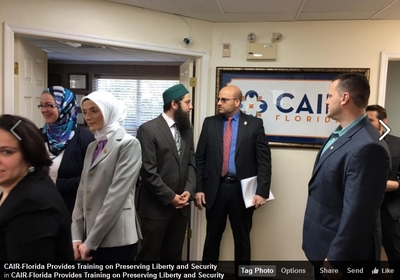


 Posts
Posts


No comments:
Post a Comment