Does
Israel Need U.S. Jewish Support?
|
|
|
|
Share:  
|
  Be the first of your friends to like this. Be the first of your friends to like this.
Elliott
Abrams began a conversation by asking what has caused American Jews to
distance themselves from Israel and finding the main cause to be the
50-to-60 percent rate of Jewish intermarriage with non-Jews.
Martin
Kramer then added a second factor: the changing balance of power
between American and Israeli Jews. "When the state of Israel was
established in 1948, there were six million American Jews and 700,000
Israelis: a proportion of nine to one. ... today, the ratio of American to
Israeli Jews is one-to-one—about six million in each country. In another
twenty years, there will be well over eight million Jews in Israel, and
probably fewer than six million in America." Nor are numbers the whole
story: "these Israelis are economically prosperous and militarily
powerful" even as "Jewish political clout" erodes in the
United States. As a result, Israelis pay less attention to American Jewish
opinion, which in turn leads to American Jewish alienation.
I agree with both their arguments and should like to add a third
perspective:
Jewish support for Israel has weakened primarily because Jews are
solidly on the liberal-left of the political spectrum (these days
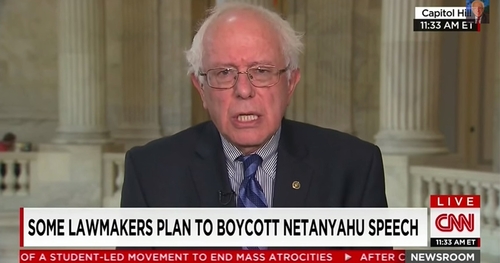
symbolized by Bernie Sanders), the side most critical of Israel.
|
Sen. Bernie Sanders has
long been critical of Israel.
|
From Israel's point of view, the fact that American Jews are losing
their ardor for Israel is a distinct loss. But it is made up for by
American conservative support for the Jewish state.
The conservative-moderate-liberal spectrum of opinion is consistent in
poll after poll (I have collected a decade's worth of them here)
and it shows large and growing conservative support for Israel. For
example, the Gallup
poll in February 2016 found Republicans favoring Israel over the
Palestinians by 79 percent to 7 percent, or a margin of over 11-to1. With
such political backing, Jews have lost their primacy in pushing the U.S.
government to a favorable policy toward Israel.
To be sure, this support could one day erode too but it looks solid for
now, being a core issue of the conservative outlook. As one proof, note how
a Republican politician (Charles
Boustany) who associated with J Street felt compelled publicly to
apologize for this step ("I had been deliberately misled").
|
Cong. Charles Boustany
(on the right) at a J Street conference in 2009.
|
Conservative support includes self-professed Christian
Zionists, of course, but it also comprises many others (such as defense
hawks or those worried about Islamism) who do not have a religious outlook.
|
Christian Zionists make
up just a portion of conservative support for Israel.
|
Mathematically, is it better to have the near-unanimous support of Jews,
who make up 1.8
percent of the U.S. population, or the very substantial support of the 38
percent who are conservative? To ask that question is to answer it.
That said, this change does have disadvantages for Israel: For one,
conservatives tend to know less about Israel. For another, Israel has
become a partisan issue.
These subtleties aside, it remains true that as Jewish support weakens,
conservative backing has moved in to take its place. The focus on Jewish
opinion, therefore, has less salience than it once did. Conservatives, now
the Zionist bulwark, deserve that attention and solicitude.
Mr. Pipes (DanielPipes.org, @DanielPipes) is president of the Middle
East Forum. © 2016 by Daniel Pipes. All rights reserved.
This
text may be reposted or forwarded so long as it is presented as an integral
whole with complete and accurate information provided about its author,
date, place of publication, and original URL.
|






 Posts
Posts


No comments:
Post a Comment