 |
|||||||
|
Join Daniel Pipes in Cyprus in October 2013. For
more information, click here.
|
|||||||
|
Please take a moment to visit and log in at the subscriber area, and
submit your city & country location. We will use this information in
future to invite you to any events that we organize in your area.
What Turkey's Riots Mean
  Be the first of your
friends to like this. Be the first of your
friends to like this.
China-like material growth has been the main achievement of Recep Tayyip Erdoğan and the party he heads, the AKP. Personal income has more than doubled in the decade that he has been in power, changing the face of the country. As a visitor to Turkey since 1972, I have seen the impact of this growth in almost every area of life, from what people eat to their sense of Turkish identity. That impressive growth explains the AKP's increased share of the national vote in its three elections, from 34 percent in 2002 to 46 percent in 2007 to a shade under 50 percent in 2011. It also explains how, after 90 years of the military serving as the ultimate political power, the party was able to bring the armed forces to heel. At the same time, two vulnerabilities have become more evident, especially since the June 2011 elections, jeopardizing Erdoğan's continued domination of the government. Dependence on foreign credit. To sustain consumer spending, Turkish banks have borrowed heavily abroad, and especially from supportive Sunni Muslim sources. The resulting current account deficit creates so great a need for credit that the private sector alone needs to borrow US$221 billion in 2013, or nearly 30 percent of the country's $775 billion GDP. Should the money stop flowing into Turkey, the party (pun intended) is over, possibly leading the stock market to collapse, the currency to plunge, and the economic miracle to come to a screeching halt.
These two weaknesses point to the importance of the economy for the future of Erdoğan, the AKP, and the country. Should Turkey's finances weather the demonstrations, the Islamist program that lies at the heart of the AKP's platform will continue to advance, if more cautiously. Perhaps Erdoğan himself will remain leader, becoming the country's president with newly enhanced powers next year; or perhaps his party will tire of him and – as happened to Margaret Thatcher in 1990 – push him aside in favor of someone who can carry out the same program without provoking so much hostility.
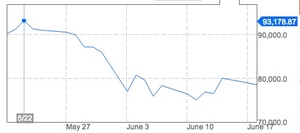
Payroll employment is down by 5 percent. Real consumer spending in first quarter 2013 fell by 2 percent over 2012. Since the demonstrations started, the Istanbul stock market is down 10 percent and interest rates are up about 50 percent. To assess the future of Islamism in Turkey, watch these and other economic indicators. Mr. Pipes (DanielPipes.org) is president of the Middle East Forum. © 2013 by Daniel Pipes. All rights reserved.
Related
Topics: Turkey and Turks
This text may be reposted or forwarded so long as it is
presented as an integral whole with complete and accurate information
provided about its author, date, place of publication, and original URL.
|
|||||||
|
To subscribe to this list, go to http://www.danielpipes.org/list_subscribe.php
Sign up for related (but non-duplicating)
e-mail services:
Middle East Forum (articles and event reports) Campus Watch (articles, blog posts) Islamist Watch (articles, blog posts) Legal Project (articles, blog posts) at http://www.danielpipes.org/list_subscribe.php |




 Posts
Posts


No comments:
Post a Comment