Muslim Migration into Europe: Eurabia Come True?
|
|
|
|
Share:  
|
  Be the first of
your friends to like this. Be the first of
your friends to like this.
The transcript has been lightly edited.
Multimedia for this item
Click Image to View Video
|
Pipes
introductory statement:
Erick Stakelbeck: Our next speaker is, to my mind, one of the
most brilliant voices of thinkers, analysts on all of these issues we're
talking about, and he has been before anyone else was doing it. Dr.
Daniel Pipes is president of the Middle East Forum and a columnist at National
Review, The Jerusalem Post. You read his stuff everywhere and
many other publications. He's the author of several books on the Middle
East and Islam. He is a true authority. Dr. Daniel Pipes.
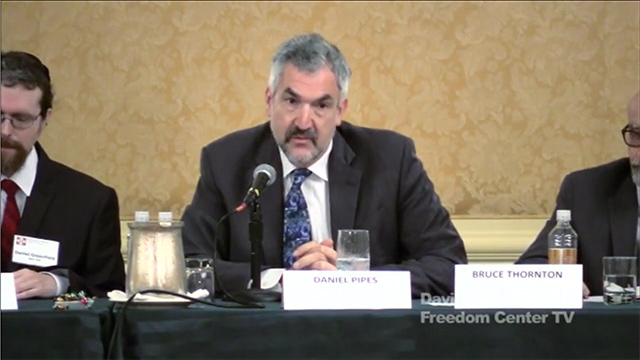
Daniel Pipes: Thank you, Erick, and good morning, ladies and
gentlemen. My topic is the European response to the wave of migration
that took place, that is still taking place. Indeed, the largest number
of migrants to Europe was in October; far more than September or July or
August. And the number this October was nine times more than last
October.
My assumption is that people respond to realities on the ground and
that the recent surge of migration is having an impact on European
attitudes. I expect that this will have a profound impact, that we've
just begun to see the implications. The first significant implication is
the election in Poland, which was directly influenced by fear of large
numbers of migrants coming into the country. I expect the impact will be
especially acute in countries like Austria, Germany and Sweden, where the
governments have been the most enthusiastic about bringing in large
numbers of migrants. The question I cannot answer for you is how quickly
this is going to take place but it's clearly under way.
One important factor in this context is the existing institutions. In
some countries, there are political parties, intellectual associations,
and volunteer organizations which are available to be joined by someone
concerned with immigration. In particular, there are political parties,
most especially, for example, the PVV of Geert Wilders in the
Netherlands. But in other countries, such in Germany, there's no such
party. There are possibilities. Maybe in the future, they will take up
this issue, but they have not yet.
The ruling ideas of these institutions are very important. At one
extreme stands the neo-Nazi movement in Greece, the Golden Dawn. At the
other extreme stands a very acceptable party such as the United Kingdom
Independence Party, or UKIP, which consists up of people you'd be happy
to invite to dinner. There's also a range in between.
These parties have a range of commonalities. They're all worried about
Islam, immigration, they tend to be populist, and, to a certain extent,
nativist. They are not generally right-wing parties. They usually combine
a strong sense of nationalism and a left-wing economic program. Wilders
is a perfect example of that mix, as is Marine Le Pen in France.
Marine Le Pen is also very important in another way. Her father,
Jean-Marie Le Pen, founded the National Front Party in 1972; he is a very
cranky man full of Holocaust denial theories, bizarre economic notions
and the like. His daughter has recently thrown him out of the party
because he's baggage she doesn't need as she moves to the center to be
electable. I see this and its equivalent in other countries as a positive
step. In other words, if you want to grow your party, if you want to get
to 50 percent, then you have to slough off all those eccentric, nasty
habits and attitudes that many parties once indulged in. If you're
serious about dealing with this penumbra of issues concerning Islam and
immigration, you have to do so in a moderate and serious way, without
strange and ugly theories. This shift is taking place in country after
country.
I often focus on Sweden because it offers a most dramatic case of
change. The Sweden Democrats (SD) got started in 1988 and has enjoyed a
remarkable rise. It received 0.4 percent of the vote in the 1998
elections - which are every 4 years, like in the United States. That then
tripled to 1.3 percent in 2002. It then more than doubled to 2.9 percent
in 2006. It then almost exactly doubled to 5.7 percent in 2010, which was
a critical achievement because a party needs 5 percent to get into
Sweden's parliament. SD more than doubled again to 12.9 percent in 2014.
Current polls show it at 23-24 percent, almost double again. You see here
how Swedes are awakening to the issues of immigration and Islam in a way
unimaginable in 1998, going from one half of 1 percent to nearly a
quarter of the electorate.
You'll be hearing a lot more about the Sweden Democrats. Speaking of
which, we have with us here in the room Kent Ekeroth (please stand,
Kent), international secretary of the Sweden Democrats. He'll tell you
more about the situation in Sweden later in the conference.
Finally, some observations about Eastern Europe, that part of Europe
formerly part of the Soviet bloc. It experienced, to refer back to Mr.
Greenfield's presentation, true and full socialism, indeed communism.
Inoculated by that experience, its residents are not interested in trying
socialism again. One consequence of this is that they speak frankly, in
ways unheard of in Western Europe. Viktor Orban of Hungary talks about
the Christian civilization of Europe. The Slovak and Polish governments
say sure, we'll take Syrian refugees, but only the Christians among them.
That their elected leaders, people in positions of power, such as the
prime minister of Hungary, say things unimaginable in Western Europe is
important, not just because suddenly Eastern Europe is in play as the
pathway to Western Europe, but also because they articulate ideas their
counterparts in Western Europe dare not express. This is a new element
that suddenly came into the equation only in the last half year, one that
possibly has serious implications for an alternate way of understanding
the immigration and Islam issues throughout the whole of Europe.
In brief, my message is: Don't give up on Europe. It's not yet
Eurabia. Positive responses to the crisis now underway do exist. It's by
no means certain the Europeans will respond constructively, but it's a
real possibility. We Americans, in our various ways, can help guide them
in the right direction. Thank you.
An excerpt
from the question & answer period:
Daniel Pipes: I'd like to add a word of caution [to the prior
conversation celebrating the West and denigrating Muslims]. I'm a
historian, and the role of a historian is to understand how things change
over time. In this context, I'd like to interject two words: communism
and Nazism. The Muslim world has never developed anything remotely as
evil as what we in the West have developed. Let's not get too high on our
horses.We Westerners have a lot in our history to be very ashamed of.
Yes, the Muslim world is at a low point today, going through a crisis,
and the West not going through a comparable crisis. But this is but a
brief moment in time. In 1943, where would you have rather been living?
In Germany or in Iraq? In Italy or in Senegal? Let's not say that the
Judeo-Christian world is so wonderful on the one side, while the Islamic
world is so horrible on the other.
Let me put it differently, as you [the questioner] attend a Jewish
school. In the long history of Jews living in predominantly Christian and
Muslim lands, it is striking to note that from the origins of Islam until
the close of World War II, that is to say from 622 until 1945, a very,
very long period of time, Jews almost always fled from Christian-majority
countries to Muslim-majority countries. They voted with their feet
because they rightly expected to be better off in Muslim countries. It's
only the last 70 years, since 1945, a moment in time, that Jews have fled
Muslim-majority countries for predominantly Christian countries.
So let's keep some perspective. Yes, I agree with all the specifics
that have been mentioned - that the current immigration is only way and
not the other way, that there's only one civilization where girls are
being genitally mutilated, and so on; all true. But things change over
time. We were not always who we are today and Muslims were not always who
they are today. Do keep this in perspective.
This observation offers grounds for hope that the Muslim situation can
get better. In my career, starting in 1969, it's been almost nothing but
getting worse but that has the positive implication that things could get
better. It also implies we Westerners should not be too proud of
ourselves and assume that nothing can go wrong for us, because we too can
make monumental mistakes, too. Note the rise of the Golden Dawn movement,
an atrocity, in Greece, the home of Western civilization. Please, let's
not be too proud of ourselves and not too condemnatory of Muslims.
This
text may be reposted or forwarded so long as it is presented as an
integral whole with complete and accurate information provided about its
author, date, place of publication, and original URL.
|




 Posts
Posts


No comments:
Post a Comment